
Wordless Wednesday
Facebook kindly informed me that one of my favorite garden centers was having a sale on mums and asters.

The ad looked like this.
The garden center is on my way home from work (well, sort of), so I stopped in today. Wow, Fitchburg Farms has an amazing array of healthy, colorful mums, and gorgeous asters in shades of purple! As I mentioned in a recent post, I’m noticing that my flowerbeds are in dire need of some more color. Well, “dire need” might be a slight exaggeration, but they are looking a bit drab.
I drove slowly down the gravel drive into the garden center, admiring the nicely shaped trees along one side and could see that the front of the store was awash in autumn colors. I pulled into one of just a few paved parking spots, then donned a face mask and made my way over to the area where the carts and flatbed wagons were corralled. Three mums and three asters was the “buy limit” I had in mind, so I chose one of those flatbed wagons and set off in search of just the right colors to complement the mums Wayne bought me earlier in the week. There were just two customers shopping in the outdoor section of the garden center, so I picked an area other than where they were shopping so that I kept adequate social distancing in mind.
Since I was in my own spot, I could play with colors. I’d find two or three that I liked and then play with the combinations on my little flatbed. I couldn’t help but notice that there was this lady staring at me as I played. I wondered if she thought she perhaps knew me from somewhere, but couldn’t quite recall. Before I knew it, she was in the same garden aisle as me, so I moved to the next one over to give her (and me) some space to shop.
She followed me.
I couldn’t help but notice that she kept an eye on me the whole time I was there. Wherever I moved, she moved.
Strange. It wasn’t creepy. Just weird. It reminded me of those detective shows where a private eye detective is tailing a suspect and trying to stay incognito (and doing a bad job of it).
I moved to another aisle where I spied more amazing colors that I could play with. She tailed me again. This time the lady finally spoke up and said, “Please, don’t mind me. I am watching you as you’re arranging and rearranging the colors.”
I chuckled, “Oh! I was hoping I wasn’t getting in your way.” She grinned as she shared that she had been there for awhile before me and just couldn’t make up her mind. When she saw me breeze in and start playing with the color combinations she knew what she would do. My garden center stalker-friend shared, “I like the color palettes you are creating and decided, whatever you buy, I’m buying.”
Sure enough, weird turned into a compliment when I looked at her cart and she had duplicated every flower I had chosen.
My husband Wayne has been trying out a new hobby – flying a drone. So far he has been sticking close to home as he practices maneuvering his new toy. I asked him to take a few aerial photos of my gardens. One thing I noticed was that color is quite lacking in my fall garden. I have a few mums and asters to plant, so maybe that will help.

While the gardens are a bit drab at the moment, I do have a few things which are looking quite pretty. Maybe you’ll remember the pots I planted (with a little help from a squirrel). My theory was correct. He stole the seed from another area and planted a sunflower seed in the middle of one of those pots. It ended up being ‘Teddy Bear’, a short and bushy variety, which sports a long-lasting golden yellow flower. I will probably plant more of them next year.


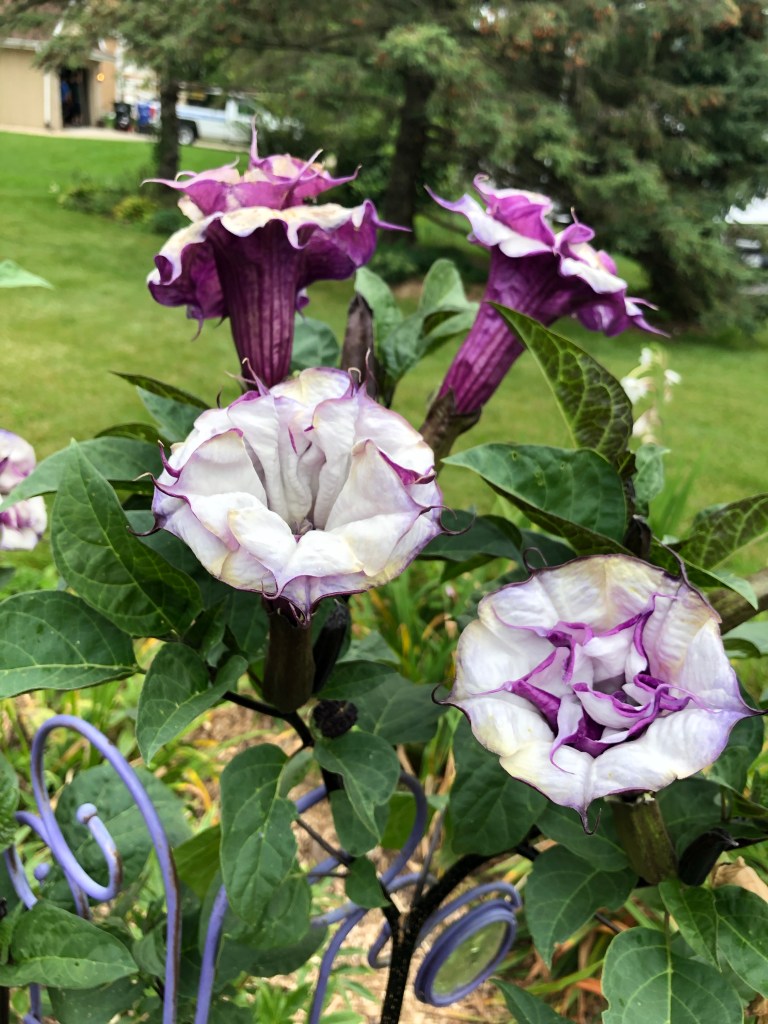
Here’s an update on Datura ‘Blackberry Swirl’. It’s still blooming in my garden and I’m still undecided as to whether I will keep it. The flower IS pretty spectacular, but it is an evening bloomer, so is rather ‘meh’ during daylight hours. This post explains my thoughts concerning the drawbacks of Datura. I did go ahead and snip off the seed pods so as to not invite more of the plants.



I planted quite a few peacock orchids earlier in the summer. They’re blooming now and quite lovely. The flower is rather demure, but the fragrance is incredibly beautiful, reminding me of jasmine. The flower isn’t an orchid at all – it belongs to the iris family. I plan to dig them up and store the corms for the winter to replant in late spring. Next year I will plant them in larger groupings, as I think they’ll make a bigger impact that way. If I plant more of them in the little flowerbed by the mailbox, the neighbors who pass by on their walks just might get a whiff of their perfume.
My garden does have a few areas which still have color. The clematis on the arbor that leads to the backyard is finished, but the phlox planted at its base is still strutting its stuff. The sedum in the foreground is still hosting parties for the bees and butterflies too.

One last photo of the shaded area beneath our locust tree. The color is courtesy of potted impatiens in my favorite shade of pink. I’m really happy with how this flowerbed turned out this year.

Next year I plan to plant up more pots to help layer my garden with color at various heights. I shared my thoughts about that plan with my husband. Next thing I knew I had a stack of pots and bags of potting soil in the garage. Yep, he totally supports my barefoot gardening endeavors.
That’s it for my Six on Saturday. Many thanks to our host, Jon the Propagator. It’s always a pleasure for me as a gardener to see what fellow gardening enthusiasts all around the world are doing in their respective garden spaces each week. I hope you’ll check it out and perhaps share your own six next week.
I truly admire some of my friends who plant enormous gardens and manage to “put up” a sizable cache of jar upon pretty jar of garden fare to last their families through the long winter months.
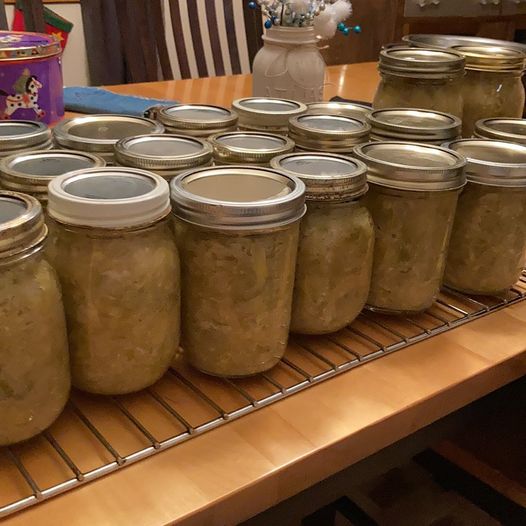
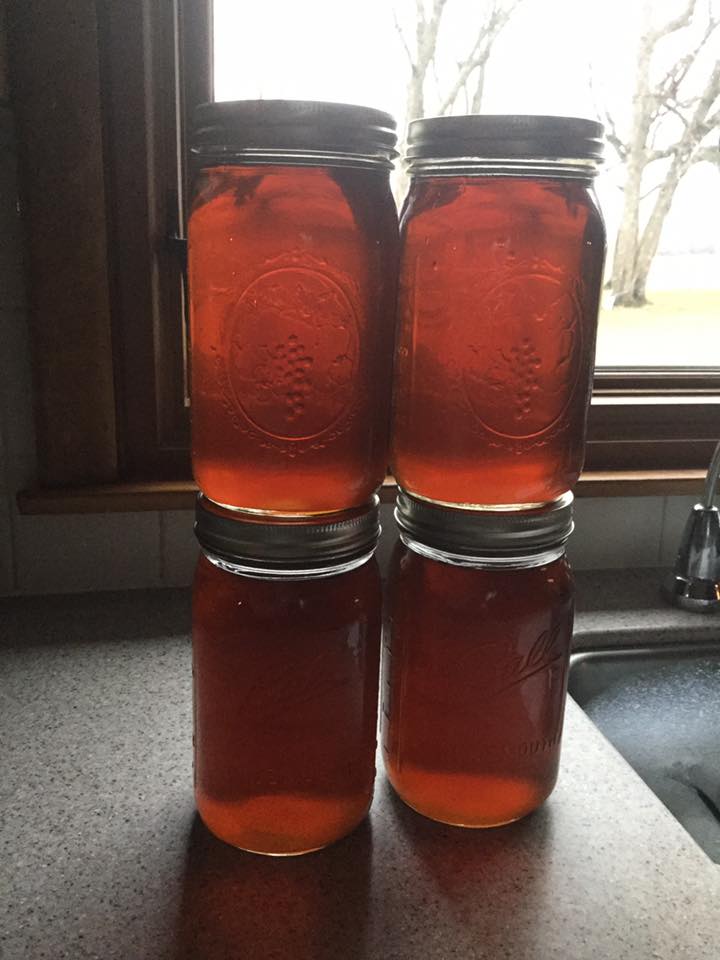
I truly admire some of my friends who plant enormous gardens and manage to “put up” a sizable cache of jar upon pretty jar of garden fare to last their families through the long winter months. Here is just a small sample of what a few friends have posted on Facebook.




While I love to plant flowers, I’m not the greatest at growing veggies. Aside from occasionally freezing enough rhubarb to bake a mid-winter pie or two, I do very little in the way of setting aside food for later.
In God’s world of creation there is a bird known as the Acorn Woodpecker, who has a unique way of creating caches of food for future sustenance. Take a few minutes to give this YouTube video a watch and you’ll see that his caching habits are a fascinating demonstration of one of God’s most creative bankers.
The creatures God made often teach me a lesson about life. The Acorn Woodpecker got me to thinking about time, of all things. I’m envisioning my day as my own personal tree trunk with little tiny pockets, each meant to contain one of 1,440 minute-shaped bits of time. While many of those pockets are already filled with the necessary things of life like sleep, meal preparation, laundry and such, I still have plenty of empty spaces. My investments of time go into those little pockets, and the quality of each investment I choose to deposit in my time bank is almost entirely up to me.
The difference is that I can’t cache time and save it for later. It’s only given to me one moment at a time. Sometimes I think about the fact that I’ve already lived almost 64 years of my life and that those years seemed to have flown by. I have no guarantee of tomorrow (or the next breath), but should God grant me another 20 years (or just a day) of life, I pray that my minutes will be spent doing what matters. There is a song that plays on my Christian radio station quite often on my way to or from work. It’s called “Keep Me in the Moment.” Tucked somewhere toward the middle of the song is this verse which challenges me as I contemplate my use of time in my one go around in this beautiful life.
When I wake up in the morning, Lord touch my heart
Jeremy Camp in “Keep Me in the Moment”
Don’t let me stray, I just wanna stay where You are
All I got is one shot, one try, one go around in this beautiful life
Nothing is wasted when everything’s placed in Your hands
I planted D. metel ‘Black Currant Swirl’ earlier this summer hoping that it would become a tall and showy feature in the middle of my late summer garden. One of its nicest features are its flowers – pretty bell or trumpet shaped flowers in super-swirly shades of purple and white. The flowers are up-facing, rather than pendulous like the more commonly known ‘Angel’s Trumpet,’ a cousin in the closely related brugmansia family.
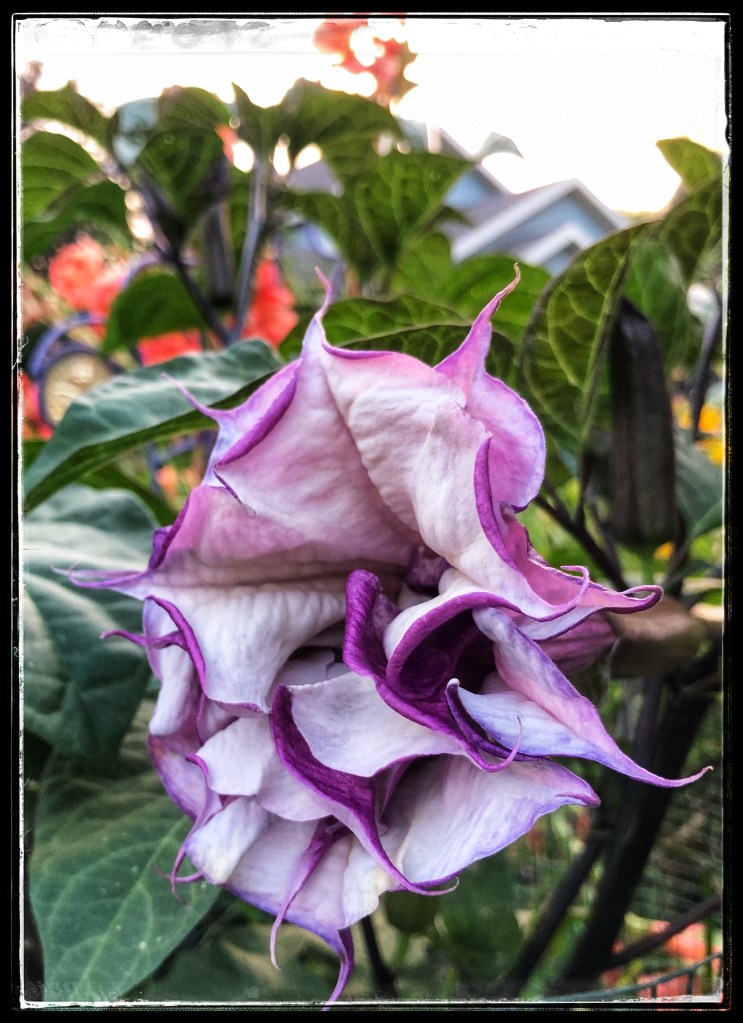
So, what’s not to like about Datura?
Well, for one thing, the entire plant is poisonous – leaves, flowers, seeds and all. For another, this plant does not have a pleasant aroma. The tag said something about gardeners praising it for its “night-blooming beauty and fragrance”. I guess I’m not hanging out in the garden late enough in the evening to catch a whiff of its beauty or its purportedly sweet fragrance because, to me, it has the aroma of dirty sweat socks. (Trust me, I’m a mom and an expert at sniffing down that odor.)
This plant sprouts walnut-sized green balls with knobby purple spikes, each fruit containing hundreds of seeds. Very poisonous seeds, so I’ve read. I have also read that it’s wise to remove the seed pods before maturity because they tend to self-seed and can become invasive…and the seeds can be viable for years to come.
Oh, great! Just what I need – another “invasive” in my garden. Hold on a sec while I don a pair of gloves and head outside armed with my trusty snippers.
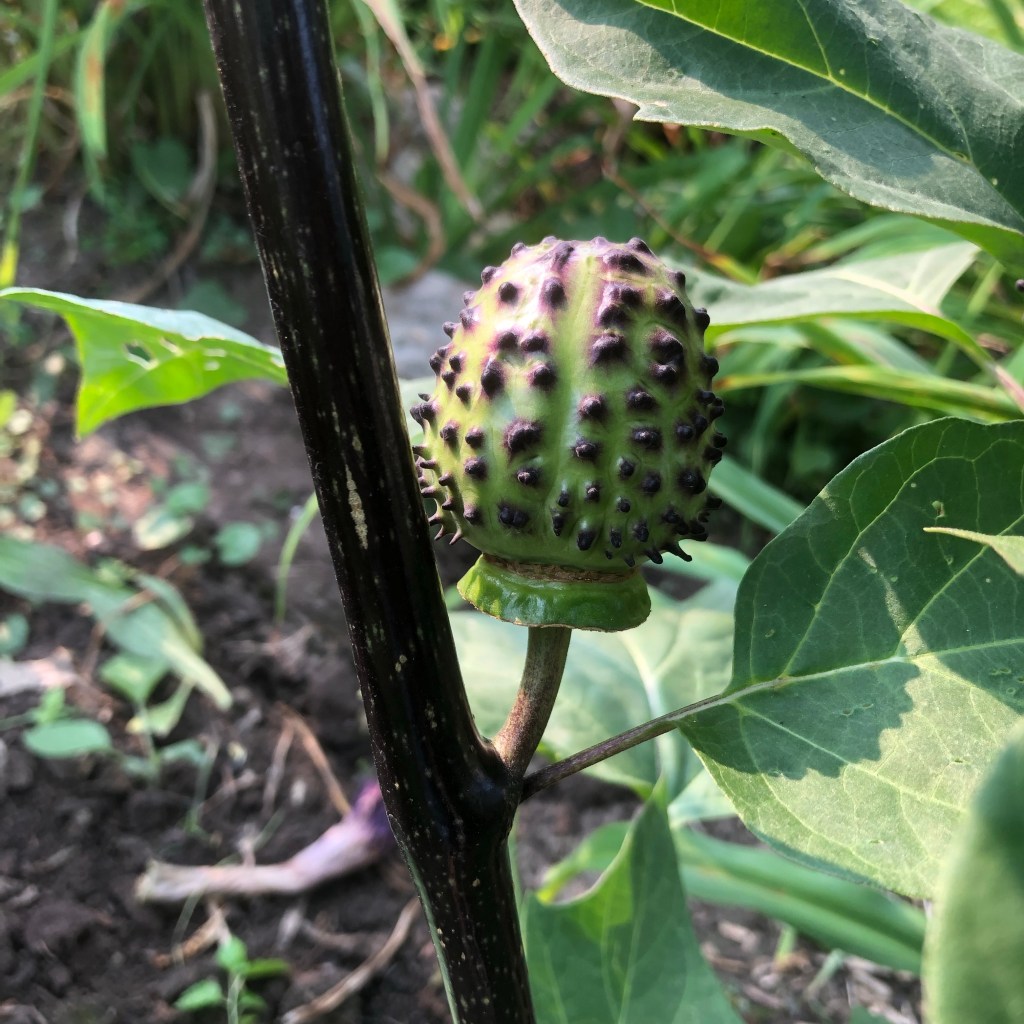
There! I’m back. The surgery has been performed.
As you’ve probably guessed, I’m not sure I like this plant as a whole. I had such great expectations it would become a show-stopping centerpiece in my front yard’s most visible flowerbed.
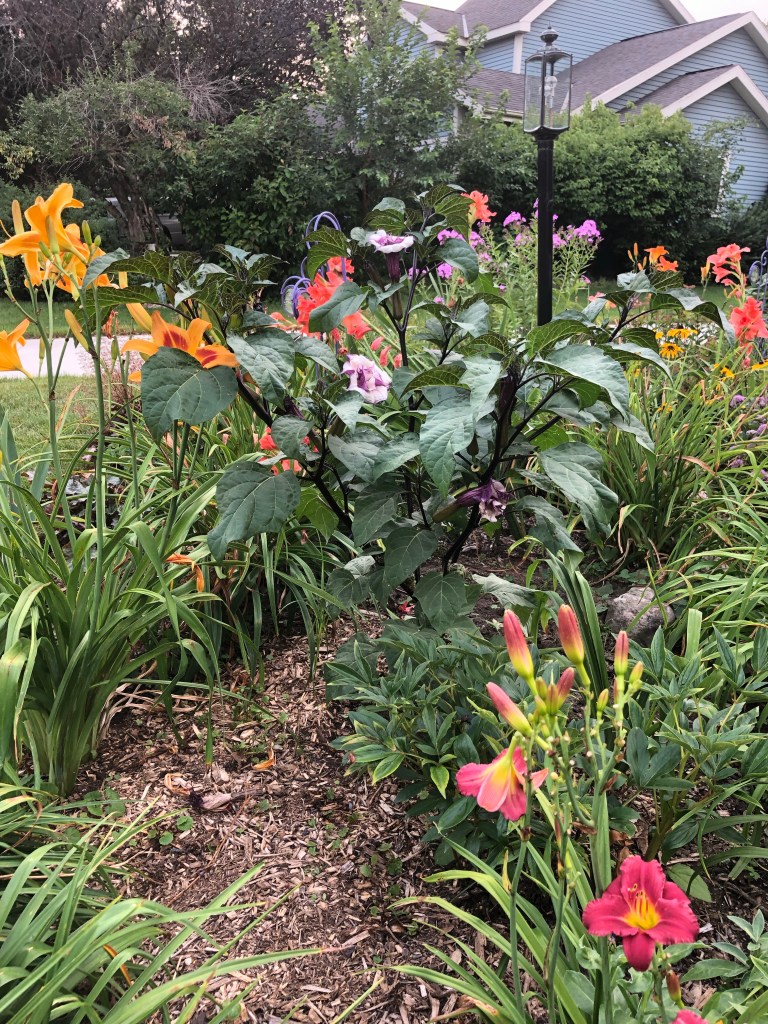
Our two person jury is at an impasse. My husband really likes it. He thinks its cool and wants us to keep it. Me? Well, maybe it’ll grow on me, but I think it’s just ‘kinda meh’ and taking up valuable garden real estate . I’m thinking I’d be happier with another hibiscus strutting its late summer stuff in that spot.
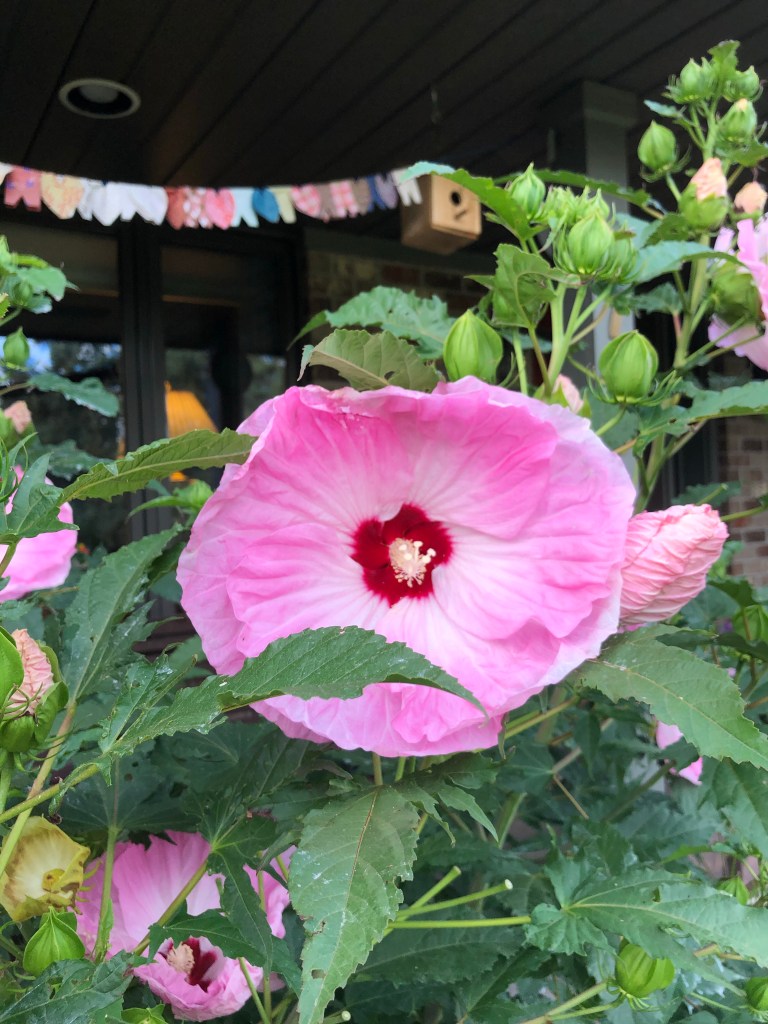
Any thoughts or suggestions from my fellow gardeners?
Sorry, only five photos this week, but that’s it for my Six on Saturday. If you are a gardener (or just like to play in the dirt), you should really pop on over to our Six on Saturday host Jon’s blog “The Propagator”. You’ll find all sorts of gardens to tour with just a click, lots of inspiration, and collective wisdom from gardeners around the world – each sharing six things from their garden on Saturdays (unless they’re perpetually late bloggers like me).
Let me invite you to join me for my ‘Six on Saturday’ writing challenge and a glimpse of my late summer flower garden.
“Some say that a garden just grows from seeds, but we think it grows from trying and failing and trying again. A garden is hard work, but so is most of the good, important stuff in life.”
― Joanna Gaines, We Are the Gardeners
Gardening does involve a good bit of trying and failing; I’ve had a bit of both this year. My garden is like a classroom, and I will confess that I am a bit of a YouTube junkie when it comes to learning about gardening. Early this summer I watched several Garden Obsessions videos from Proven Winners and was inspired by this video to grab three empty pots from the garage, fill ’em with soil, add some slow-release fertilizer, and choose three plants for each.
The first plant I chose from a local nursery was a beautiful coleus. I had admired some grown in pots at my workplace and just knew I would have to plant some this year. I thought a purple flower would pair up nicely with the chartreuse of the coleus, so chose Proven Winners’ Angelface Blue Angelonia, described on the tag as a summer snapdragon which should achieve a height of 18-30″. I also purchased a Fantasia Pelargonium (geranium) called ‘Summer Sizzle’ to add a punch of hot pink.

This pot features another Proven Winners plant. It’s a Supertunia Mini Vista Pink Star. It looks so sweet spilling over the edges of the pot. This petunia hasn’t gone all leggy on me and is a self-cleaner, not requiring pinching and deadheading. I paired it with an annual Hawaiian Punch hibiscus, which is a truly dreamy shade of pink with a magenta throat. Deadheading (removing faded blooms) the hibiscus does promote new blooms, so it does require a little bit of fuss and bother, but totally worth it.
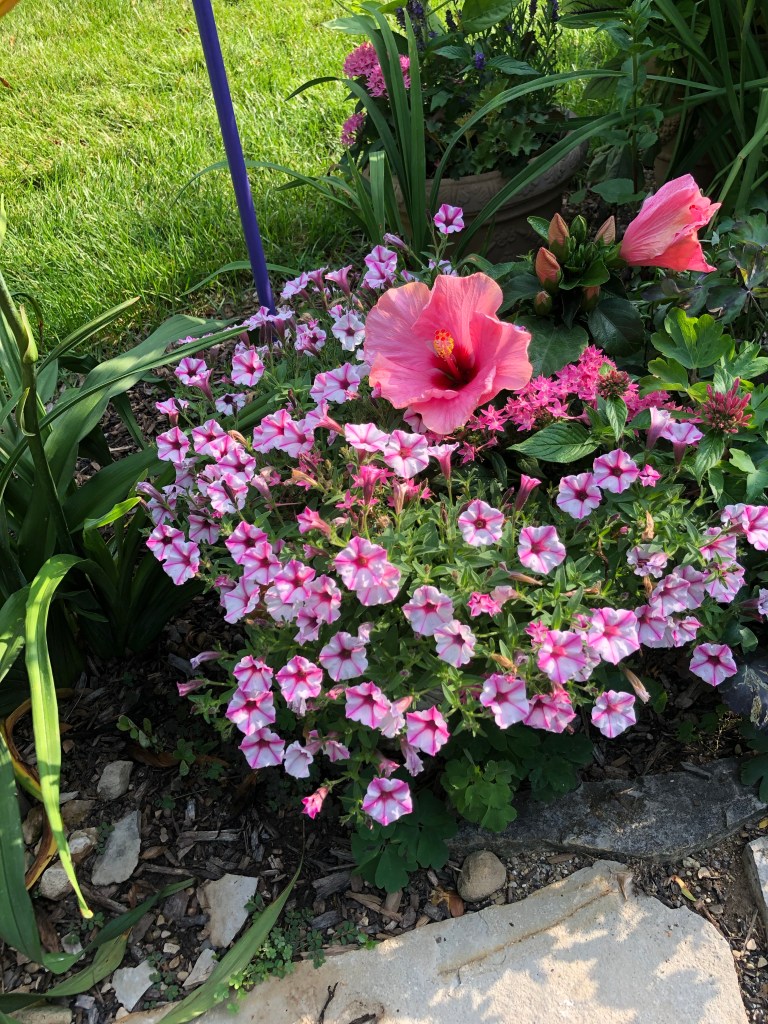
Sticking with my purple, pink and green color scheme, I planted this third pot with a bit of lavender for the purple and Pentas Bee Bright Pink for the pink. Instead of purchasing another plant, I decided to dig up a little something from my garden to use as a filler – some sort of heuchera. It looks like I needn’t have worried about a third plant, as a squirrel chose to plant a sunflower smack-dab in the middle of the pot. The squirrel probably stole the seed from my birdfeeder, but I’m really hoping he procured one of the seeds from the little plot of sunflowers I planted which met their demise earlier this summer (story a bit further down in this post). We shall see. Anyway, this pot makes me smile every day.
It’s not my garden, but I took a walk in a park I found near my work place (I’ll post about that later), and absolutely adored this sweet pairing in the park’s glorious meadow.


I set out this summer to plant these sunflowers here and there dotted throughout my existing flowerbeds. You can read about my great expectations for that garden here: Year of the Sunflower. Well, none of those seeds made it past the dinner table of my yard’s resident bunnies. I wrote about their late night marauding in an update you’ll find here.
Thankfully, they didn’t get into one of the raised beds where I had planted a packet of Livingston ‘Little Dorrit’ sunflower seeds, planted on the south-facing side of the first raised bed, since it was supposed to attain a height of 2-4′. Its packet declares “Little Dorrit produces a large, rich yellow head with a deep chocolate center. The large, green foliage accents the shorter stems and brilliant blooms.”
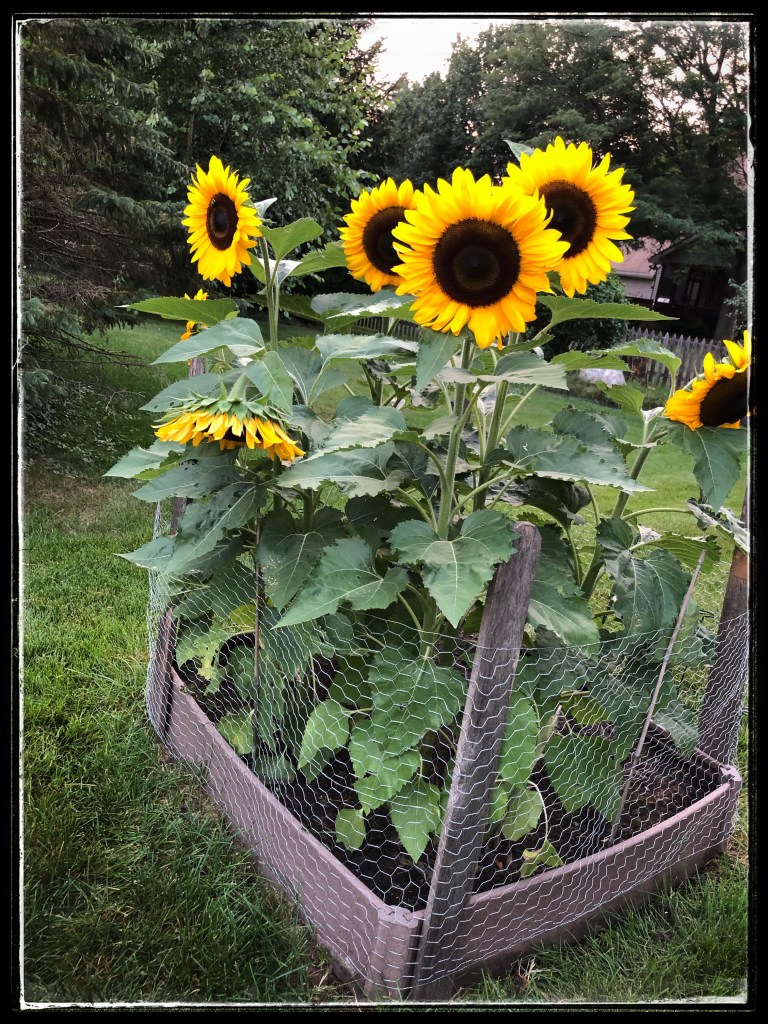
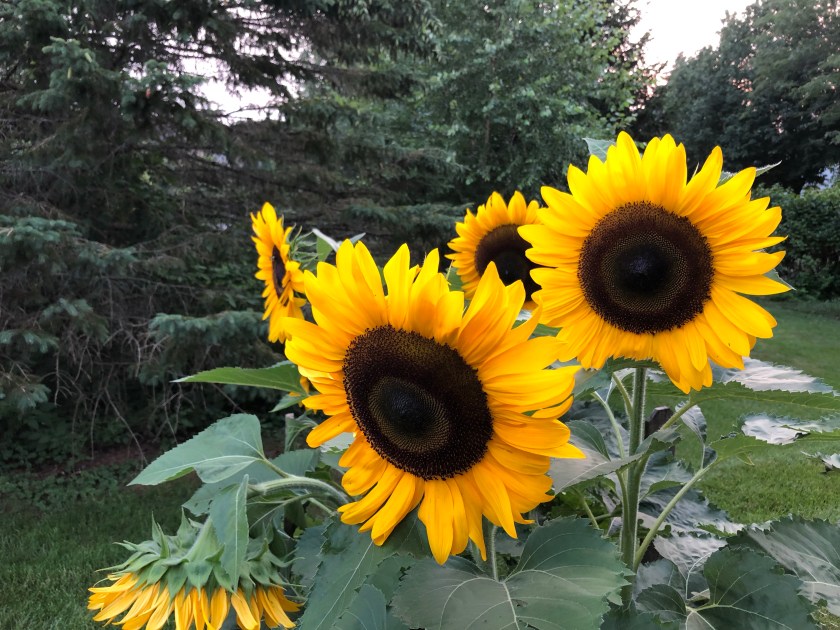
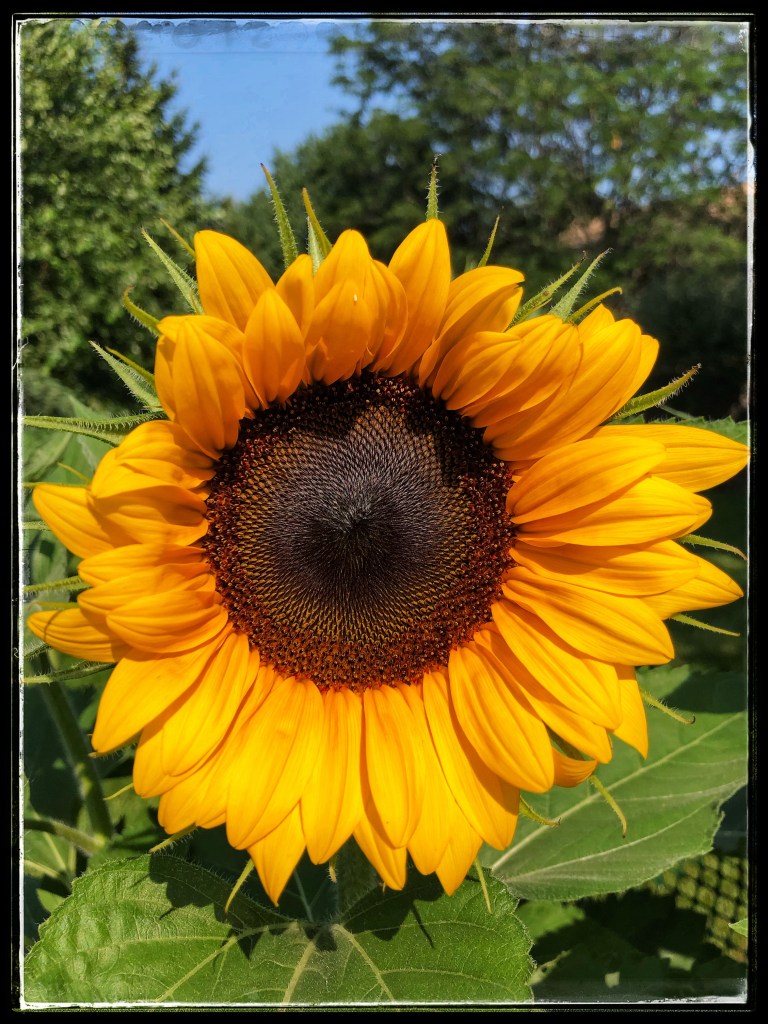
It ended up being closer to the 4′ prediction in height and did not disappoint in its beauty.
Well, that’s it for now. My Six on Saturday. Now, let’s see yours!
It’s pretty disheartening fighting a war you will likely never win. But my battle with Campanula Rapunculoides, also known as ‘Creeping Bellflower’ has been going on in my garden for nearly two decades — ever since receiving the flower as a tagalong companion of another digging from a fellow gardener’s plentiful flowerbed. To the other gardener’s credit, she did warn me that the gifted flower might have a problematic plant tagging along. I wish I had heeded the warning and not planted the gifted plant, or just put it in a pot for a season or two, for an invasive I have come to know as creeping bellflower was indeed lurking in the soil.
This beautiful adversary is not to be confused with its better behaved look-alike, Campanula Rotundifolia, or harebells. I am personally familiar with this confusion between such similar plants, having mistakenly applied an herbicide to a little group of harebells. Sadly, as you can imagine, I had more success killing the wanted plant than I did with the unwanted invasive.
Creeping Bellflower is a bodacious beauty with a bit of folklore in its story of how it became a gardener’s curse. As I recall, it’s somehow linked to the story of how the Rapunzel of fairytales got her name. Unable to resist the allure of beautiful Campanula Rapunucloides’s lavender bells, her father stole a beautiful flower from the garden of the local enchantress and planted it in his own garden. The evil witch got her revenge by hiding Rapunzel away in a tower and cursing this flower to be a rover that takes over gardens in its path.


Fairytale curse aside, it really does look pretty intermingling with other plants.

So why get rid of it?
The problem is, this innocent looking bit of gorgeousness is so prolific, it will wage war and spread like a cancer in your garden in just a few seasons using several tactical manuevers to conquer every bit of garden space it can. The plant, also known as Rover Bellflower, is a biennial which produces a small rosette of leaves its first year, then flowers the next with the flowers producing seeds which will start the whole cycle again.
Fortifying its stronghold in the gardener’s territory, each plant sends out long, thin fingers of white lateral roots just under the surface of the soil. These slightly hairy fingers push their way through the roots of nearby plants, entangling the two plants in a messy, conflict-destined skirmish for territorial rights. This persistent perennial also sends down thick, tuberous water-seeking roots. Once nestled under the earth, a rhizome is created from which future generations of the plant will thrust their way upwards. Pulling the plant while you are weeding your flowerbeds will definitely help prevent it from going to seed (each plant produces thousands of seeds), but any portion of the root or its tiny hairs left behind will regenerate and produce a new generation of unwanted roving garden thugs camouflaged in lovely purple-ness. To complicate matters, the plant has a tuber which resides about a foot beneath the soil.
In my less than expert opinion, getting rid of weeds and unwanted vegetation without the use of chemicals should always be the gardener’s first line of defense. My personal first line of defense is to take out the enemies I can see, thus preventing the flowers from going to seed. I usually head outside to weed just after a good rain has softened the earth. If I can keep each year’s growth de-flowered, I theorize that the root system will eventually be exhausted, weaken and die. My next tactic involves a shovel and painstaking removal of the plant’s root system. As I have mentioned in a previous post, these insidious non-native plants have made my state’s list of invasive plants, so I bag them up and dispose of them according to their recommendation. My county has a special process for disposing of invasives, so I take them to an appointed drop-off place where they will be properly handled and destroyed. It is NOT a good idea to add these to your compost heap.

Smothering the plants when they are in the first-year rosette stage of growth can be somewhat effective in preventing the current generation of plants from making progress, but does very little to attack “the root of the problem” – that fibrous tuber lurking beneath the earth. I do occasionally use this method, especially in pathways and garden edges (see photos below), but generally take the time to dig out whatever I can and then lay down layers of newspaper or sheets of black plastic, topped with a few inches of mulch. Smothering buys me a year or two of reprieve, but the war isn’t won.

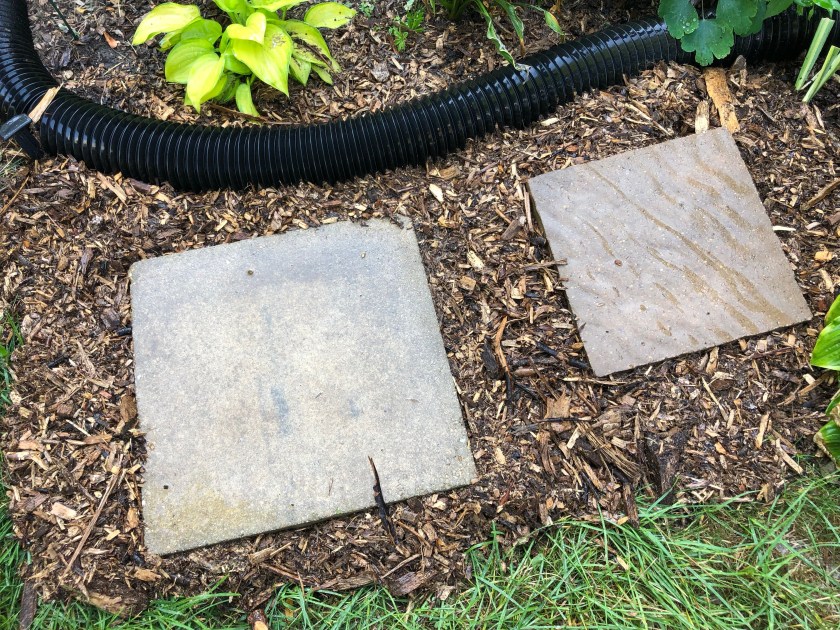

I may make some enemies here, but I think the battle with creeping bellflower requires judicious use of an appropriate chemical over the course of several seasons. Applying an herbicide directly to the plant and allowing the plant to systemically take the chemical to its own arsenal of innermost growth paraphernalia is the most effective way to eradicate this particular foe.
I had a moderate degree of success in a few infested areas where I have used Monsanto’s glyphosate-based herbicide, Roundup. No other weed killer that I have tried has been able to kill this invasive plant. However, a great deal of care needs to be taken when applying glyphosate, as it is a non-selective herbicide, meaning it will also kill nearby plants and grass if it comes in contact with them.
Sadly, Roundup is also known to harm beneficial insects, which is a huge problem in these days of endangered bee and butterfly populations. For this reason, whenever I judiciously use Roundup (or any herbicide), I carefully remove the tempting flowers from any plant I am treating. I choose a day when the air is rather still and when rain is not predicted for a few days. Armed with gloves to protect my skin, and a sheet of cardboard, I set to work on a group of plants. Using the cardboard to shield any nearby plants, I target and spray the leaves of the plants I am trying to eradicate. Within a few hours the leaves begin to carry the herbicide to the underground parts of the weed, the leaves begin to brown and then shrivel and die.
Another great concern related to the use of glyphosate is that it has been classified as a carcinogenic in the United States since 2015, so care must be taken to avoid or minimize personal exposure to it. In fact, this herbicide may no longer be available for purchase in the near future. Bayer (Monsanto’s parent company) has announced that it will be removing Roundup from retail store shelves by 2023 due to costly lawsuits related to cancer cases.
A Canadian blog-reader of mine, Lyle Tremblay, has given me another weapon to try. Lyle once read a post I had written about my war with this plant and contacted me personally to tell me that he was working on a chemical answer to this problem which is prolific in his country as well. Lyle sent me a sample of his experimental treatment and asked me to trial his product in my garden. It was just a small sampling, so I chose a little corner of my garden that was deeply infested with bellflower. I applied the herbicide, as per his instructions. It’s two chemicals, each applied separately.


It’s a somewhat tedious process, due to the need to paint two different chemicals on the leaves, but it worked. The area I treated in early summer has remained free of the weed, while the surrounding area is still infested.

If you are in a similar war with this foe and would like to learn more about Lyle’s experiment, you may contact him directly via email: maracon1@shaw.ca
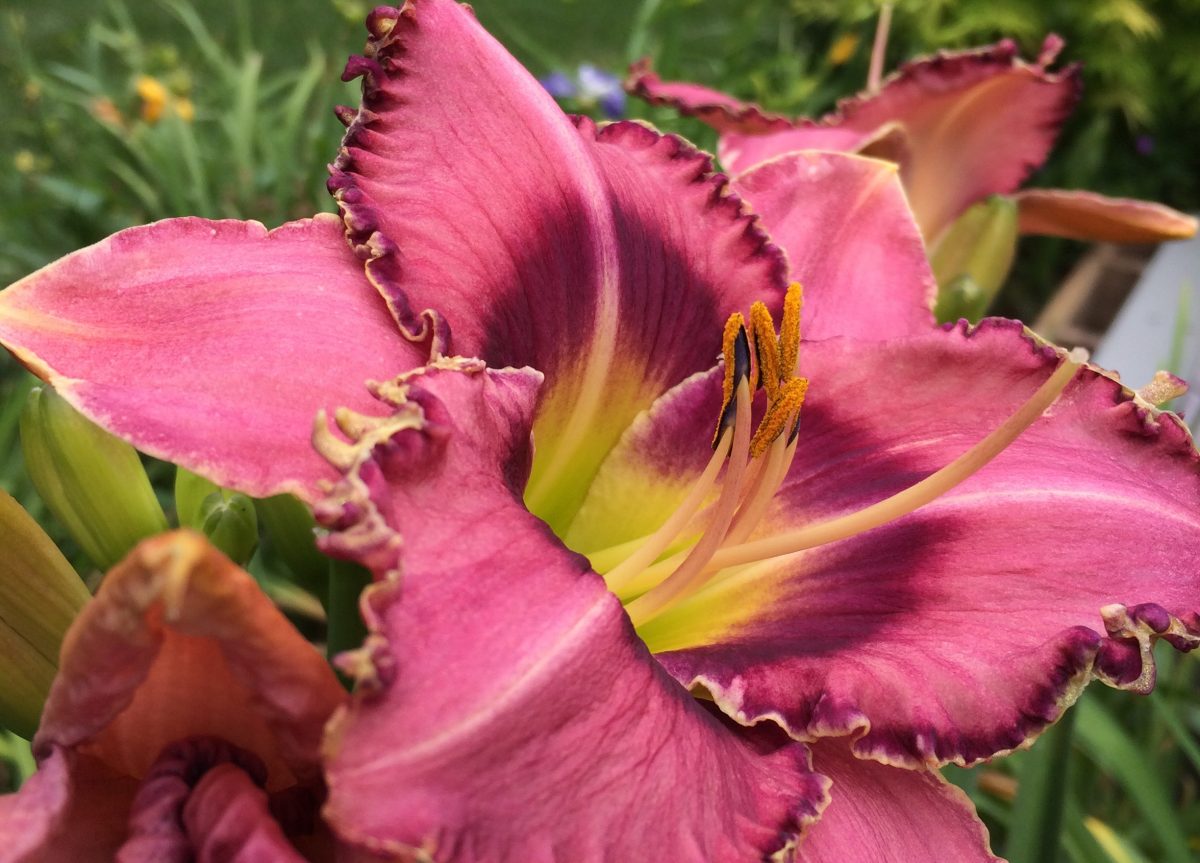
Hemerocallis ‘Eenie Fanfare’ is fairly new to my upper Midwest garden. Purchased in August of 2019 after it had already bloomed, she found a place gracing the edge of a little strip of full-sun garden nestled alongside our backyard’s flagstone pathway. She’s a tough girl, having survived a crazy winter and a 2020 attempt on her life by a hungry rabbit. Standing a demure 10-12 inches tall, I may purchase two more to flank either side of her to create a little short-stuff trio. A few years down the road (barring further late-night snacking by the rabbits), I hope to be able to divide these little beauties and create a grouping in another flowerbed.
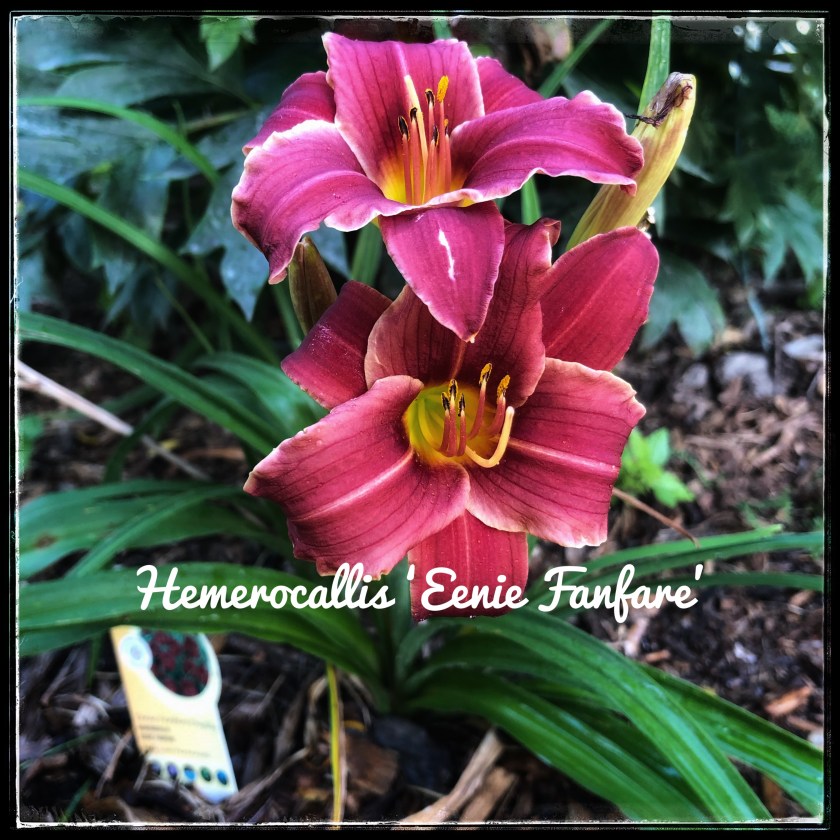
Her thick grass-like leaves are a lush green and will provide visual interest long after the flowers fade. Her plant tag says she’s supposed to be “velvety red,” but I would describe ‘Eenie Fanfare’s’ flower as a very dark pink (almost red) with a lovely chartreuse throat, and a thin white pencil-edge outlining each slightly crimped petal. She may be getting a little too much sun. In my gardening experience, red-petaled daylilies stay truer in color if given a bit of shade and protection from late afternoon sun. I’d like to experiment with this plant beneath the dappled light of my locust tree.
I would encourage my daylily-loving friends to give her a whirl in your garden. She’s a charmer, so be sure to give her a front-row seat.
“God writes the gospel not in the Bible alone, but on trees and flowers and clouds and stars.”
Martin Luther
Ride Run Ramble
Garden · Bike · Run · Write
Notes on Seeing, Reading & Writing, Living & Loving in The North
All things come. All things go.
Simple ideas to make every room feel stylish and welcoming
Behaviour Support Specialist • Emotion-focused Care Strategies
Low Carb Diet & Lifestyle
CONNECTING HEARTS THROUGH WORDS
thoughts on the spiritual journey
the joy of creativity
The Lord God has given me the tongue of those who are taught, that I may know how to sustain with a word him who is weary. - Isaiah 50:4
A retrospective of the photographs from my last garden plus a few meanderings based on my own experience and a love of all things Asiatic.
Connecting the Americas, Bridging Cultures Supergringa in Spain: A Travel Memoir

