

 My heart was recently challenged by reading a book from the Heroes of Faith series – the biography of Watchman Nee by Bob Laurent. I was so moved and inspired by this man’s faith, his godly wisdom, and courage in the midst of persecution and trials of life greater than I will ever experience. So challenged was I by his life and teaching that I found myself yearning to learn more from him. I reserved two books written by Nee through my local library: “The Normal Christian Life” and “The Character of God’s Workman,” and am currently reading the later.


I take a book with me when I go to the gym each morning, having purposed in my heart to use this time to exercise my body and feed my heart, mind and soul too. I have come to treasure this precious time…an hour on an exercise bike is over before I know it. As I pedaled and read today, something in chapter 3 made me think of my dear mother. In this chapter, Nee speaks on 1 Peter 4:1, regarding our Lord’s attitude toward suffering and its admonition for Christians to have the same attitude and mind as Christ in our various earthly encounters with suffering. Nee notes that many Christians who encounter trials in life find themselves side-lined, withdrawing from serving Christ. Nee challenges the Christian reader by saying:
“No one who serves the Lord may stay home during rain and go forth only after the sun comes out. If you have the mind to suffer, then you will work on in spite of privation, difficulty, pain, sickness, or even approaching death.”
I immediately thought of my mom when I read that bit today, causing me to reflect on some of the ways she handled the trials in life.
When she was faced with having to take early retirement from her nursing job due to budget cuts the county was facing, my mom rejoiced. Now she could serve the Lord more in her local church.
My parents’ ministry to their family also carried on – cancer, headaches, bad knees and all. Where most retired couples have empty bedrooms, my parents had a steady stream of children and grandchildren occupying those rooms. It didn’t matter if they were out of a job, or cash-poor students, there was a bed with clean sheets, and a fridge full of favorite foods.
Each time my Dad faced a cancer diagnosis (five different cancers in his lifetime), mom was by his side for his surgeries and treatments. She could have used that as a perfectly plausible reason to back out of her ministries, but she kept on serving in the church, working her ministries around helping him. She also encouraged my dad to persevere in his church attendance and ministry as long as he was able. Only the final debilitating scourge of sarcoma took my dad away from his volunteering as a handyman at his church, and as a driver and treasurer for Christian League for the Handicapped.
When my dad died, my dear mother grieved, but she didn’t wallow in her grief and discontinue her ministries. Quite the contrary! She and a friend who was also a recent widow set their minds and hearts toward forming a ministry to other widows and widowers.
As I look back over her numerous notepads and journals that I packed when she made her move from Milwaukee, I can see that she was aware her memory was failing long before it became noticeable to anyone else. If I read between the lines, I can see there was a certain amount of fear that came with the awareness of memory loss and where it might lead. Knowing that her memory was fading didn’t stop her from serving in her many ministries. Even when the disease reared its ugly head enough for her friends to take notice, she never said, “How can I possibly take on the Lord’s work when I can’t even care for myself?”
Though my mother certainly had a “mind to suffer” in whatever hard things life threw her way, there did come a time when Alzheimer’s dealt a life-altering blow. The day came when driving to church was no longer an option. Another day came when planning anything was an insurmountable obstacle. Then, a time when remembering names was an impossibility. Everything about life was changing and becoming very hard. Only then did her ministries begin to fall away – not because she wanted them to, but because it was time.
Even now, in this time of life “approaching death,” I see in my sweet mother’s life yet another “grace of Alzheimer’s” – the grace of Christ-like suffering.








 It’s especially sad because, for the most part, her world is two rooms of our house connected by a short hallway. She passes that bathroom multiple times a day, but still has to ask where it is.





 Not long ago, she was telling Wayne that “someone who works here” had given her some pills. She wasn’t sure who it was, but figured they knew what they were doing, so she took them. It was Tylenol, and it was me giving them to her just moments ago. Oh, and the “people who clean this place” and do the gardening around here just aren’t doing their job. The floors are always dusty. The gardens have so many weeds. “You should talk to them,” she insists.

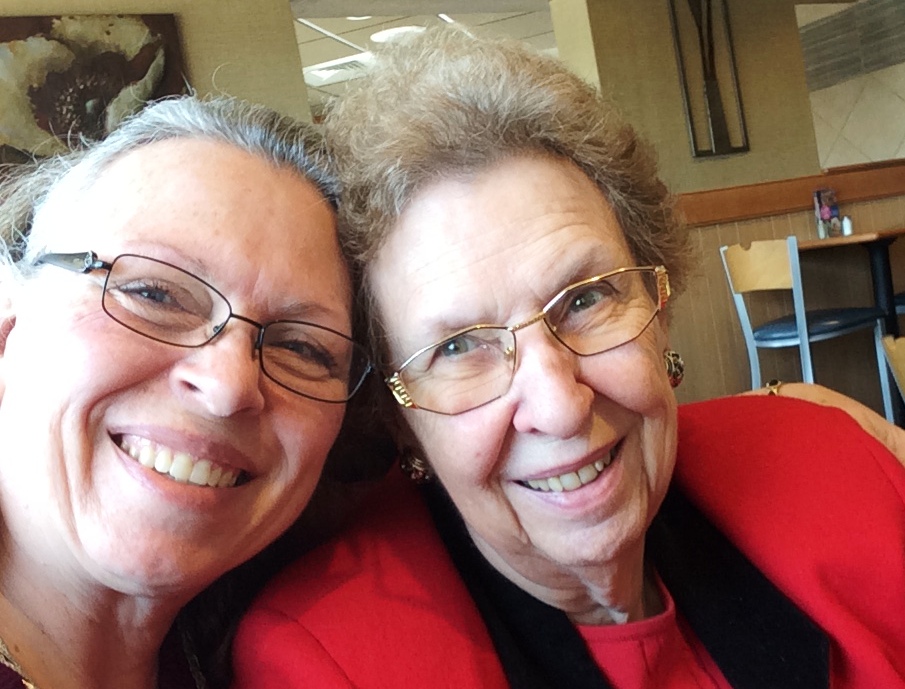
 So, in my mother’s mind right now, I’m her mother. That’s okay by me. She took good care of me for many years. Now, in this circle of life, it’s my turn to take good care of her.


 I love to get my hands and feet dirty. Try as I might, I can’t seem to keep my shoes or gloves on when I garden. I guess I’m a tactile sort of person who enjoys the feeling of the warm earth squishing between my toes or sifting through my fingers. I try my best to make things grow, but know in my heart that very little of it is up to me.
 Landscape designer
  I start planning my garden in the dead of Wisconsin’s winter when the first seed catalog comes in the mail. I get out my Sharpie marker and circle the flowers that capture my attention in the catalog pages and dream about where I’d put them in the garden. I get out my garden journal and jot down a few notes about what I’d like to plant, what I want to move, which plants I’d like to dig out, and what I’d like to purchase.
 Whether shopping by catalog, or cruising the aisles of my favorite garden centers, I pay attention to the description of each plant, determining whether I have adequate space or light, or whether I’m in the right planting zone. My dear husband fully supports my need for dirt therapy, allowing me to add to my cart whatever little lovely attracts my eye.
 I often draw parallels for life from my garden, and Tish’s philosophy holds true on that front as well. As I seek to take care of my mother’s increasing needs for care, I am just setting the stage as a designer. With the help of our family, my husband and I turned our dining room into a lovely bedroom for her. She has a special spot at our kitchen table where she can watch the birds and view the gardens. We make sure she has meals that are reasonably healthy, treats that make her life enjoyable. I make sure she receives appropriate medical and dental care, and that she is adequately clothed and groomed. We try our best to ensure her safety by putting up baby gates, installing handrails, building half-steps, using video monitoring systems while she sleeps, and making sure someone is with her 24-hours a day.
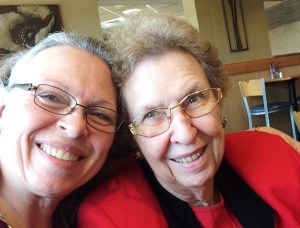 I can design a stage for her care, but I do not have total control over what’s going to happen. She may take a fall. She will undoubtedly get a urinary tract infection and have hallucinations which will keep her (and us) awake. If this disease takes the usual sad course, she will lose the ability to walk, talk, swallow, toilet herself, or perform even the most basic of personal care. I have absolutely no control over her future. I have no idea what even this day will bring forth. But God does, and He will give me wisdom for the next step of Momma’s life journey…and mine.
 In the meanwhile, we will enjoy the flowers that survived, each moment of restful sleep, the birds playing in the fountain, the September breezes, porch-sittin’ days, visits from family and friends, knees that are sorta working today, and all the other beautiful daily benefits that come from God’s storehouse of blessings.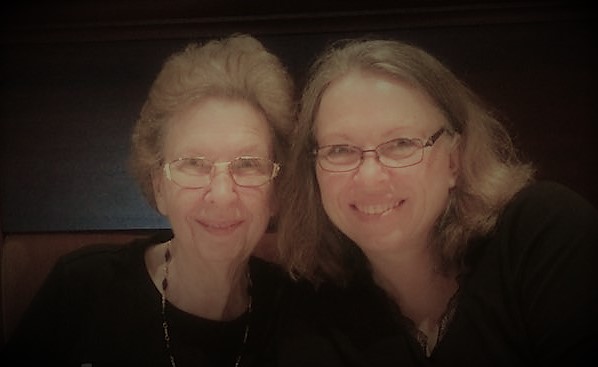
 Having nixed the expensive addition idea, we decided that keeping Momma in her nearby senior apartment under our close supervision was still the best option. With the assistance of family, an occasional friend, 11 hours of professional caregiving a week, and well-placed wi-fi cameras, we made it work. Then, about five months into this arrangement, a recurrent battle with a urinary tract infection resulted in hallucinations, alarming behavior, and plenty of evidence that Momma needed more care.
 Barefoot Lily Lady