The Decline: Praying for Moments of Clarity

“Touch can reach through the fog, confusion, and fear of dementia. Reassuring touch grounds those who are spatially disoriented, bring people back to their bodies, and increases their awareness in present time and space. One touch can affirm that they are not alone and they are valued by the person who is beside them.”

Teresa Stecker, R.N., Hospice Nurse, excerpt from Creating Moments of Joy Along the Alzheimer’s Journey, by JoLene Brackey

Following mom’s recent and very life-altering stroke, I wanted to make sure my sister Viv would be able to share some special time with our mom. Between the restrictions related to COVID-19, my sister’s work schedule, and her car that needed tires and brakes, Viv hadn’t been able to see mom, and I felt time was running out. I phoned Viv and told her that I thought mom would be going Home to heaven soon and encouraged her to visit if she could.

In an effort to prevent the spread of COVID-19, visiting a loved one in a care facility was limited to window visits. But there was an allowance for residents who were in end of life or needed “comfort care.” Mom had been under hospice care for quite some time, but had now officially transitioned to end of life care, so family was permitted to gather as long as certain precautions were taken.

Viv didn’t have reliable transportation, but said she could come on Wednesday when her daughter would be able to bring her. In my heart, I was worried that mom wouldn’t make it until Wednesday, but didn’t want to burden Viv with trying to pressure someone else to bring her or tempt her to drive a car that was not roadworthy. By Tuesday, Mom was sleeping a lot and had completely stopped eating and drinking, so I prayed that Viv would be able to make it in time and that she would find a measure of peace for having been here.

I noticed that mom was a tiny bit more alert in the minutes immediately following being changed and turned, so requested that her caregivers do her daily cares shortly before Viv was scheduled to arrive at 1 pm. They say that when a person is in the end stage of life there is often a rally, or a short time of clarity. I hoped and prayed Viv would get one of those moments.

Mom was weak and groggy when Viv and her daughter Jessie arrived, but she had her eyes open and was more talkative than she had been since her stroke on Sunday. Viv lotioned mom’s hands while she visited, which was something that seemed to be very soothing for mom. Mom started talking and tried to tell her, among other things, that her arms and mouth didn’t work anymore.

It was the moment of clarity I had been praying for. My heart rejoiced seeing God’s answer to prayer as they had that little moment together.

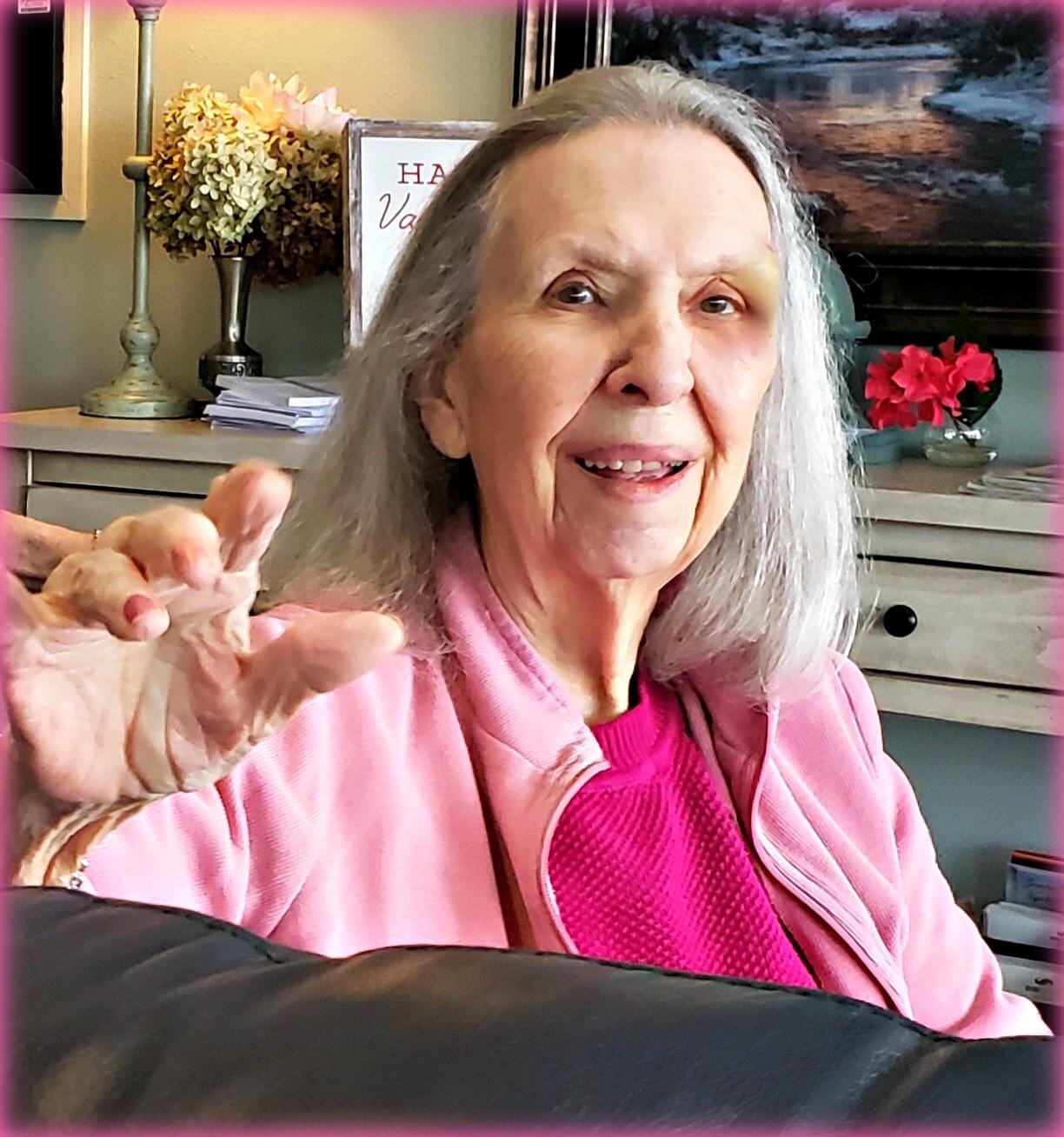
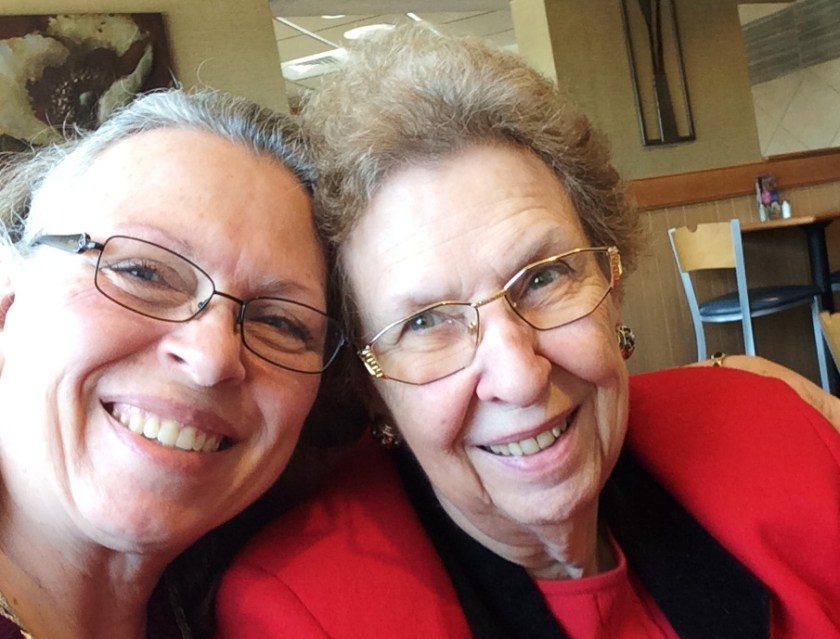
May 20, 2020 – A weak, but sweet smile from Momma, pictured here with her youngest daughter Vivian and youngest granddaughter Jessica.

The Decline: Forgetting The Love of Your Life

My parents, Jerry and Charlotte Boyles, were married on a sultry hot day, the third of July in 1955. From time to time, mom told a few wedding day mishap stories about that memorable day, one of which was that her little sister (and flower girl) came home from summer camp that morning and had head lice. I can’t imagine what it was like taking care of that problem along with the usual hurry and scurry of a wedding day.

The other story that I rather like was best told by my granddad – the short of it was that he couldn’t find his brand new pair of dress socks, so subbed in a pair of his well-worn Sunday socks. He said that his feet hurt something fierce that day. As he told the story, it was because the “lost” socks were actually not lost. Rather, they were stuffed for safe-keeping in the toes of his dress shoes; a fact that was not to be discovered until after the wedding.

Except for candid photos and snapshots taken by family and friends, many of which are fuzzy, there weren’t many photos from their wedding day. My daughter took the photos we could find and created a beautiful memory book for their 50th anniversary – they loved to page through it. Though there were no professional photos taken on her wedding day, Momma had some beautiful formal portraits taken of her in her wedding dress prior to the wedding. She was a strikingly pretty bride in her waltz-length lace gown with a matching jacket. For her flowers, she carried a small white, lace-covered Bible with a sweet corsage on the cover and little ribbons tied with flowers streaming from it.

Twenty-one years later, I carried the same little Bible with my own choice of flowers on my wedding day.

Momma honored her wedding vows in every way as she loved, honored and cherished my dad. Her commitment to him shone most brightly in her keeping of the “in sickness and in health” part. She walked alongside dad through battles with five different types of cancer in his lifetime until the day God took him Home in 2008.

Forgetting is one of the harsh realities of Alzheimer’s.

It’s hard to pinpoint when mom forgot dad. There were signs along the way as her memory of dad dimmed. I grew a little suspicious when I’d find notebooks and scrap bits of paper where she had written his name over and over again; perhaps willing herself not to forget. Some days, the memories could be resurrected or refreshed as we would look through photos together. Other times, they were harder to conjure up.

One night when mom was still living with me, I thought I heard her crying so peeked in on her to make sure she was okay. I could see that she had a photo of herself and dad in her hands. Her back was to me, but I could also see that she was dabbing at her eyes with big wads of Kleenex. It broke my heart to see her look at that photo and say through her tears, “Oh, Jerry Robert. Where are you? I think you died, but I just can’t remember.”

Turning the Last Page

From the moment I arrived at BeeHive, it was apparent to me that we would be experiencing the final chapter of Mom’s remarkable sojourn on earth. The stroke had dealt a crushing blow, adding further injury to Alzheimer’s furtive chipping away of her mind and body.

I will forever be grateful to the staff of BeeHive for graciously allowing me to stay at my mother’s side during her final days. It was a hard week, filled with opportunities to be a comfort to my mother, and moments both endearing and bittersweet. My overnight vigil afforded a rare opportunity to observe the night shift at work, deepening my appreciation for those dear ones who watched over the residents at night.

On May 24, 2020, a beautiful Sunday morning, as I held her hand in mine, the final page of Momma’s life was quietly turned. My sweet mother’s story on this side of Glory ended just as I hoped and prayed: Alzheimer’s lost and God won as He called her gently Home to begin the story that never ends.

Reading the Last Chapter

If you’ve read my blog for any length of time, you may have noticed that I have been candidly sharing what is happening in my mom’s world living with the diagnosis of Alzheimer’s. The story has been a few years in the telling; parts of her story are not easy to tell, other parts are sprinkled with joy and little bits of humor. The part of her story that we are in right now is very hard to write about, but telling her story has been important to me because I know there are others traveling on this path and perhaps our experience can shed a little light on the path of those traveling behind us, and comfort and companionship for others.

In addition to blogging about mom’s story, I have been finding great comfort in listening to audiobooks while on this somewhat solitary part of mom’s journey Home. Books are great companions. As a wanna-be writer, I enjoy seeing how various authors tell their stories, develop characters, and weave their story lines. One of my friends likes to jump ahead to the last chapter of books and read how the story ends before she decides whether the book is worth reading. If she likes how the story ends, she’ll read the book. She explains, “Knowing how the story ends doesn’t ruin the story for me.” For my friend, there is enjoyment in knowing where the plot is headed. She loves noticing how each character is introduced and how the little twists and turns in the story line fit into how the story will ultimately end.

A phone call I received on Sunday night makes me feel like I’m about to skip ahead in mom’s story. My phone rang at 7:09 pm and lasted only one minute. The call was Kate from BeeHive calling to tell me that they believed my mom had suffered a significant stroke. Kate’s voice was filled with compassion. She didn’t have to say it, but we both knew that this new twist meant that we were most likely in mom’s final chapter of life.

I told Kate I would be there in a few minutes and then hurriedly tossed a few changes of clothing in my backpack, grabbed my Bible and my favorite pillow, then headed toward BeeHive.

I am so thankful I already know the end of the story. Alzheimer’s loses. God wins.

The Decline: Falls & Playing on the Floor

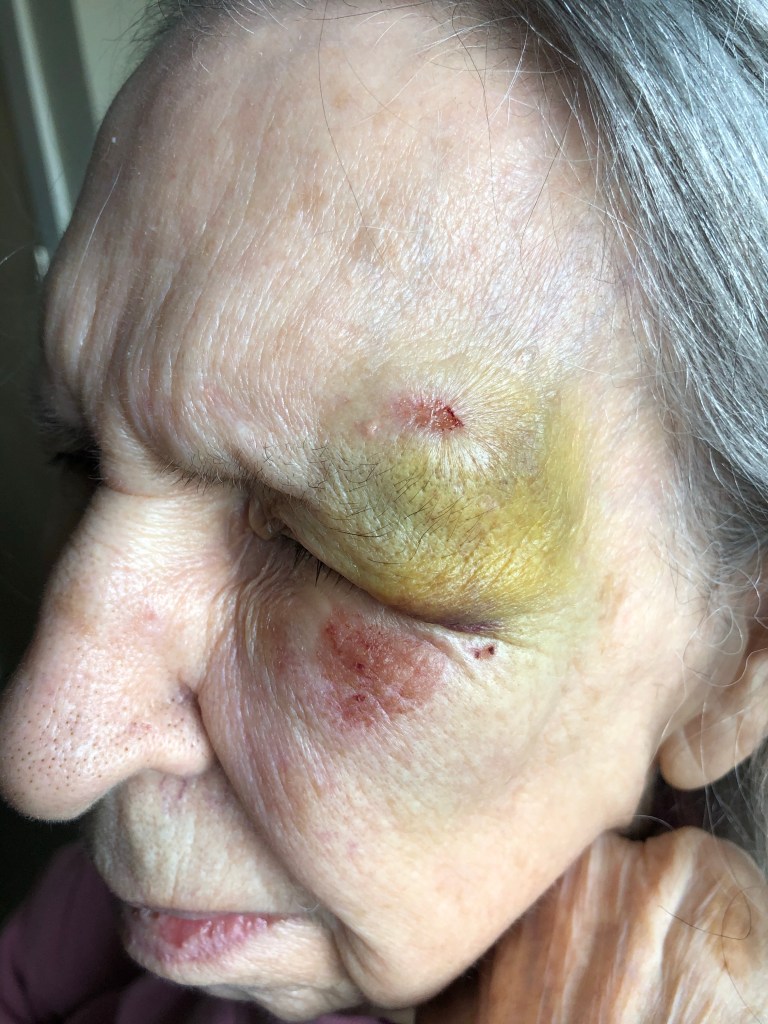
My poor mom! She’s got quite a few nasty facial bruises and abrasions sustained in recent falls. Let me be quick to say that my mom receives EXCELLENT care in her abode at BeeHive. None of the falls she has experienced have anything to do with her not being closely monitored. The staff does their best to keep an eye on her, and so do I.

Case in point: earlier this week I was just a few feet away from her when she suddenly decided she was going to attempt to transfer herself from her wheelchair to a nearby recliner. She ended up unceremoniously dumping herself onto the floor in the process. Thankfully, she wasn’t injured this time, but that just demonstrates how quick and stealth-like she can be when she sets her mind to doing something.

Much thought and effort goes into “how to keep Charlotte safe” at BeeHive. I surely appreciate the staff’s diligence, their willingness to keep tweaking medications, schedules, and processes in order to create an environment where she is as safe as possible. I make every effort to work with them and support them in their endeavors, and her team of caregivers is always more than willing to give my ideas a try.

I know some of the readers of my blog may be experiencing similar difficulties with their loved ones, so thought I’d share a few things we have tried which seem to help.

A floor alarm is in use by her bed, which helps the staff know when her feet hit the floor. She also has a wheelchair alarm which will alert them if she lifts her weight off of the chair. Unfortunately, alarms only let you know that the loved one is already in motion and caregivers may not be near enough to respond before the incident occurs. The greatest strength of an alarm is that it brings help sooner than later.

Learning her habits and “reading” her signals is a very important part of anticipating her risky behavior. For instance, they know that mom can no longer reliably sense when she has to use a toilet, and her ability to voice a need to “go” varies greatly daily. However, through observing mom and recording her habits, they know that it is wise to wait about 45 minutes after lunch when she’s getting a bit sleepy to take her to use the restroom, and then put her in bed for an afternoon nap.

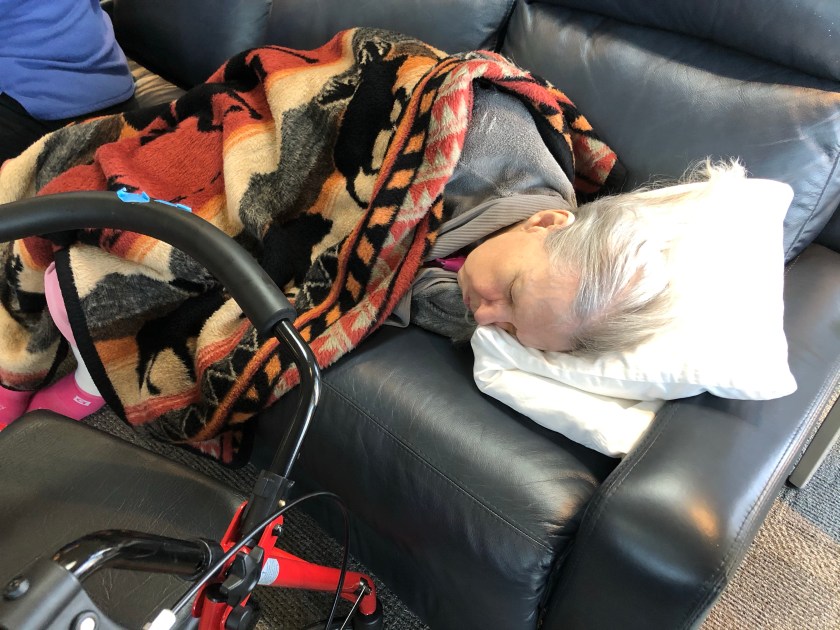
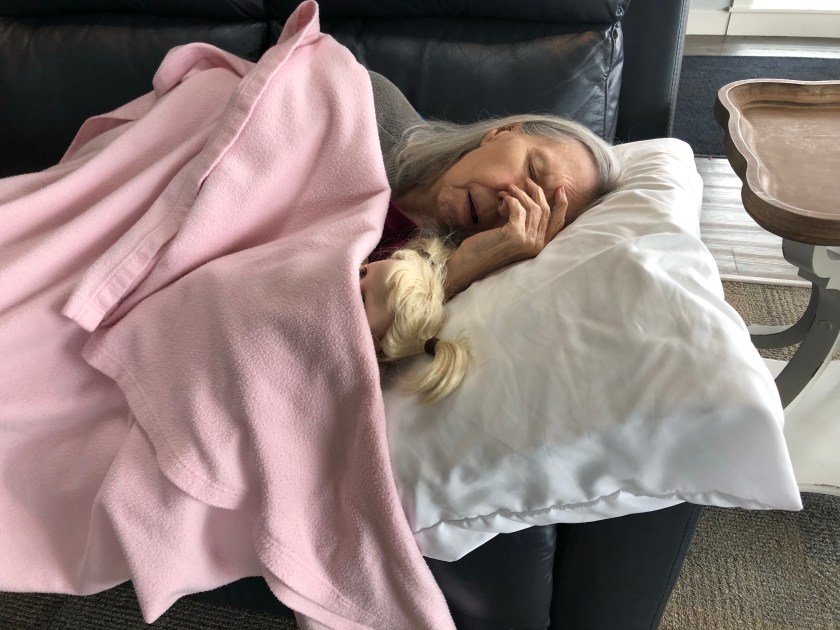
Mom likes to tootle around in her wheelchair, but can get into a bit of trouble as she explores the rooms of other residents and tries to get in their beds or chairs. Restraints aren’t allowed, but her caregivers have learned that mom will stay put and sometimes take a quick nap if she is placed in one of their comfy recliners (and reclined). She also likes to sleep on one of the roomy couches; if she seems sleepy and is trying to transfer herself to a couch, they help her get comfy by bringing her a blanket and pillow. Dolly sometimes joins her for a little snooze.

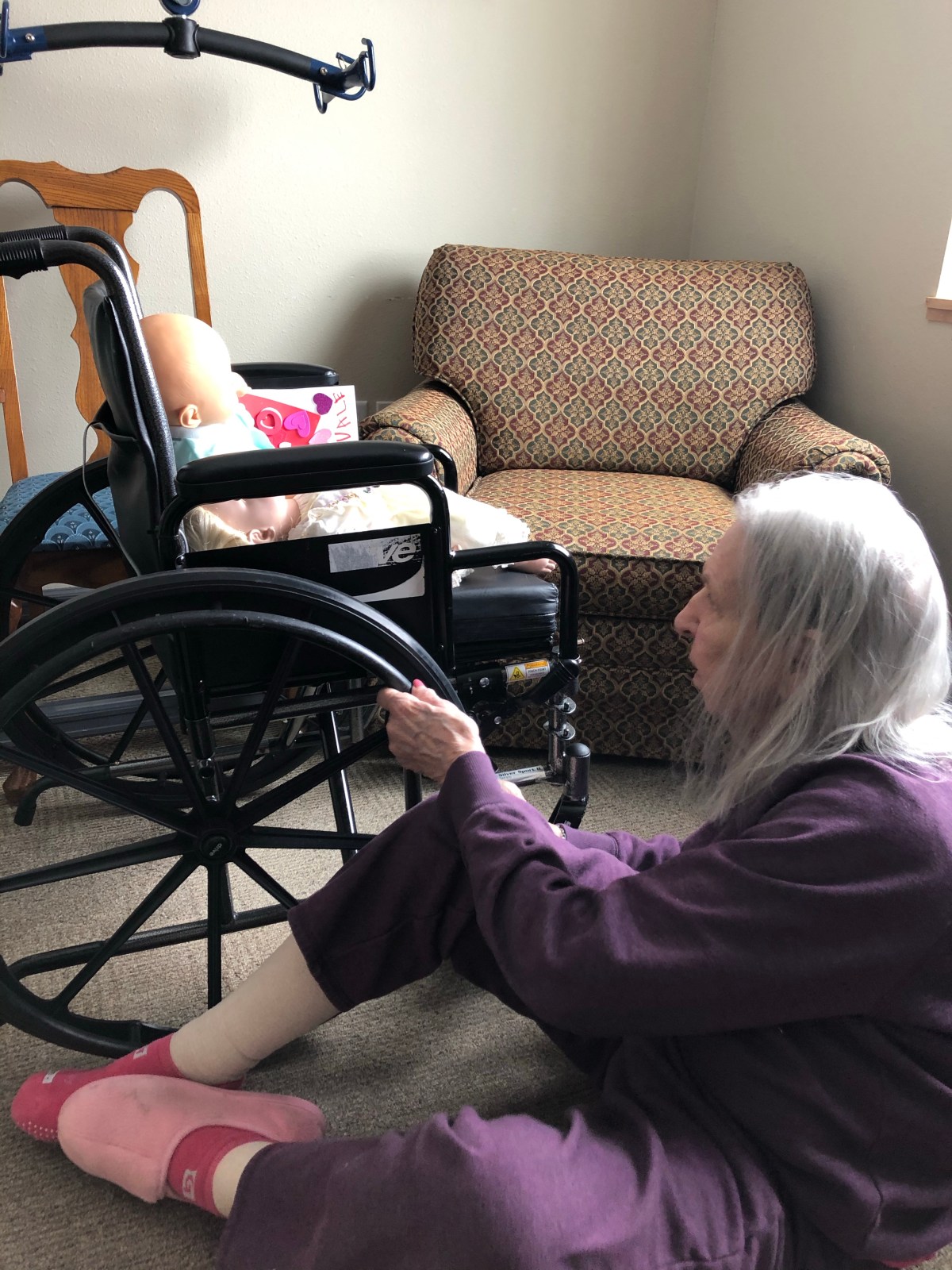
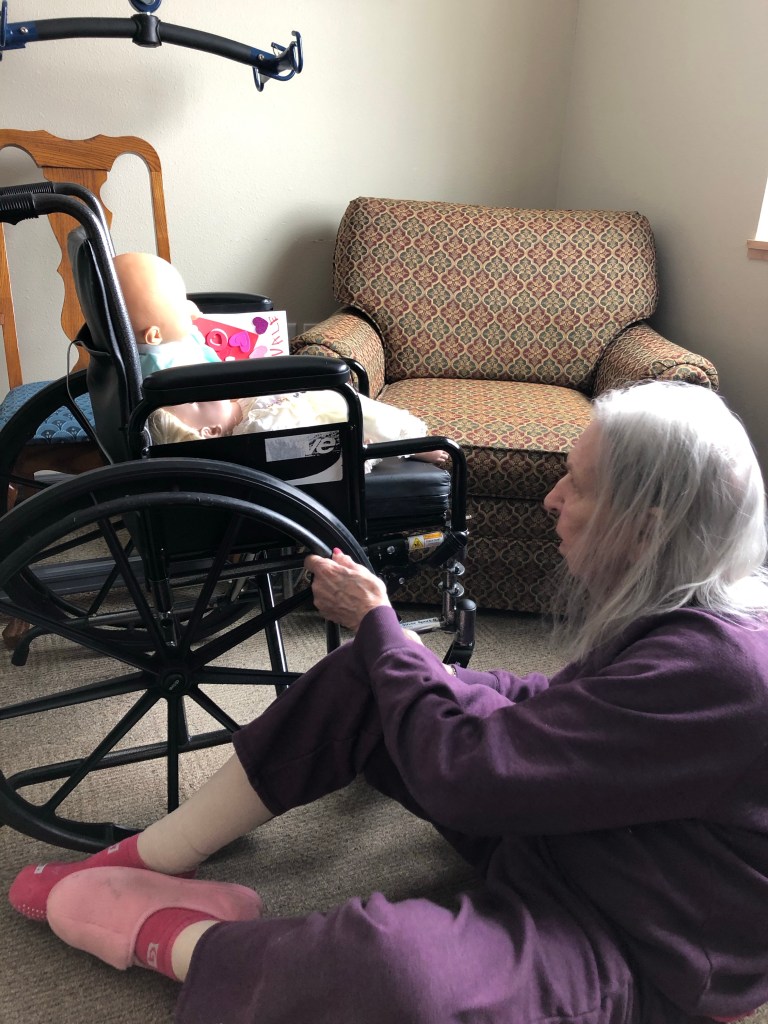
Mom’s risk for falls is complicated by the fact that she seems to enjoy being on the floor. Sometimes she is playing on the floor like a small child, inspecting the wheels on her wheelchair, or scootching around on her bum in a crab-like crawl (see the sassy video below). Other times she just wants to sleep on the floor. It’s HOW she gets down onto the floor that is risky and causing her injuries (that and falling asleep in her wheelchair and then toppling out). If the staff sees her attempting to get down on the floor, they have learned she will become agitated if they keep picking her up and putting her in her chair or bed. It truly is best to help her get down there safely and let her hangout down there until it’s time for the next meal or activity.

As you can imagine, the sight of a frail-looking, elderly sweetheart crawling around on the floor is a bit disturbing to visiting family and guests who sometimes assume that the staff is just not paying attention.

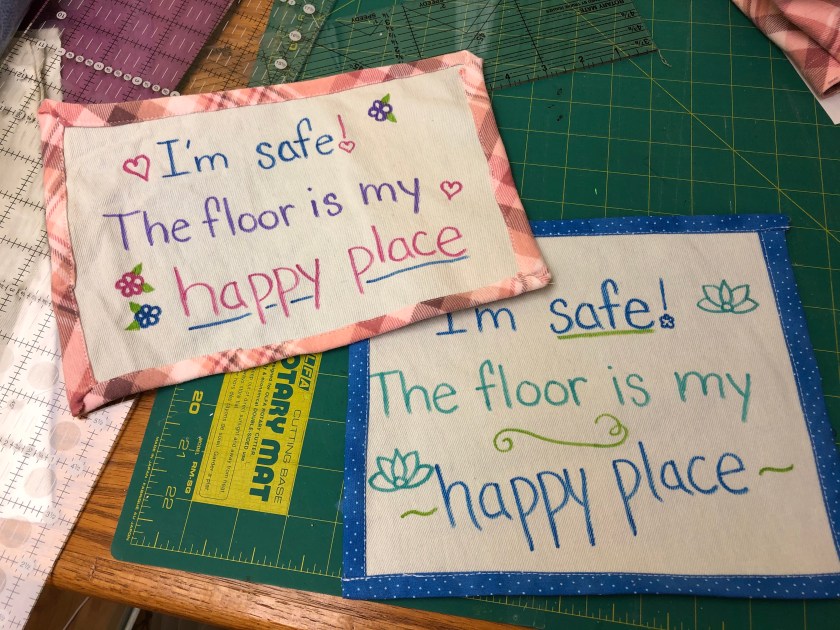
To keep the staff safe from undue criticism, my granddaughter Mia helped me decorate a few little fabric signs for her back which help communicate that she is safe and happy. The staff pins the little signs to her sweater so she can play to her hearts content and everyone knows she’s okay.

Mom’s ability to communicate her needs is definitely on a course of swift decline. I know I say this a lot, but I am incredibly grateful for those who lovingly care for my mom. I couldn’t possibly meet mom’s needs as well and keep her safe if I were caring for her on my own. How wonderful that, through BeeHive Homes of Oregon, Agrace Hospice, and Bluestone Physicians Group, I have doctors, nurses, nursing assistants, personal care workers, a cook, a pharmacist, a social worker, and an activity director who ALL care about my mom so very much.

Mom is safe. I am blessed.

The Decline: Bumper Car Wheelchair

As a kid, there was one ride at a carnival or theme park where you would rarely see me:

bumper cars

I hated them.

Sorry, I don’t have a personal photo to illustrate this paragraph; if I did, I would be the terrified looking kid (or adult) stuck in the corner with everybody crashing into me. There was nothing fun about it.

I can probably count on one hand the number of times I have allowed myself to be in a bumper car. Each of those times my participation was only under great duress from a friend. The last time was when my kids were small (and super cute), with big eyes and sweet voices that pleaded, “Puhlleeeze, Mom!” So, I acquiesced and ended up in another corner – this time my own kids taking devious joy in crashing into me. I can smile about it now, but back then I couldn’t wait to get out of that car!

You might be wondering why I even bring up this crazy aversion related to bumper cars. Something I saw in my momma’s world today reminded me of my scary experience with bumper cars. Let me tell you about it.

As I mentioned in one of my last posts (you can read it here), mom has been closing her eyes to the world around her. Perhaps she is just tired, but I think it is her way of shutting out some of the confusing stimuli. Living life with her eyes closed may offer a measure of control over her world. In combination with her inability to hear, closing her eyes may bring peace and control to her chaotic world of life with Alzheimer’s. Nowadays, she eats most meals with her eyes closed; a bit messy and effectively shuts out any interaction with her table-mates. When she is offered the medications she takes, Mom often refuses by closing her eyes tight. In effect, she makes the unpleasant things in life disappear, much like a child who thinks you can’t see them if they cover their eyes and can’t see you.

Mom’s latest eyes closed activity has been fiddle-footing around in her wheelchair with her eyes closed. Watching her bump into walls and other obstructions in her path reminds me very much of driving a bumper car with her eyes closed. Over and over again, she’ll try to propel herself through a doorway, not bothering to open her eyes to see that she is hung up on the door frame. As afternoon anxiety seeps into her consciousness, she will bump-bump-bump her way around her room, sometimes getting stuck in a corner and then whimpering that she is stuck. When offered help, she often refuses and continues to whimper about her stuck-ness, rather than accept help from someone who cares about her.

As I watched my mom struggle with this today, I was reminded of another person who has similar self-imposed blindness.

Myself.

How many times do I keep bump-bump-bumping into obstacles to growth in my life without bothering to open my eyes to my need for help?

In an effort to encourage us to apply the truth of God’s Word in our lives, our pastor likes to give us homework at the close of his sermons. I try very hard to complete at least one of the three suggested assignments each week. This week’s sermon really challenged me and one of his suggested assignments really resonated with me. So here’s the assignment I’m prayerfully considering this week:

Who have I invited to help me grow spiritually?”

The Decline: When Birthdays Are No Longer Celebrations

Mom turned 86 years old yesterday. I think I have been saying this for three years, but I honestly believe this may be the last birthday she will celebrate on this side of heaven. Nonetheless, I baked a cake especially for her and brought it to share with her friends at BeeHive.

I didn’t remember to take a picture of my cake, but found this photo and a recipe similar to mine.
Photo credit: https://www.keyingredient.com/recipes/3782245034/ding-dong-cake/

In my heart, I knew the birthday cake probably wouldn’t matter to her. But it mattered to me. My mother’s life is worth celebrating.

As expected, she enjoyed eating the cake, but her birthday didn’t phase her. She didn’t seem to understand or believe it when I told her it was her birthday, and the greetings of her friends and caregivers were met with disbelief and a blank expression. She looked quite confused (and maybe a little mad at me) while her friends and caregivers sang ‘Happy Birthday’ to her after lunch. She didn’t want to blow out the candle on her piece of cake, but she enjoyed eating the cake.

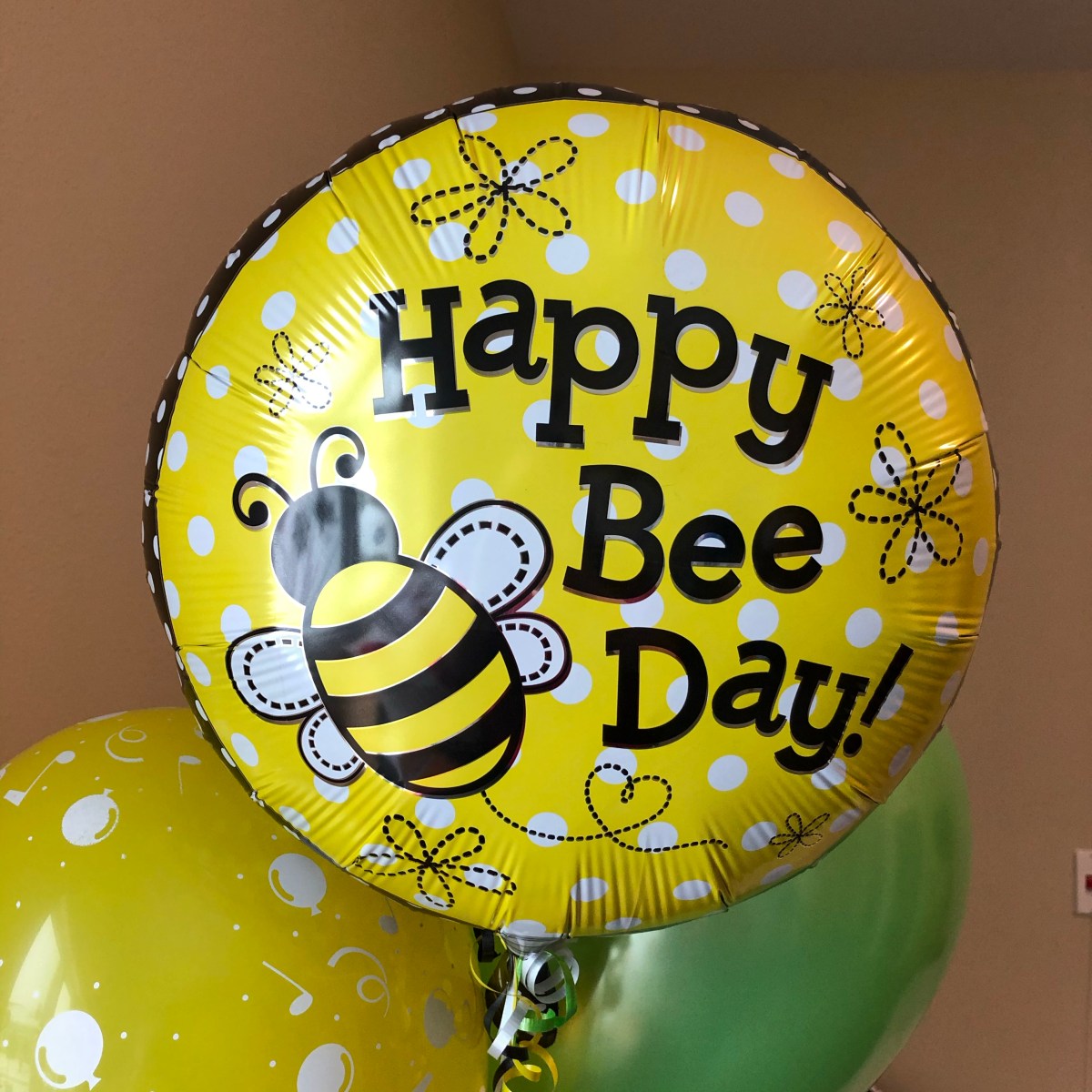
She didn’t want to open the cards from friends and family, or the present her brother sent her. She didn’t seem aware of the sweet gift of balloons and a cute little teddy bear that one of the staff purchased for her – but I basked in their love for her on her behalf. I opened the cards and gifts for her and set them up where she could see and hopefully enjoy them.

The birthday display didn’t seem matter to her, but it mattered to me. My mother’s life is worth celebrating.

As we sat in her bedroom that afternoon, she would talk to me, but her eyes would be closed, or open just a tiny sliver. She would scootch around in her room a bit in her wheelchair, but with eyes closed and directionless. I could tell she really wanted to go to bed and sleep, so I asked the staff to help me get her in bed.

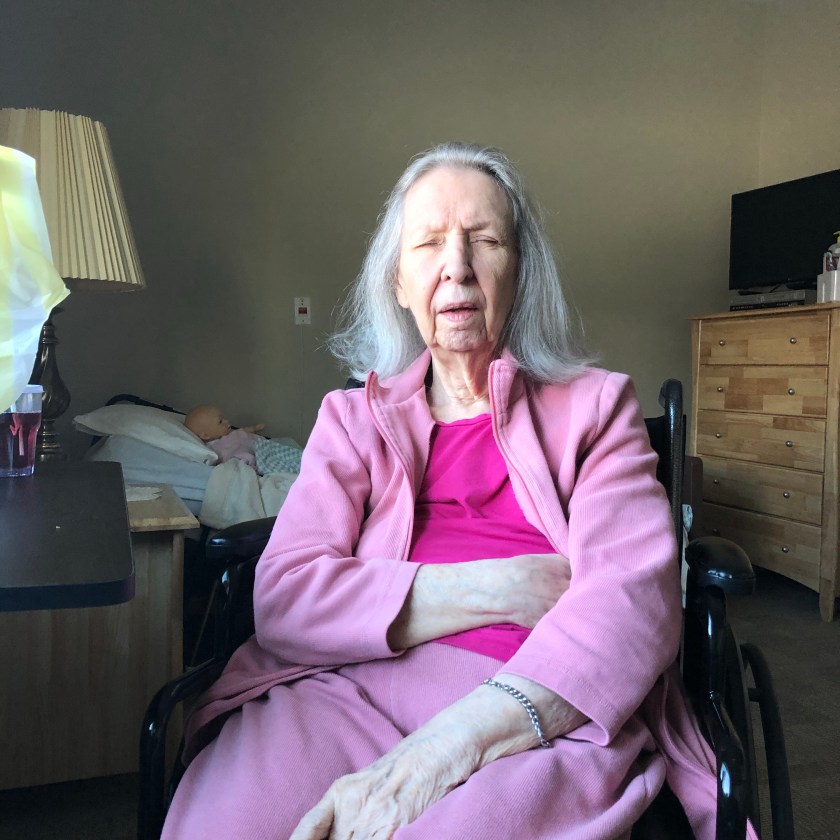
Mom shuts her eyes to her world when she is talking

Today was the first day the staff needed to use a Hoyer lift to help her get out of her wheelchair and into bed. The fact that it was her birthday wasn’t lost on me. This contraption is a gift; a gift which will keep mom safer as she transfers. This gift will also keep those who care for her safe from injuring their own backs as they assist her. Part of me wanted to cry knowing that mom was at the stage of care where this device was even necessary; but the other part of me smiled knowing that it was a blessing.

As I celebrate this woman’s extraordinary life, I pray for those who are caring for her. They are a blessing to me, and a gift worth celebrating too.

The Decline: Eyes Closed to Her World

Mom has been closing her eyes to her world a lot lately. From what I read, it is further evidence that she is entering the last stage of this disease. Mom can’t hear real well, so I think that it is also her retreat – a safe and quiet space – closed off from the sights and sounds of the world around her which grows less familiar each and every day.

Mom shutting her eyes to her world when she is talking to me.

I believe this may be mom’s final winter of life trapped in a body and mind afflicted with Alzheimer’s. This stage morphs wildly from good to bad daily – sometimes several times a day. Mom will take a huge downward step one day, then surprisingly recover the next day – sometimes all within a day.

One day she’ll see me arrive and clap her hands together in joy while announcing to anyone within earshot, “Oh, good! My mother is here!” and the next day (sometimes that same afternoon) there will be a vacant look and not even a glimmer of recognition or joy in her eyes.

One day she’ll be sitting at a table with two of her friends enjoying her lunch in the dining room (and maybe sneaking things off of a nearby plate of a table mate too), and then the next several days she will only eat her meals from her bedside. On those days, she usually eats with her eyes closed. These steps downward are more frequent these days, and times of recovery are increasingly brief.

This may sound crazy. My heart hurts at seeing this happen to my mom, but is strangely comforted by the fact that it is happening too.

Sadness mingled with joy: that is what I feel. Sadness in knowing that she is going through so much pain and confusion, yet I know full well there are harder days ahead. Joy in knowing that her long journey is coming to an end here on earth and that the beautiful and long-awaited day is drawing near when she opens her eyes in Heaven.

The Decline: Getting ‘Home’ Before Dark

The indignities of the later stages of Alzheimer’s are many, and it is hard to watch my mother wrestle with them. As I sit with her on her rough days, I pray for her and ask God to “take her gently Home” in His perfect time. I confess praying too that God would somehow spare me from this oftentimes familial disease.

A few days ago, Momma was having a very rough day. It broke my heart to see her in such pain and mental anguish. As I sat with her and tried to be of comfort, I thought about something my sweet mother-in-law used to pray. Quoting from a poem that was dear to her heart, her prayer was, “God, in your time, please let me get home before dark.”

By God’s providence, I came upon the prayerful poem that Shirley had typed out and prayed by faith for herself. Today, I make this my prayer as well.

Let Me Get Home by Dark

by J. Robertson McQuilkin

It’s sundown, Lord.
The shadows of my life stretch back
into the dimness of the years long spent.
I fear not death, for that grim foe betrays himself at last,
thrusting me forever into life:
Life with you, unsoiled and free.
But I do fear.
I fear the Dark Spectre may come too soon –
or do I mean, too late?
That I should end before I finish or
finish, but not well.
That I should stain your honor, shame your name,
grieve your loving heart.
Few, they tell me, finish well…
Lord, let me get home before dark. 
The darkness of a spirit
grown mean and small, fruit shriveled on the vine,
bitter to the taste of my companions,
burden to be borne by those brave few who love me still.
No, Lord. Let the fruit grow lush and sweet,
A joy to all who taste:
Spirit-sign of God at work,
stronger, fuller, brighter at the end.
Lord let me get home before dark. 
The darkness of tattered gifts,
rust-locked, half-spent or ill-spent.
A life that once was used of God
now set aside.
Grief for glories gone or
Fretting for a task God never gave.
Mourning in the hollow chambers of memory.
Gazing on the faded banners of victories long gone.
Cannot I run well unto the end?
Lord, let me get home before dark. 
The outer me decays –
I do not fret or ask reprieve.
The ebbing strength but weans me from mother earth
and grows me up for heaven.
I do not cling to shadows cast by immortality.
I do not patch the scaffold lent to build the real, eternal me.
I do not clutch about me my cocoon,
vainly struggling to hold hostage
a free spirit pressing to be born. 
But will I reach the gate
in lingering pain, body distorted, grotesque?
Or will it be a mind
wandering untethered among light phantasies or
grim terrors?
Of your grace, Father, I humbly ask…
Let me get home before dark.

Alzheimer’s – Sensitive Topics

With Alzheimer’s, the filter on the tongue is missing. My sweet mother’s ability to reign in her emotions and frustrations is broken.

Sometimes I wrestle with whether or not I should write about something related to caring for a loved one with dementia. Some things just feel too private, too personal. In writing about an especially sensitive topic, I wonder if I will dishonor my mother in some way. I’ve wrestled earnestly with today’s topic for these reasons and more. However, as I speak with others who are caring for a loved one suffering from memory loss, many of them are dealing with the same thing. So, for the sake of those who need to know they’re not alone, here’s the topic:

Swearing.

As Mom’s battle with Alzheimer’s dementia intensifies, so does the bad language and harshness of the tongue. Those who help provide her care each day assure me she is still incredibly sweet – they love, love, LOVE her to pieces. They tell me that when her tongue gets sharp, she almost immediately apologizes and layers on the salve of kindness.

Before Alzheimer’s, Momma would never swear at someone. In a moment of frustration, she may think a curse word in response to a frustrating situation, but she would never say it out loud. She would quickly reign in her frustration and replace it with graciousness.

With Alzheimer’s, the filter on the tongue is missing. My sweet mother’s ability to reign in her emotions and frustrations is broken. With arms flailing, out come the curse words when her caregiver tries (sometimes in vain) to help her shower or get dressed. She’ll even blurt out curse words at me, the one who provides daily love and care for her.

It hurts my heart to hear her swear and say ugly, mean-spirited things.

Before Alzheimer’s Momma’s tongue held kind words, not critical and harsh ones. Her tongue reflected her actions and her love for her Savior; she was gracious and benevolent with both. She’d never blurt out what she thinks. She’d just smile and keep her thoughts to herself.

I know it’s the result of this disease. But, I also see very clearly that the curse of the sinful nature we are all born with is uncovered and revealed by this relentless and wicked disease. I know in my heart how much my mother loves Jesus. And I know how immersed she was in the Scriptures and what a prayer warrior she was before this disease stripped her mind of the ability to recall the things she has learned.

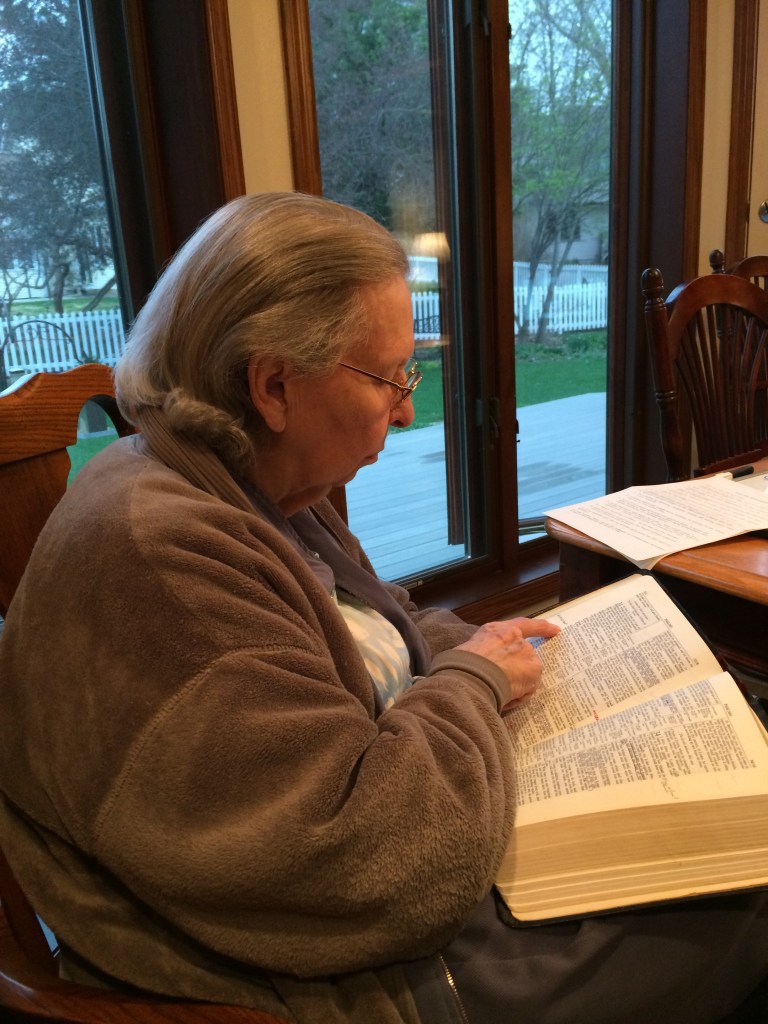
I always hoped that she would defy the odds of this disease and never forget the Scriptures she has learned. But now, it seems, she cannot understand what she is reading and tells me that the Bible I keep on her nightstand isn’t hers, even though it is filled with her own handwritten notes, prayers and thoughts.

I always hoped that music and the great hymns of the faith would be a help and stronghold for her in her later years. But she is usually quite ambivalent to it – although her poor hearing might play a role in that.

I always hoped she wouldn’t forget that she is a child of the King. On this last unfulfilled hope – she has forgotten, but God has not. She is His child and He knows it. He remembers her and will never forget – never forsake.

Someday, when all is made new, music will be restored and she will sing a new song in heaven. Best of all, she will meet the One she read about in Scriptures and has trusted by faith – Jesus – the living Word.

FabFourBlog

Notes on Seeing, Reading & Writing, Living & Loving in The North

Patti Bee

All things come. All things go.

Caring for Dementia

Behaviour Support Specialist • Emotion-focused Care Strategies

Low Carb Revelation LLC

Low Carb Diet & Lifestyle

Debbie Prather

CONNECTING HEARTS THROUGH WORDS

Lindy Thompson

thoughts on the spiritual journey

Wild Daffodil

the joy of creativity

Stacy J. Edwards

The Lord God has given me the tongue of those who are taught, that I may know how to sustain with a word him who is weary. - Isaiah 50:4

A Plantsman's World

A retrospective of the photographs from my last garden plus a few meanderings based on my own experience and a love of all things Asiatic.

Fake Flamenco

Connecting the Americas, Bridging Cultures Supergringa in Spain: A Travel Memoir

100CountryTrek.com

Travelling is my joy of living. Sit back relax and come with me.