One story my mom told of her childhood sticks out in my mind today, but is a bit fuzzy around the edges — how I wish I had paid closer attention and written down the details while I had the chance.
Mom told of an aunt and uncle who owned a restaurant. When mom would visit, this auntie would let mom explore the former bookstore on the other side of the building she owned. When her aunt unlocked that door, mom had personal access to all of the books that were still nestled on each shelf of that now abandoned bookstore. A whole new world opened up to her as she fingered the pages of each book that she read. It is no wonder that mom carried the love of reading with her throughout life, until Alzheimer’s would overshadow her ability to read in her last year of life.
In 1964, a new branch of the Milwaukee public library opened up on Capitol Drive, in a neighborhood very familiar to my parents. Just a handful of years earlier, I had been born in the Capitol Drive hospital (where mom was a nurse) just a few miles east down the road, and my parents had lived in the house just behind that hospital for the first years of my life. Looking back, it’s no wonder my mom would be one of this library’s early patrons, or that some of my earliest memories are of her helping me choose books from its shelves. What a wonderful feeling it was when, a few years down the road, I received my very own library card, giving me my very own access to countless adventures in books, plus the resources I would need for school research down the road a few years.
Yours truly in kindergarten, the year my adventure in reading would begin. Note: mom was much better at helping me choose books to read than she was at cutting my hair.
Fast forward to 1969 when another library opened up to me. This library of just 66 books was contained within one greater volume. Yes, the Bible. It was during the 12th year of my life when I, by faith, met the Author of this book. In the very moment that I placed my trust in Christ, His Spirit came to dwell within me, unlocking and giving me full access to the truths within the pages of my Bible.
I learned a verse during that year which helped me understand the importance of this Book of all books in my new life as a believer and why it continues to speak to my heart and change me from within each and every time I spend time within its pages.
All Scripture is breathed out by God and profitable for teaching, for reproof, for correction, and for training in righteousness, that the man of God may be complete, equipped for every good work.
What happens when you want to remember something, but absolutely know you won’t? You write it down. For the individual experiencing short term memory loss, lists sometimes become a source of frustration. A caregiving daughter shares her view on helping her momma remember, while guarding her fragile dignity.
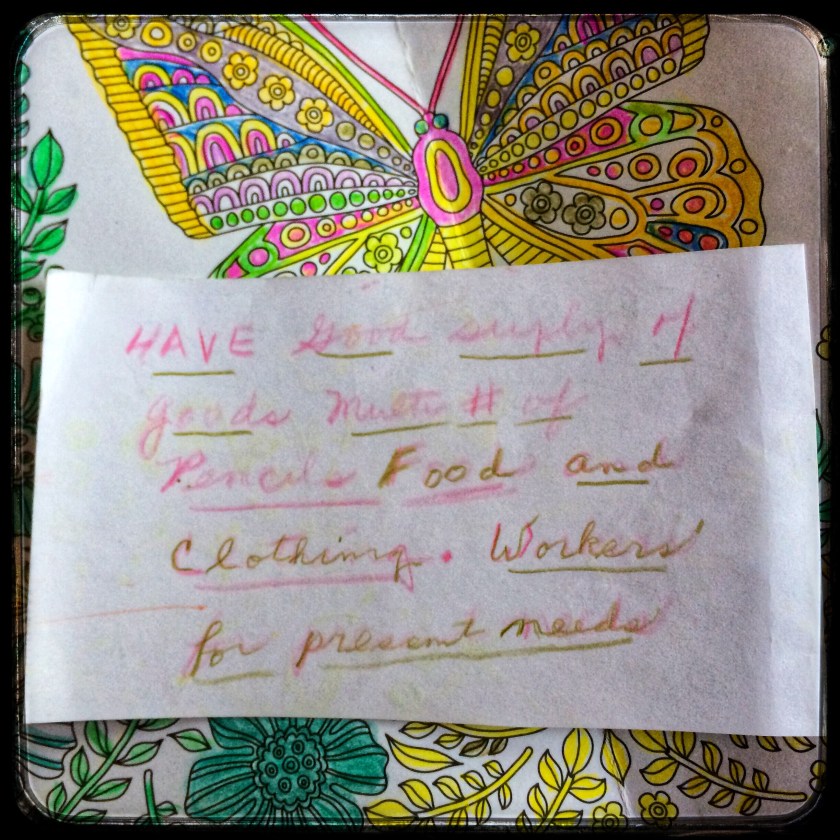
One of mom’s little notes…I was considered one of the “workers.”
Journal entry from June 7, 2016
Quite often these days, Momma will ask me to buy her a notebook the next time I go to the store, declaring that she can never find any paper on which to write her lists. I know for a fact that she has umpteen notebooks and pads of paper squirreled away all over her apartment home.
Mom is at what her doctor calls the “moderate stage” of dementia where she is keenly aware that she is losing her ability to recall information and is trying her hardest to keep random pieces of information that won’t stay filed away in her brain in a place where she can easily retrieve them. Her lists are her safety net helping her capture not only her to-do list, but the stray thoughts, ideas, and necessities of life.
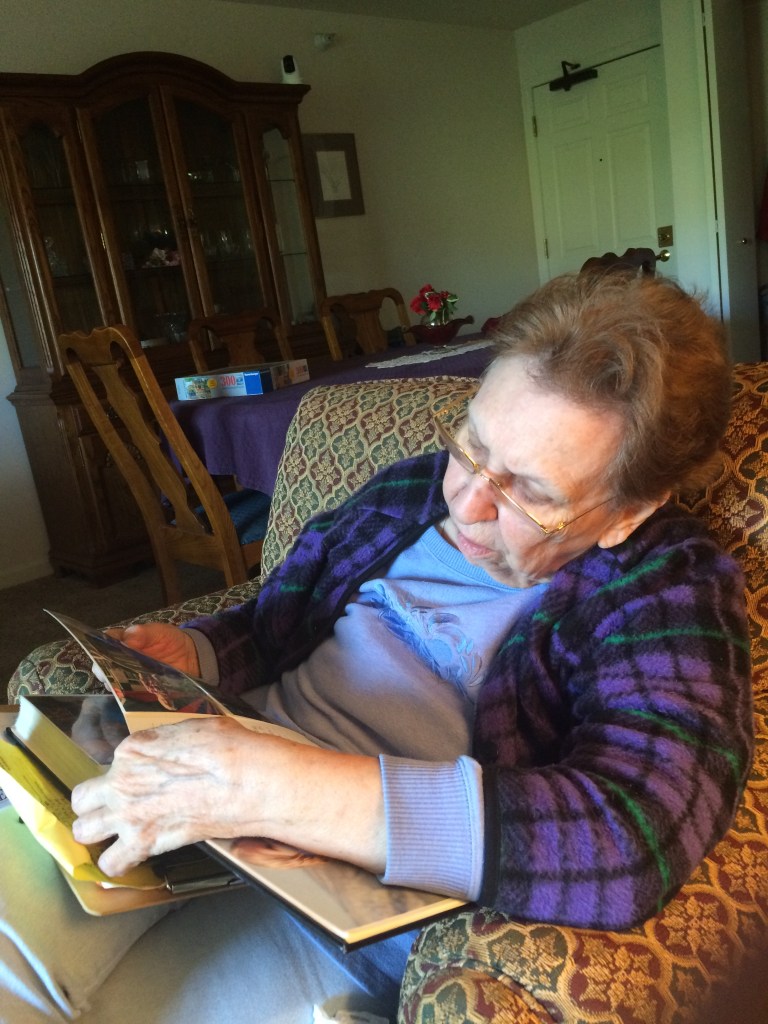
She’s enjoying a photo album which has lots of captions written in the margins. Underneath, you can see her clipboard with a few of her important pages of notes.
Once in awhile, mom asks me to take her shopping. Shopping excursions to Walmart or Walgreens invariably result in Mom tossing a new package of legal pads or a brightly colored spiral bound notebook into her shopping cart. She insists she is all out of them and there is no convincing her otherwise. Rather than bringing a sense of order to her world, the multiplicity of lists bring chaos to her sense of order as she tries in vain to gather her thoughts into one place.
I have since gathered most of those notepads/books into one cabinet in her apartment. One thing is certain–she has no need for more notepads. Rather, under her watchful eye, I acquiesce to mom’s request and jot down a note for myself on a shopping list, assuring her I will purchase a notebook for her on my next trip to the store.
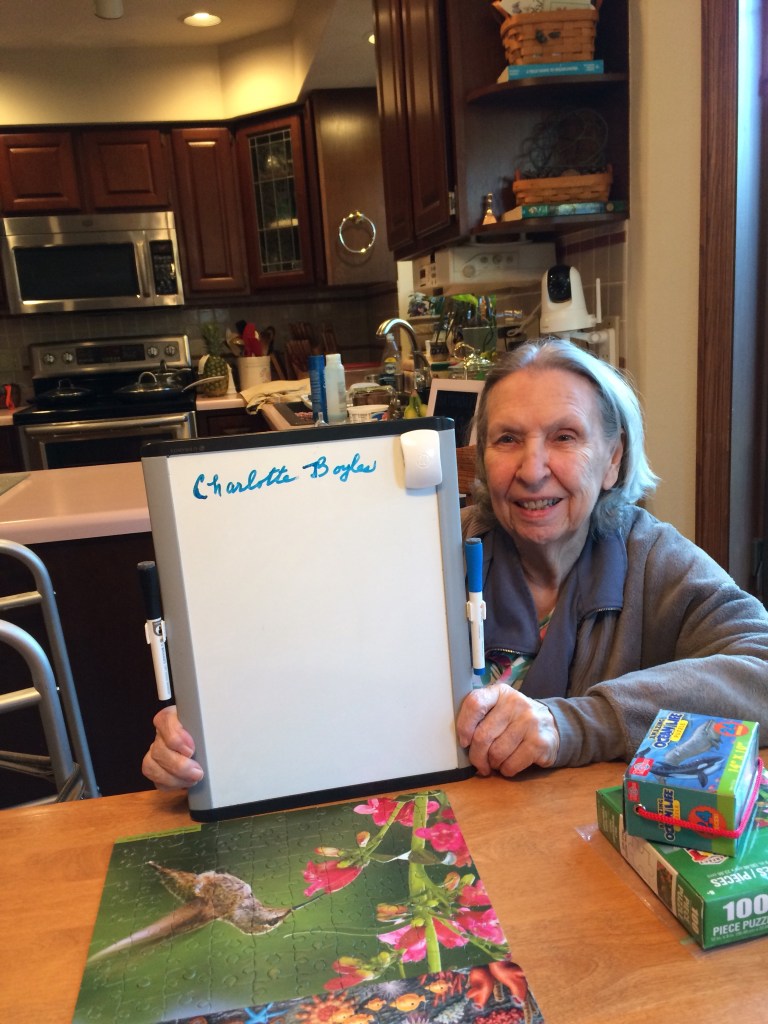
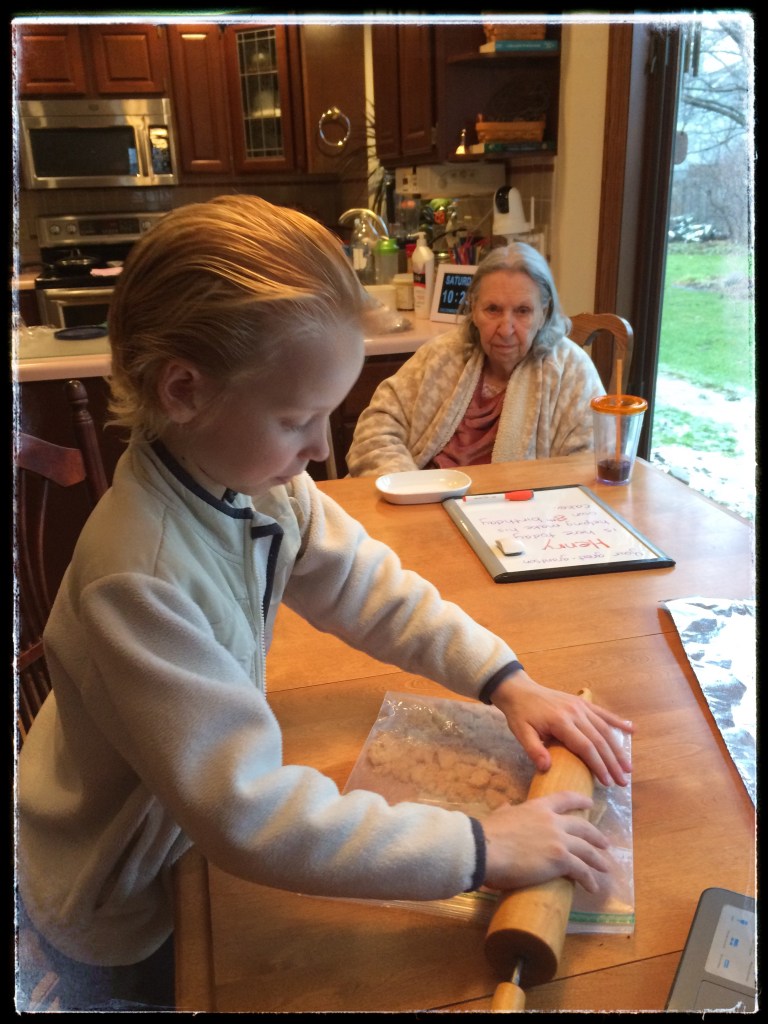
This whiteboard was one way we tried to help her gather her thoughts.
You may be wondering, why not tell her the truth? Why the charade? Why not just tell her that she has plenty of notebooks? Right or wrong, I believe I am honoring my mom when I later “find” one of her notebooks and we can cross the “notebook for Mom” off my list. It gives mom the fleeting pleasure of having one of her requests granted, and I receive the gratification of pleasing my mother and guarding her fragile dignity.
Here’s the next in a series of Tuesday’s Caregiving Tips posts inspired by A-Z Caregiving Tips (an article in Alzheimer’s Today pictured below). A diagnosis of cognitive impairment or memory loss presents caregiving challenges, each as varied as the person experiencing it. Alzheimer’s was the diagnosis that spelled memory loss for my sweet mom. You can read my previous posts for my personal tips on A – M. Today I am sharing my thoughts about “N” and will add my own “O,” since the article did not address that particular letter. Thanks for stopping by to read my blog – the “likes” and “comments” of my readers feed my motivation to write.
N – Note that I take your words literally, so avoid teasing and sarcasm.
In the early stage of memory loss, mom would sometimes take “just kidding” comments quite literally. Likewise, when mom reached what was thought to be the stage of “moderately severe” memory loss, it seemed that her ability to understand and appreciate sarcastic humor and irony disappeared too. This was especially noticeable in social “table talk” situations.
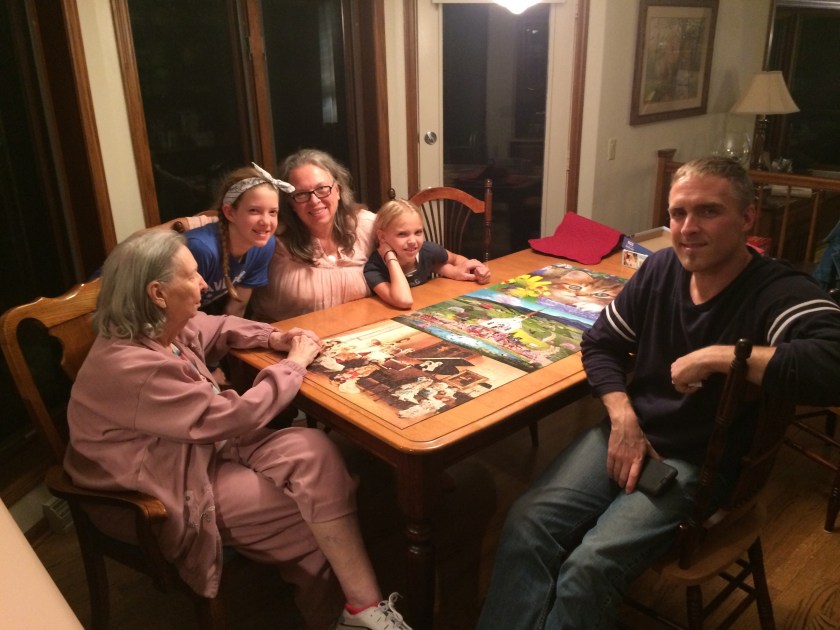
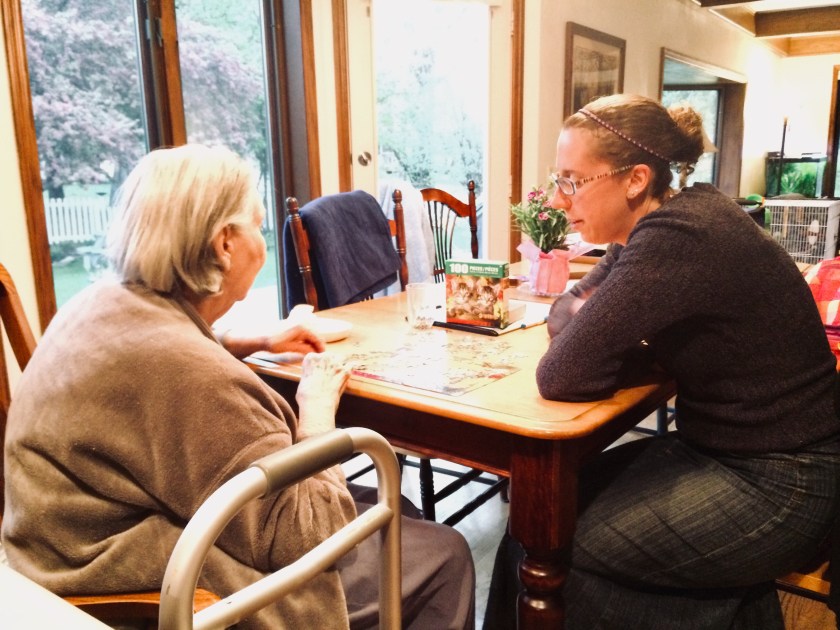
Mom enjoying putting together puzzles (3 in one evening!) with the help of her grandson Matt and her great-granddaughters Mia and Noelle. Puzzles were helpful in guiding enjoyable conversations with mom.
Teasing and sarcasm are part and parcel of family gatherings such as Thanksgiving. We like to tell stories on one another and kid each other about silly things we’ve done lately. We sometimes use tongue in cheek jesting during our bantering around the table. Mom always had a quiet sense of humor–she would appreciate a good joke, but usually was not the one to tell it. She’d smile at the kids. But now, while she herself could often say something witty, there was no understanding of the “punch line” to someone else’s joke and a blank look at any attempt at humor.
Turning off the humor at the table isn’t the answer, but understanding how our loved one with dementia might be processing the conversation can be helpful in making the conversation inclusive for them too. Our bigger family dinners (e.g. Thanksgiving and birthdays) were the most confusing for my sweet mom. She would sometimes leave the table and go to the quietness of her room. When that would happen, family would go in an visit her one on one. She enjoyed that experience much more.
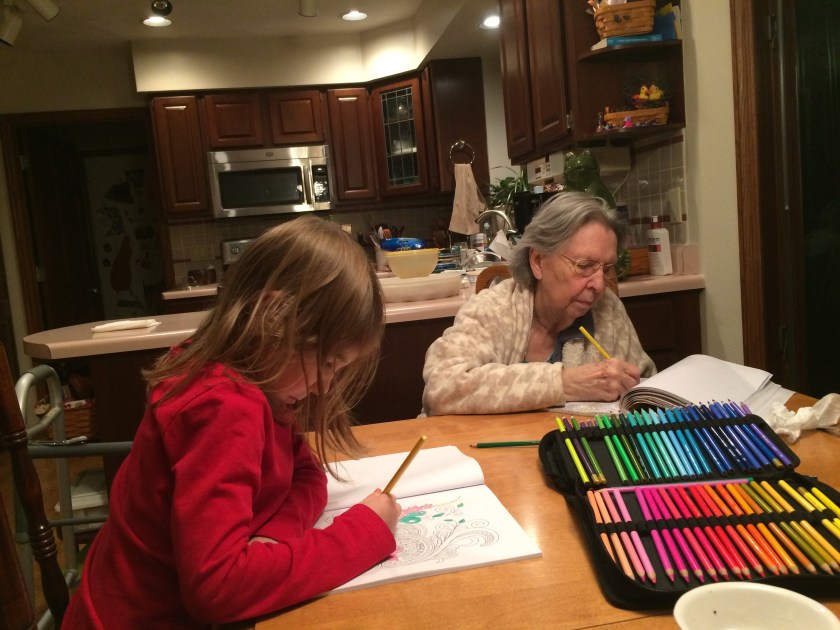
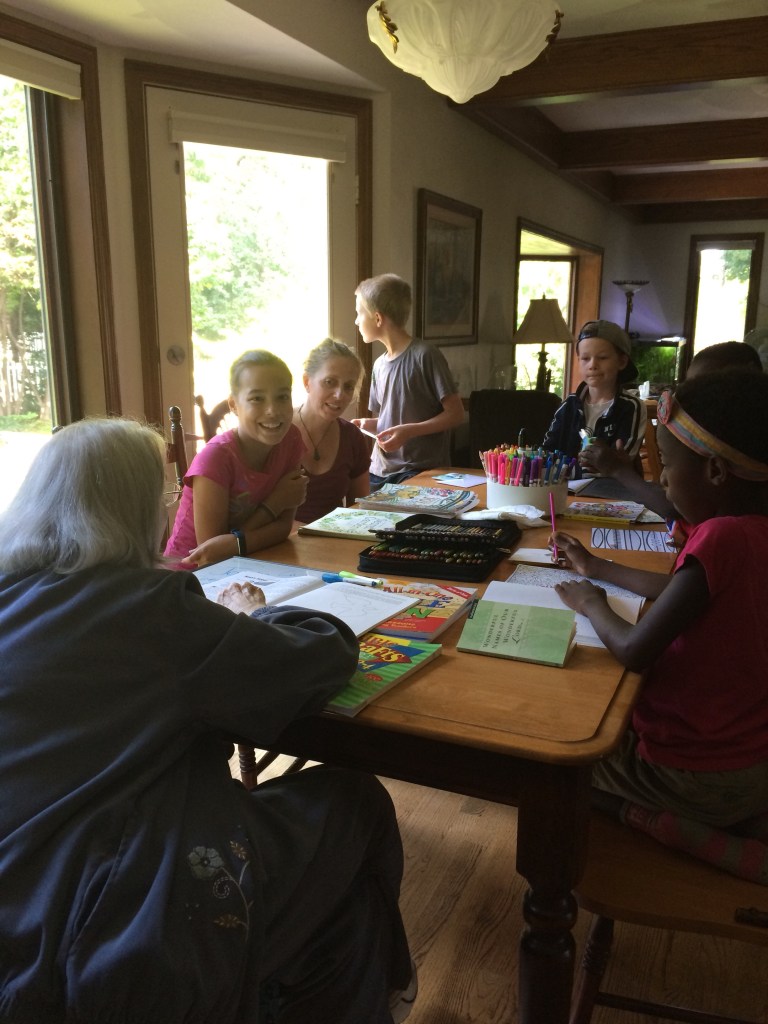
Another helpful tactic was to do something mom enjoyed at the table. Working on a puzzle or coloring became a unifying factor in conversation for her.
O – Own up to your mistakes in caregiving, but don’t beat yourself up about them. Mercy is new every morning.
I freely admit to making a lot of mistakes in caregiving. I recall days when my voice carried more than a little annoyance in it and harsh words would fly. Days when I was anxious and weary and my facial expressions did not communicate Christ-like love and compassion. There were times when I would confuse mom by asking if she remembered something when I knew full well that she couldn’t–or, similarly, when I would expect her to remember something we had already talked about. One of the hidden grace gifts of Alzheimer’s is that momma wouldn’t stay hurt and mad at me for long. She would soon forget my blunders and I would have another opportunity for a do-over in caregiving.
Likewise, in other relationships, there were times when I did not express my appreciation freely enough. I’m thinking of a time when I made my sister feel bad about how she handled a caregiving situation, rather than being gracious and knowing she did what she thought was best when she was taking a turn at caring for our mom. It’s sometimes easier to see the mistakes and failure of others than it is to see the same problem in our own lives.
It’s a wonderful thing for me as a believer in Christ to know that His steadfast love for me will never cease. Never. Ever. His mercy will never come to an end. Never. Ever. I praise God for His faithfulness in providing a daily (constant) supply of love and mercy. Knowing and believing the truth expressed in Lamentations 3:22-24 helped me through many times when I felt like a dismal failure as a caregiving daughter.
The steadfast love of the Lord never ceases; his mercies never come to an end; they are new every morning; great is your faithfulness. “The Lord is my portion,” says my soul, “therefore I will hope in him.” (Lamentations 3:22–24)
Written with love and great admiration for all those who are caring for a loved one who is facing Alzheimer’s or any other diagnosis that spells memory loss. I write from my experience of caring for my sweet mother in her later years with Alzheimer’s.
Here’s the next in a series of posts inspired by A-Z Caregiving Tips (pictured below). A diagnosis of cognitive impairment or memory loss presents caregiving challenges, each as varied as the person experiencing it. Alzheimer’s was the diagnosis that spelled memory loss for my sweet mom. You can read my previous posts for my tips on A – L. It seems I have a lot to say about “M,” so I will focus on that for this week.
Make new ways I can be of service to others
Mom was a nurse. A dedicated and amazing nurse. Even after she retired from her long career in nursing, she still practiced nursing in an unofficial way as she came alongside family and friends as they went through their physical trials in life. She was dad’s constant companion whenever he faced any of his cancers and surgeries. She served her friends as the requisite driver and responsible party when those friends faced day surgeries of various types. If someone was hospitalized, she was almost always one of the first visitors. Several of her friends had her come along to their surgeon’s or oncologist’s office when they were going to receive their scary diagnosis. Mom knew just the right questions to ask and how to help her friends through the difficult days ahead.
The time came when Mom was the patient with symptoms of short-term memory loss. I’m sure she knew something was amiss long before I started noticing memory blips. Who knows how many years she wrestled with that knowledge alone? Based upon dated notes and lists I found here and there, I would say for a few years.
Although Mom forgot many things, the experiences of her lifetime still served as a guide in her daily interactions. Even after mom moved in with me and then later into assisted living memory care, I routinely saw the nurse in mom present when she’d notice someone wasn’t feeling well and then do her best to make sure they were cared for appropriately.
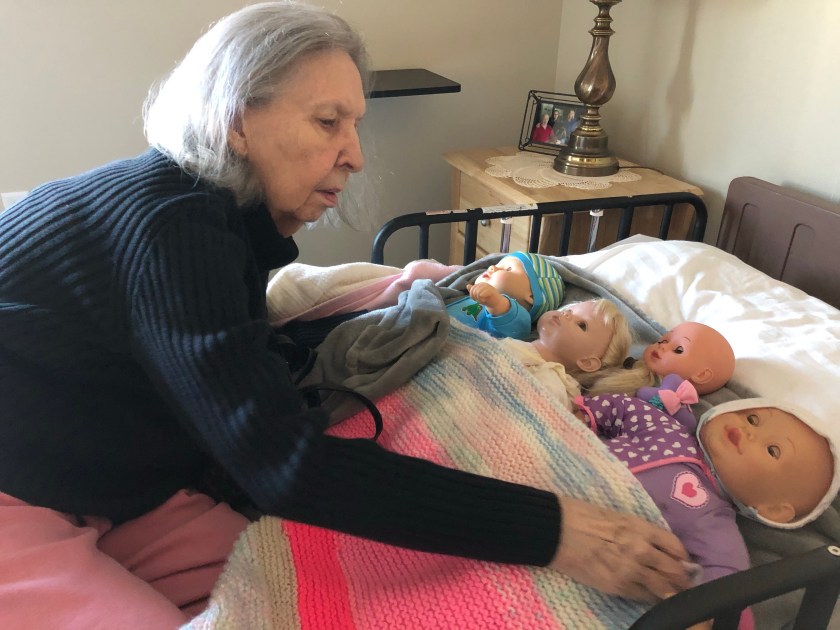
Momma lovingly putting her “babies” to bed
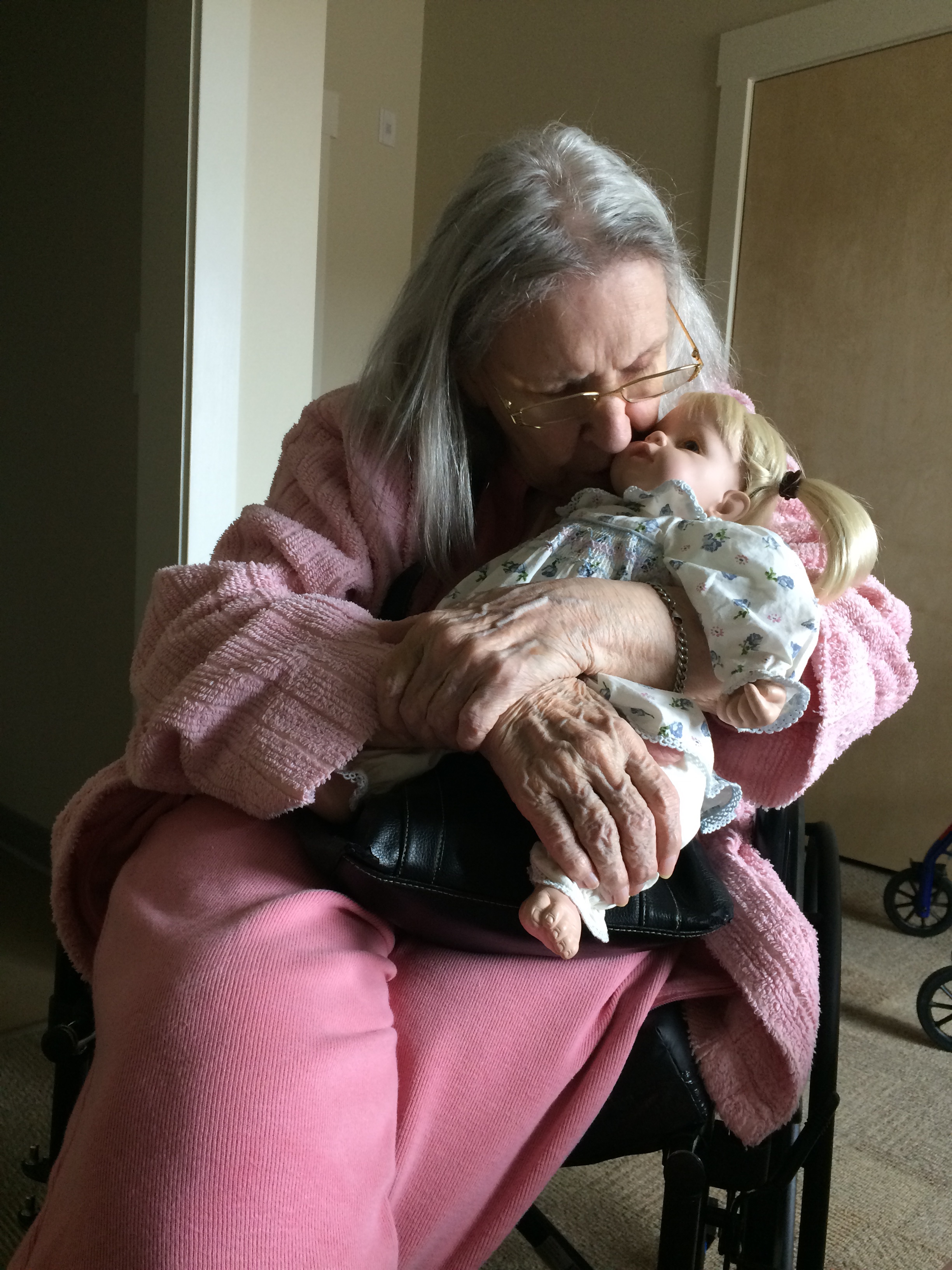
She usually couldn’t remember she was my mom, but I saw the loving mother in her displayed in the way she cared for dolls. It was like a special window into her past which allowed me the privilege of seeing what she may have been like when she mothered me as a baby. (Mom and me in this photo.)
Let me share just a few photos of her doing things which made her feel useful during her years spent living with dementia.
I’m thinking now of a resident at the assisted living memory care home where my mom lived for her last 14 months of life. June was usually the first one up every morning. She took very seriously her job of raising the window shades at the start of the day. The staff would then present her with a large basket filled with freshly laundered clothing protectors (bibs) and towels. June took great pride in folding them.
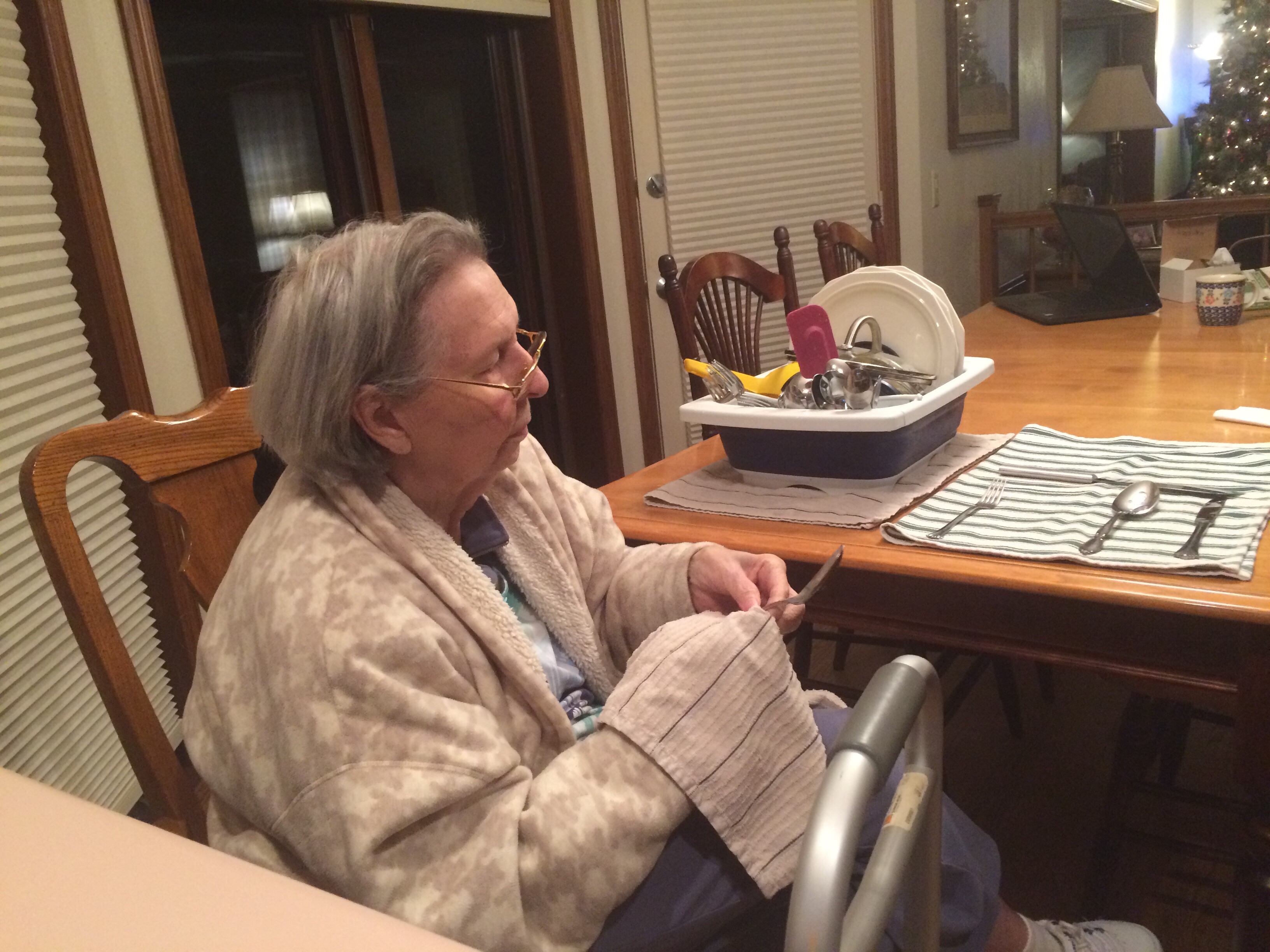
My mom would do the same thing when she was living with us for a few years. She loved to fold laundry, especially when it was warm out of the dryer. The warmth felt good on her arthritic hands. She would also dry dishes for us. Her legs were unsteady, so I would set her up with everything she needed at her place at the kitchen table. Mom had also been into gardening, so I would occasionally try to get her outdoors to help me. She especially enjoyed deadheading and cutting back spent foliage. Her specialty, however, was sweeping. She couldn’t stand to see even one leaf on the deck or porch, so we’d arm her with a broom and she’d happily sweep for quite some time.
I can’t talk about this subject without thinking of Heather, an amazing blogger I follow who cared for her sweet mother too. Heather’s mum, Margaret, had been an artist, so Heather would play to her mum’s interests and strengths by creating art therapy projects for her to work on throughout the day. They even opened an Etsy shop in order to sell some of her ‘Made by Mum’ projects, donating a portion of their profit to the Alzheimer’s Society. Heather’s amazing website Creative Carer is filled with photos and tutorials, a link to her very helpful and inspiring blog, and oodles of practical ideas for caregivers who desire to keep their loved one meaningfully engaged.
I write from my experience of caring for my sweet mother in her later years with Alzheimer’s. I hope that what I write will be an encouragement to those who are caring for someone they love.
Before you read this post, you might want read the A-Z Caregiving Tips (pictured below) which inspired me to write about my own experience related to these tips.
A diagnosis of cognitive impairment or memory loss presents caregiving challenges, each as varied as the person experiencing it. Alzheimer’s was the diagnosis that spelled memory loss for my sweet mom. I have already presented my experience with tips A – I, so let’s move right on to my take on J, K & L.
J just redirect me pleasantly if I keep repeating myself.
When memory loss becomes apparent to family and friends, it’s the repetition of stories which oftentimes raises the warning flag that something is amiss. Mom had several stories that would frequently replay. There was one she would tell about why she loves ice cream. Other repetitious stories related to how she acquired some of the items she owned, including three blue flowerpots and a purple tablecloth. I loved each of the stories and, as I mentioned in my last post, now I wish I had recorded her telling them.
Now, there’s nothing wrong with telling family stories around the dinner table. We all do it. It’s one of the best parts of gathering around the table for a shared meal. But, when the same story keeps looping during the same meal, that’s when things get a little tricky. It’s easy to hurt our loved ones by saying, “You already told me that a hundred times, Mom!” We’re tempted to roll our eyes and inwardly groan, “Oh no! Here we go again.”
That is where the art of pleasant redirection comes into play. In the world of dementia caregiving, there are many opportunities to practice this act of gently helping a forgetful loved one refocus their attention on something else.
My granddaughter provided one of the best examples of gentle redirection that I have ever seen. My mom found my to-do list on the kitchen table. Thinking it was her own list, mom kept reading the list over and over again, worrying about getting it all done. Violet (who was probably 12 years old at the time) brought a photo album to the table and sat next to her great-grandmother. In one stealth move, Violet opened the photo album and placed it in front of her GGma as she simultaneously slid the list away from view. Then she started paging through the album and talking about the photos. My Mom’s worries melted away and she was immediately engaged in this new direction of thought.
In fact, photo albums and picture books are one of the greatest tools in the toolbox of dementia redirection.
Sometimes, mom would ask the same question repeatedly. One such question had to do with her finances–something she couldn’t handle on her own anymore, but continued to worry about. My husband handled her finances for her and greatly helped alleviate this worry by creating a single page monthly statement which listed all of her financial bottom-line numbers in one place. Mom could read this over and over to her heart’s content. [I explained more about this in Alzheimer’s and Money Worries, which may be of help to anyone going through this stage with a loved one.] If mom was having a fretful moment about money, we could hand her this statement, which we kept on a clipboard. She would sit and read (and re-read) it for a very long while and would often comment about how helpful it was to her.
K Know that closing my eyes may be me trying to find my words.
Word finding is one of the earlier struggles I noticed in my mom’s journey with Alzheimer’s. It’s a problem I am wrestling with these days too. I have noticed that when I am struggling to figure out which word I want to use during a conversation, my family and friends will often provide the word for me during my long pause. Most of the time I appreciate the help; other times it just deepens my awareness and the inkling I have that my later years of life are headed in the same direction of memory loss that my mom experienced.
In fact, photo albums and picture books are one of the greatest tools in the toolbox of dementia redirection.
I don’t remember mom closing her eyes when she was trying to think of what she was going to say–at least not in the earlier stages. I remember that she would avert her eyes upwards and away, as if she was searching the corners of her mind for what she wanted to say. I do this too. I have also noticed something in my own pause to search for the words. By the time I’m ready to add my words to table talk conversation, the direction of the conversation has moved on to something else. It’s frustrating, but it reminds me of something important when engaging in conversation with my memory-challenged friends at my workplace. Don’t be in such a rush–wait for them to answer.
L Listen with me to music and dance tunes.
Mom would rather sit quietly and read a book or magazine than dance or listen to music. It’s not that mom didn’t like music; rather, her hearing deficit made listening to music more than a little bit challenging. While this point doesn’t apply much to my mom, it does bring to mind my work place. I work as a baker in an assisted living memory care home and am sometimes surprised by the music being played in the background for our residents. Sometimes I think the music chosen reflects the preference of the caregiver on duty, rather than the tastes of the generation being served.
The other thing I’ve noticed is that the radio or television in our care home is oftentimes playing too softly. The younger folks who work as the caregivers don’t seem to take into account the need for extra volume in this older population. Nor do we pay enough attention to what is being broadcast on the television in our common spaces. It’s much better, for instance, to choose a classic movie from the era in which these folks lived, rather than a talk show featuring four women arguing their views. Better (in my opinion) to choose a nature show over a scary, blood and guts movie.
Don’t get me wrong–our care home is fantastic and is blessed with a number of great caregivers. But, there is one caregiver who I find to be absolutely delightful. She will put on music the residents love and engage in a little song and dance. She’ll even make up her own tune or sing a familiar jingle, even if she’s just passing through the room on her way to her next task. If they’re having an exercise class, she’ll join in and spread her own brand of love, laughter, song and encouragement. Marnie makes the residents smile (and me too).
The world of memory care caregivers needs more Marnies.
Now that she is no longer here to tell her stories, how I wish I had recorded her voice as she reminisced about her life, and how I wish I had written down those stories she shared. Her stories were part of my life’s story too.
Before you read my post, you might want to take a peek below and read the list of A-Z Caregiving Tips which inspired me to share my own experience related to these tips.
A diagnosis of cognitive impairment or memory loss presents caregiving challenges, each as varied as the person experiencing it. Alzheimer’s was the diagnosis that spelled memory loss for my sweet mom. I have already presented my experience with tips A – G, so let me jump right in where I left off.
H Hear my stories from long ago attentively.
I treasure the rocking chair my husband bought for me in celebration of the birth of our first child. When I walk past it, I sometimes run my hand across the back of the chair and give it a gentle nudge to rock. Sweet memories of rocking my children to sleep or to soothe their tears come to the forefront of my memory. Funny thing is, as often as I rocked my babies, I don’t remember when the last time was that I rocked them. That’s because it happened when I didn’t see it coming.
Photo albums sometimes prompted some of mom’s many stories–some true, some a confabulated combination of true events and a good imagination.
Similarly, there came a time when my sweet mother told each of her oft-repeated stories from her childhood for the last time. It was so easy to tune them out over time because I had heard them so many times. I find grace in knowing that I really was tired and trying to juggle too many things, but oh how I now wish I had taken more time to listen with my heart. Now that she is no longer here to tell her stories, how I wish I had recorded her voice as she reminisced about her life, and how I wish I had written down more of the stories she shared. Her stories were part of my life’s story too.
I Invite me along on community and church gatherings.
Just as the stories our loved ones tell will one day come to an end, so too will their desire to be social. I’m so glad I carved out time to take my mother on a few road-trips “home” to visit her family in West Virginia and Ohio.
Only God knows the measure of our days.
Even though she was in the early stages of memory loss, traveling with her wasn’t easy, but the effort was rewarded many times over as I observed her quiet joy as she spent time with her family (and mine).
Mom was a woman of faith who served the Lord with gladness as long as she was able. The day did come in the fall of 2015 when, for safety sake, I needed to take her car away (I didn’t earn any popularity awards with that decision). Mom’s need for fellowship with her church family was still strong, so I’m thankful for Mom’s friend Jean, who would take mom to church with her whenever Mom was willing and ready. Mom’s ability to measure time and take cues from what was written on her calendar gradually disappeared late in 2015. Sadly, when Mom’s ability to remember the names of even her closest friends diminished, so too did her desire to attend church. Her “last day” attending church happened when we weren’t expecting it either.
Love this picture of mom saying, “Say CHEESE!”
While mom no longer had the desire to go places, I noticed there was still a glimmer of joy when people would come to visit. I soon discovered that the most loving thing I could do for her was to invite family and friends in. Just a few at a time, so as not to overwhelm her.
Mom enjoyed the times when all three of us kids were able to be with her. She didn’t remember the visit for long, and it would usually tucker her out, but the momentary joy was worth the extra effort of finagling Brad’s wheelchair into the house.
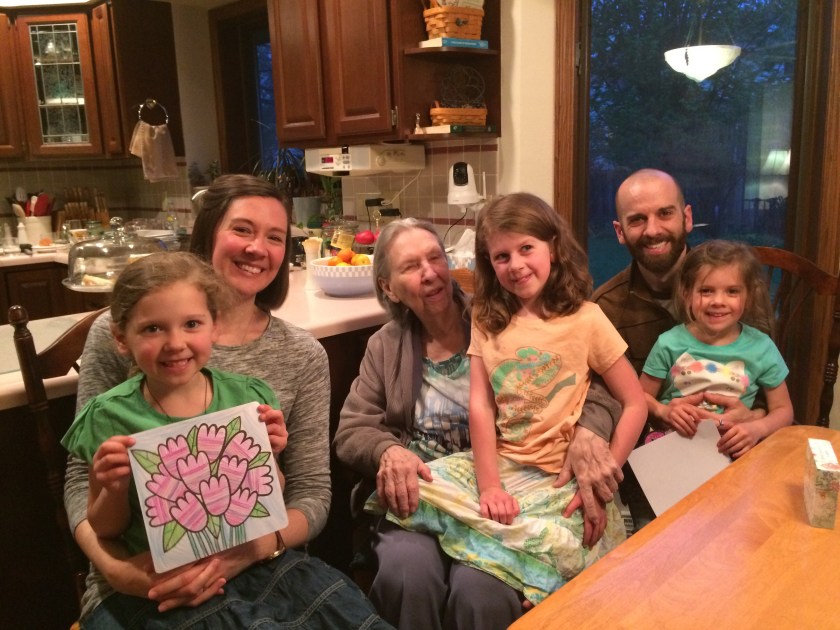
Her church family was fantastic – she loved the visits from her pastors and friends who would stop by. Her eyes would light up when her grandchildren (and especially her great-grandchildren) would come for a visit. One granddaughter would bring dinner and her family every Sunday night. One grandson came every chance he could, bringing his girls with him. All of the visiting grands and great-grands would spend time doing whatever she enjoyed: coloring, sorting colorful buttons, working a puzzle a half-dozen times, and such. My sister Vivian would come every other weekend or so to help me out, sometimes bringing her youngest son. Mom dearly loved her family, even if she didn’t always comprehend that we were her family.
My encouragement to fellow caregivers is to make sure you make room for family and friends as often as you can.
We rarely know when time spent with a loved one is the last time. Last times happen in life when we aren’t looking. Only God knows the measure of our days.
No matter where the winding path of life may lead, I am kept by God.
I’m new this year to the growing club of Americans age 65+ who qualify for Social Security and Medicare. With the help of my husband and a good Medicare Supplement insurance agent, I’m resting easy in knowing my Medicare Supplement plan has been chosen, my account on my government’s Social Security website is set up (and I sort of understand it), and my first Social Security check has deposited into my bank account (boy, am I glad I don’t have to live off of it!).
My wise hubby (financially and otherwise) has been so very helpful during the entire decision-making process. I’m very thankful for Wayne’s guidance in navigating what would have otherwise been a very confusing pathway. I learned something from him yesterday when he informed me that next year my Social Security check will be slightly larger because my Medicare premium will be slightly lower. Sounded like good news to me, but he told me that’s not the whole story. It seems that there have been second thoughts by the Centers for Medicare and Medicaid (CMS) related to providing coverage for Alzheimer’s related pharmaceuticals. I found an article on Forbes which explains this news a bit and am including a link to that article here. You might also find my husband’s blog to be chock-full of wisdom, financial and otherwise.
Mom had Alzheimer’s and my brother has Vascular Dementia
This news is a bit concerning for someone like me who is genetically at a higher risk for developing Alzheimer’s in my lifetime due to close family history. Thankfully, I know that I am always in God’s care. No matter what physical trials I may face in my future, He is the One who helps me and keeps me. Psalm 121 reminds me that I have nothing to fear.
Psalm 121 – My Help Comes from the Lord
A Song of Ascents.
I lift up my eyes to the hills. From where does my help come? 2 My help comes from the Lord, who made heaven and earth.
3 He will not let your foot be moved; he who keeps you will not slumber. 4 Behold, he who keeps Israel will neither slumber nor sleep.
5 The Lord is your keeper; the Lord is your shade on your right hand. 6 The sun shall not strike you by day, nor the moon by night.
7 The Lord will keep you from all evil; he will keep your life. 8 The Lord will keep your going out and your coming in from this time forth and forevermore.
Someone recently asked me how I decided when it was time for my mom to be cared for in a nursing home or assisted living memory care. I’ve written about that decision a time or two, but decided I should write about it again.
Before I share my personal “Top 3” list, I invite you to grab a cup of coffee (or your favorite beverage) and listen to this video by Dr. Natali Edmonds — someone who has been a virtual mentor for me as I’ve learned about being a caregiver.
Dr. Natali Edmonds
“People who place their loved ones in nursing homes are not horrible people. They don’t love their loved ones any less than people who care for their loved ones at home. In fact, sometimes placing a loved one in a nursing home is the best thing for your loved one.”
Dr. Natali Edmonds
Now, here are my Top 3 Reasons
Reason #1: Sleep
Not mom’s sleep. My sleep. I wasn’t getting enough of it and it was beginning to affect everything. Long-term sleep deprivation is brutal. Whether I wanted to admit it or not, it was creating “excessive caregiver stress” and it was showing up in all of the areas of my life that mattered the most to me. It was harming my closest relationships — my time in God’s Word, my marriage, my opportunities to spend quality time with my grandchildren, my friendships. I was a tired and distracted employee and my job performance suffered. I loved teaching Sunday School, but I knew in my heart I wasn’t able to focus on preparation for my ministry and wasn’t as creative in my teaching as I once was. Those in my circle of friends were beginning to comment about how tired I looked.
Reason #2: Personal hygiene needs
Mom’s resistance to help with personal hygiene, to put it politely; bowel incontinence, to be specific. When my mom’s brain could no longer register the “urge to go” with the need to do something about that, life got a lot messier. Literally. Between multiple clothing and bedding changes, multiple loads of laundry, and floor and bathroom cleanup, daily life was getting too hard for one or two people to handle. Mom needed more hands on care and a bathroom that was designed with disabilities in mind.
Reason #3: Safety & Mobility issues
In the later stages of dementia, mom was beginning to forget how to walk. There were days when she needed coaching to put one foot in front of the other. Her legs were growing weak, making her a greater risk for falls. Using a walker helped, but not always. Sometimes she’d forget the walker in another room. Other times, she’d drag it behind her. On a few occasions, she couldn’t figure out what it was, so stuck it outside of her room so it wouldn’t be in the way. My house wasn’t designed for using a walker or a wheelchair. All of the bedrooms and full bathrooms were inaccessible to mom since they were located on the second floor.
We made the best possible use of this half-bath space to accommodate mom’s growing needs, including taking the door off the hinges so we could have more room to maneuver and help her.
The more of a problem “Reason #2” became for us, the more I knew she needed a safer place to live.
I applaud and encourage the many who have made “at home until the end” work. You are amazing caregivers! Please understand, however, that you will still be an amazing caregiver if you make the hard choice to reach out for help in caring for your loved one. You do not cease to be a caregiver by changing the location of where that care is given or who helps you provide that care.
I’d like to leave you with a little slideshow with just a few photos depicting how happy and content my mom was in this abode where opportunities were many, friendships were sweet, and help was always on hand.
“The best place for your loved one with dementia to live and grow old depends upon several things, including: what help they receive, their willingness to receive help, their physical abilities, and the specific dementia symptoms they have. Not everybody with dementia requires the same level of care.”
It makes me a bit sad when I re-read this post and am reminded I wasn’t able to care for mom in our home until the very end of her journey on earth. But, only a tiny bit sad. I know in my heart that moving her to BeeHive Assisted Living and Memory Care in her last year on earth was the right thing to do. BeeHive was so much more than a “place for those waiting to die”. The decision to move her into memory care provided her with so much more meaningful interaction, activities, opportunities to move about, more variety in her meals, and lots of tender loving care. I am beyond grateful for the time spent with her — I know that is something I will never regret. I’m thankful for a husband whose wise investments meant that she would not “run out of money” as she had often worried. It was enough. God is good…all the time.
When you have Alzheimer’s you can’t remember that you don’t need to worry about something. So you do worry. A lot.
Mom worries about such things as whether there is food in the fridge and if she’ll be able to afford the things she needs to live. There is, and she will.
When we have guests, she worries about how they’ll get home in the dark, or where they’ll sleep for the night. She will oftentimes tell our guests that they can sleep in her bed if they need a place to sleep. Sad, but sweet.
Her worries are usually small ones. She worries every night about whether or not she has a toothbrush. She frets about leaves and twigs out in the yard, or the water on the deck after a rain.
Other times, her worries are big. Her biggest worries are about the future. Just today, she came…
Tuesday’s Caregiving Tip: Keep a journal of those special moments with your loved one.
To my fellow caregiving friends who are still in the hustle and bustle of caring for a loved one with dementia, be sure to take time to write down those special moments. I wish I had kept an actual chronological handwritten journal, but am so glad I blogged and took photos…and posted cute stuff on Facebook.
I moved in with mom for a period of about 9 months. It seemed long and tedious in the midst of it, but just a tiny blip on the radar of life in retrospect. I’m glad I posted this fun memory on Facebook and hope it will bring a smile to someone’s face today.














 Barefoot Lily Lady