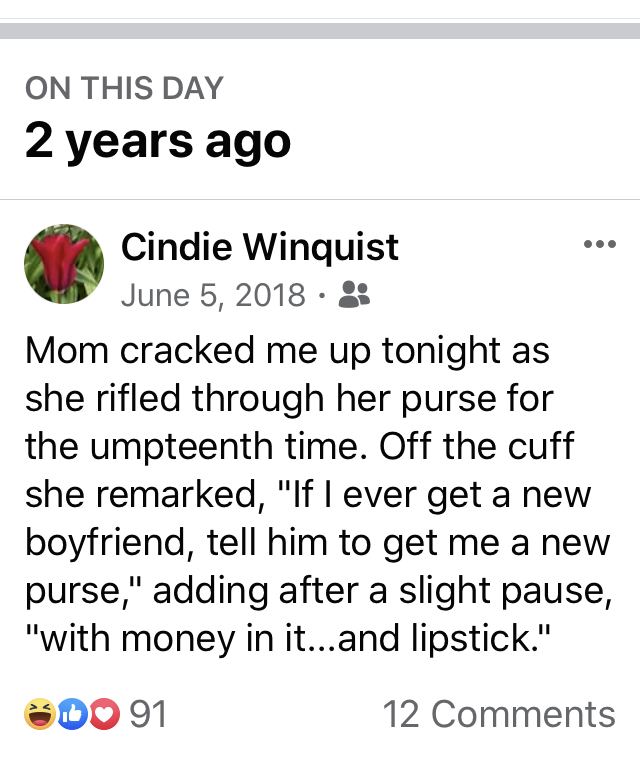
I had to laugh when I stumbled once again upon this screenshot. Oh, my sweet momma could have me in stitches.
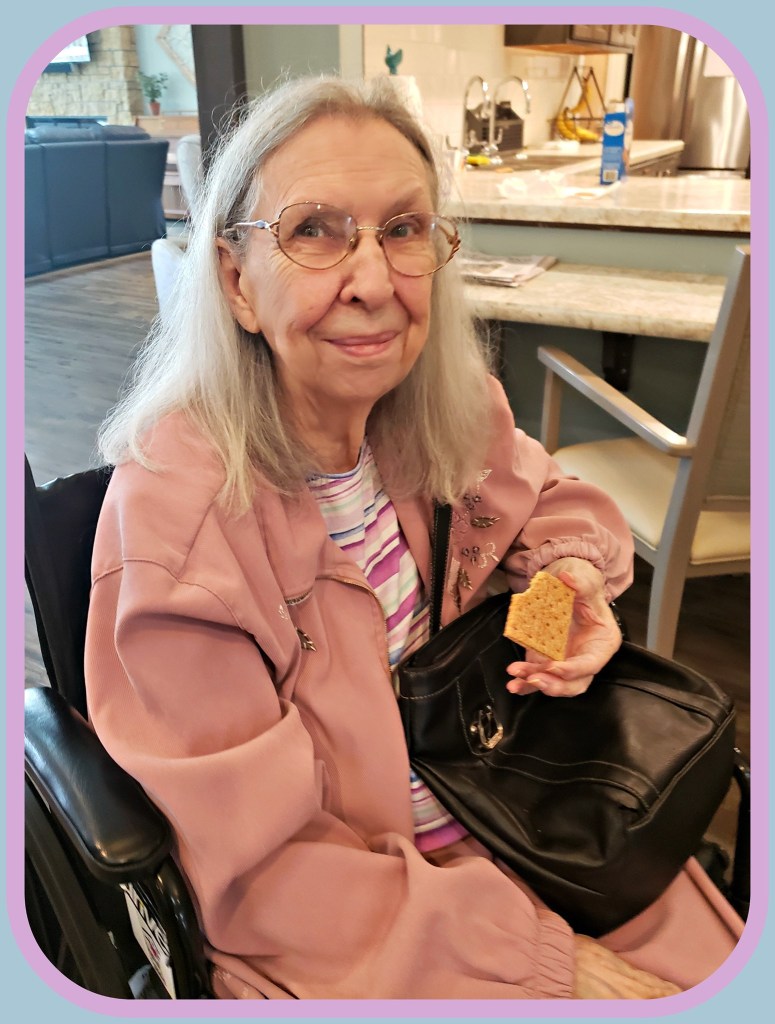
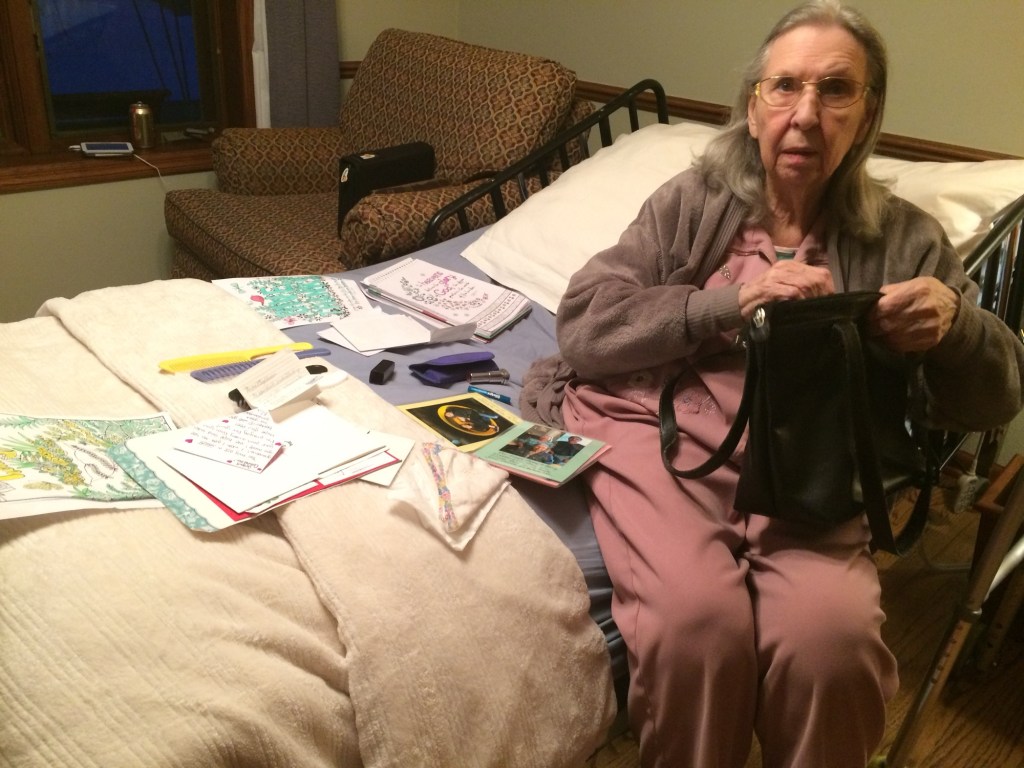
Her purse came with her for snack time at Beehive, oftentimes carrying an extra snack or two given to her by the caregivers. I mean, who could resist giving this pretty lady an extra snack or two?
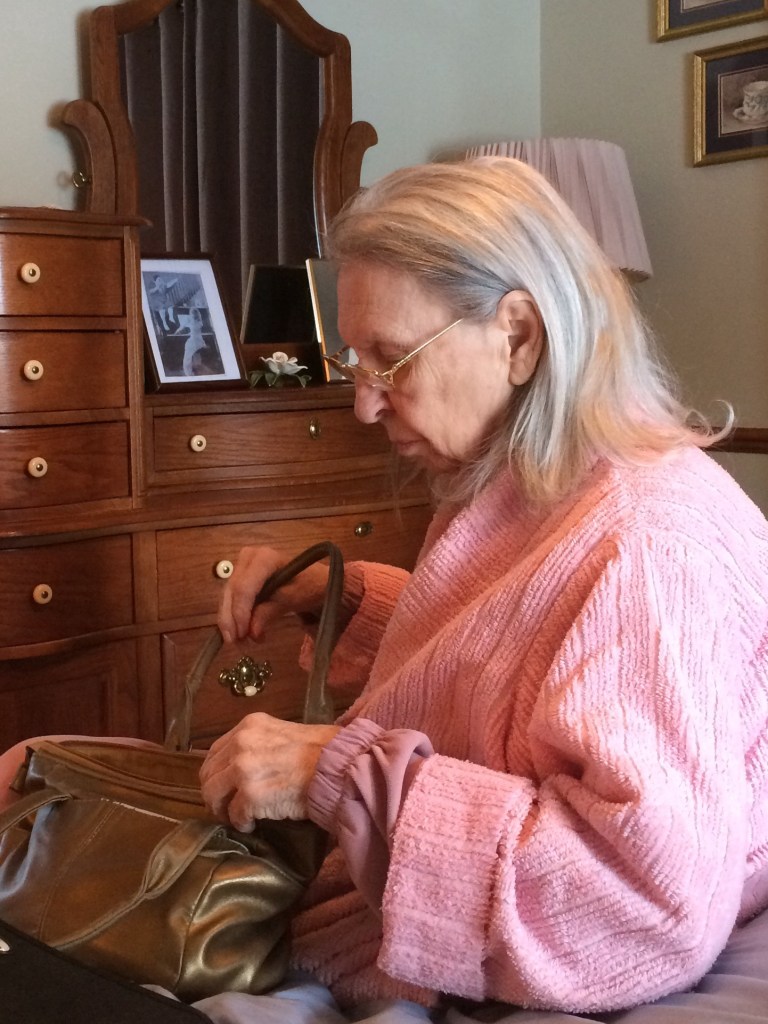
Whether living with me, or living at Beehive Homes of Oregon (WI), momma’s purse was always within reach. Sorting through her purse was a favorite middle of the night activity, so I tried to keep it stocked with all kinds of treasures and little things to sort and discover over and over again.
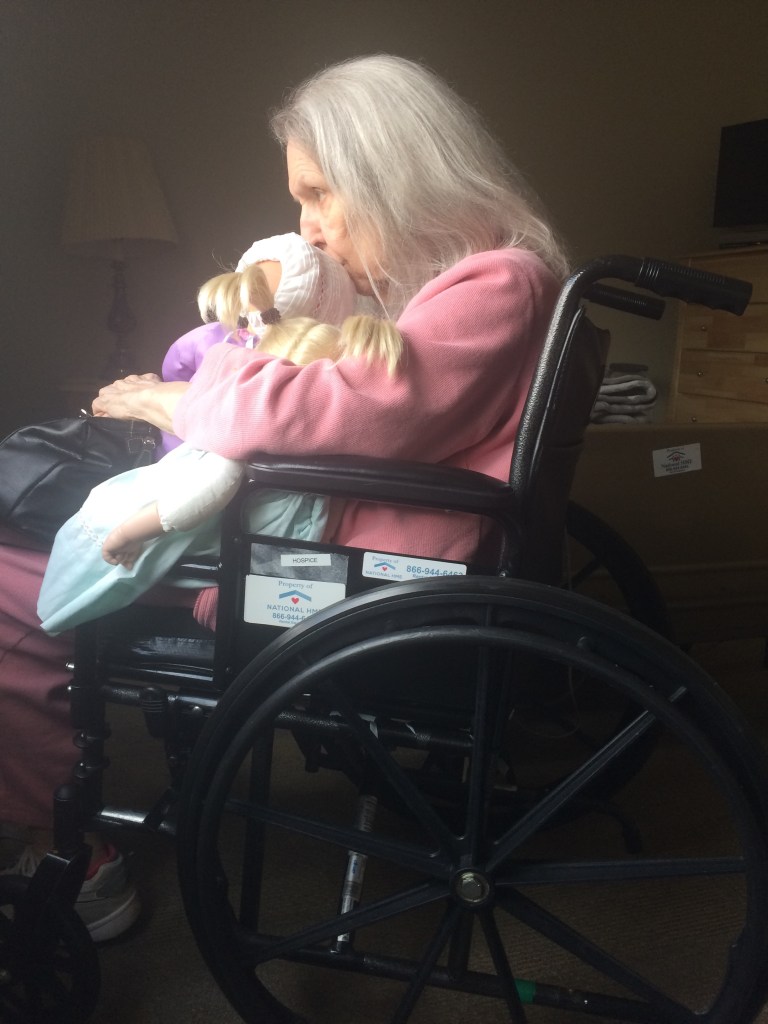
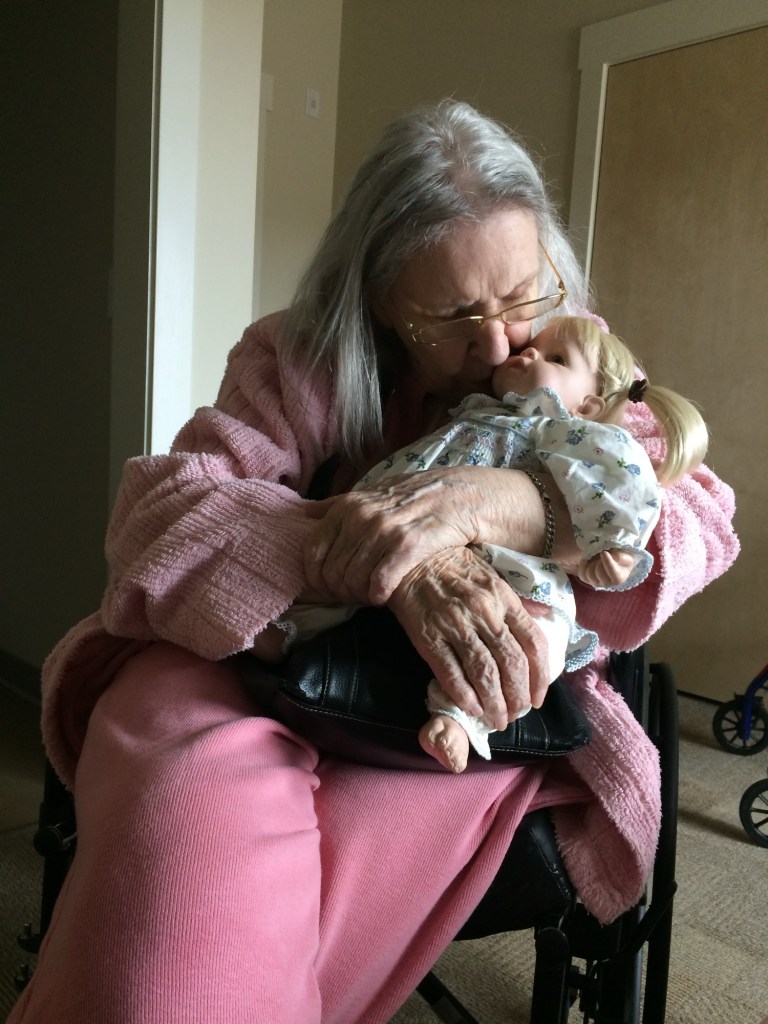
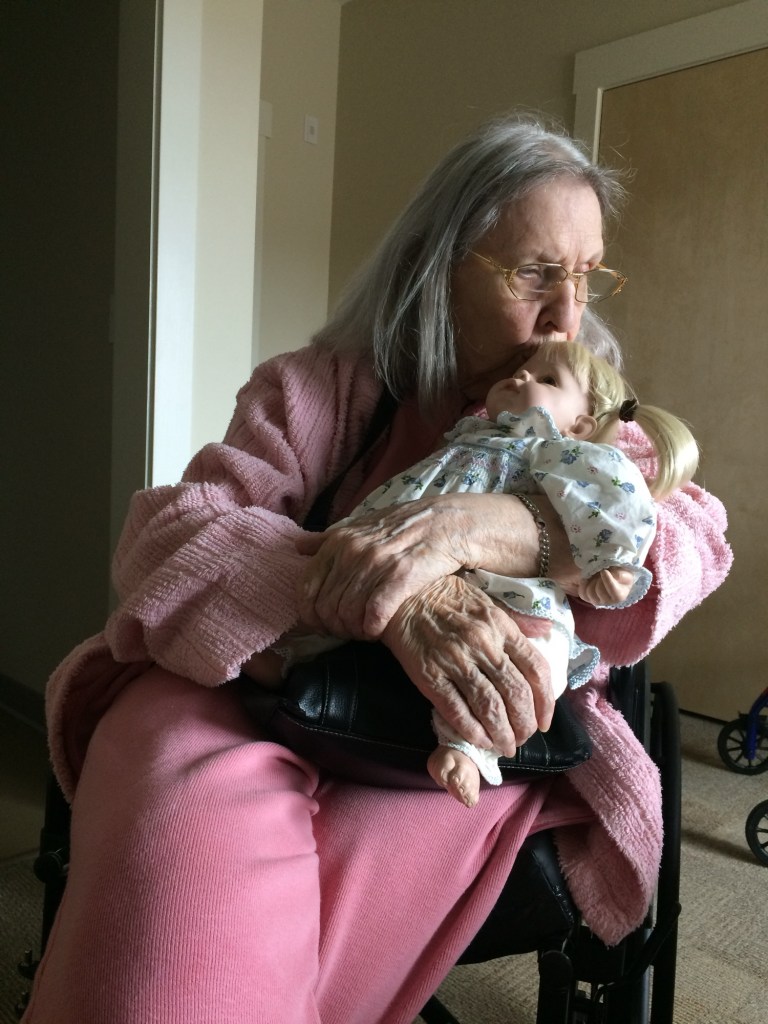
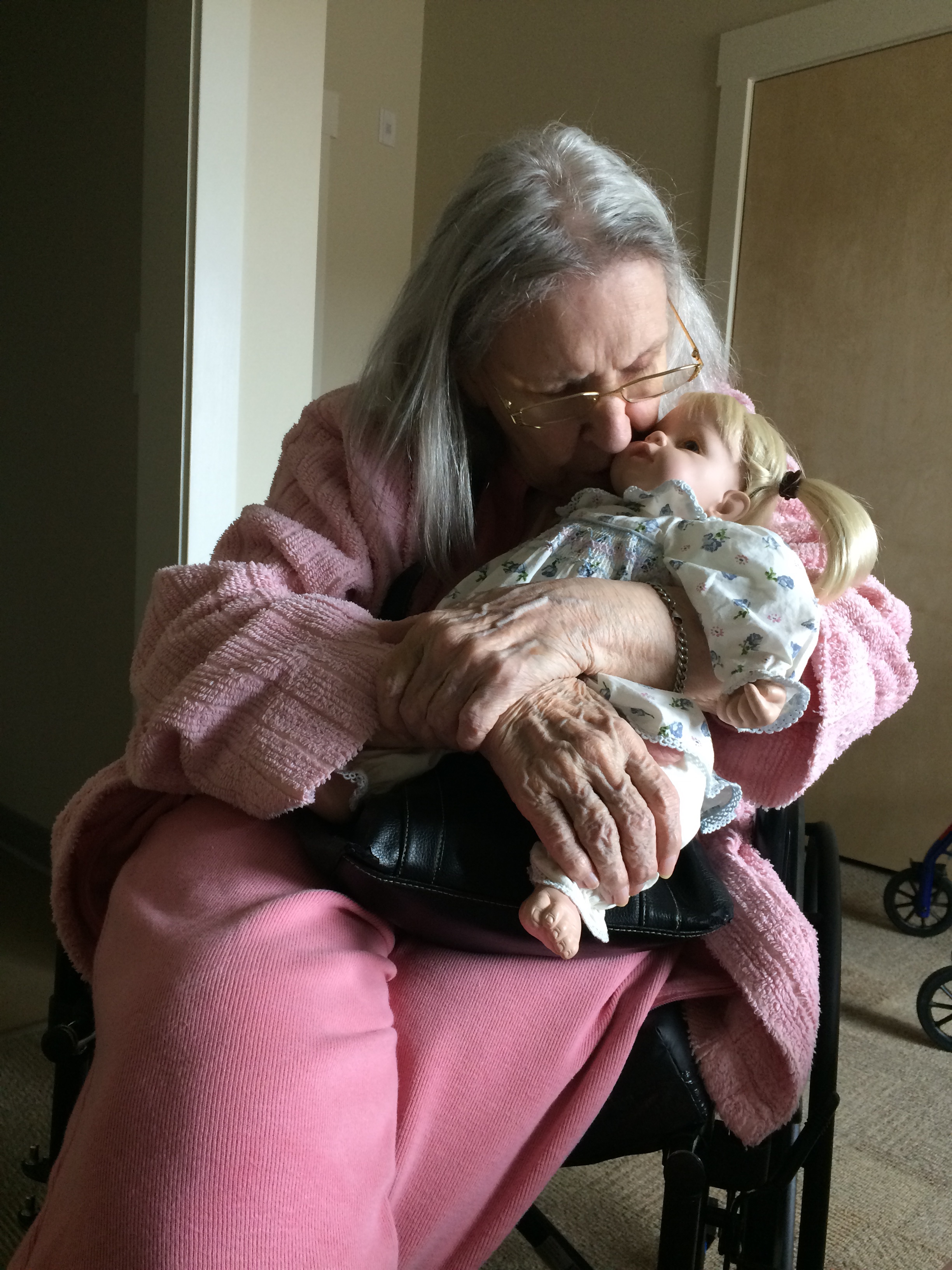
Momma and her babies
Momma always seemed to have her purse along when she was caring for her baby, Dolly. The purse would usually be in her lap with her baby sitting on top. I treasure the sweet memories of my momma loving on Dolly. They gave me little glimpses of the love and gentle kisses I know she once bestowed on me.
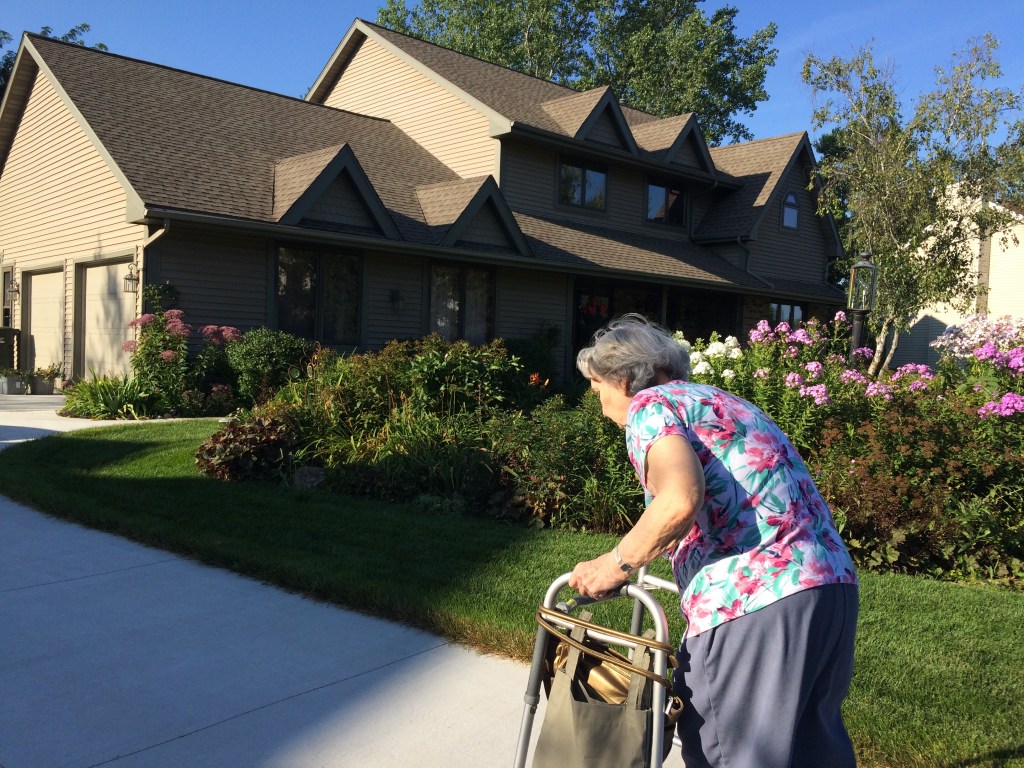
Never leave home without it
A woman never wants to leave the house without her purse, you know. We even rigged her walker so she could take her purse with her on our little walks to the mailbox and back.
An early sign of cognitive decline
Momma’s purse held one of the earliest signs of cognitive decline. I remember a day when I was visiting mom and helping her search for her lost checkbook. Her purse was one of those multiple zippered pocket contraptions that seemed to always swallow her car keys, wallet, hearing aides, and checkbook. As I once again searched the pockets she had already searched, I found both the lost checkbook and a list written in my mom’s familiar cursive hand. The list told a story of something else that was lost–the names of her very best friends at church. My sweet momma had taken her church bulletin and had practiced recalling and writing their names over and over again, willing herself to never forget them again.
Life at Beehive is somehow better when there are fresh baked cookies involved.
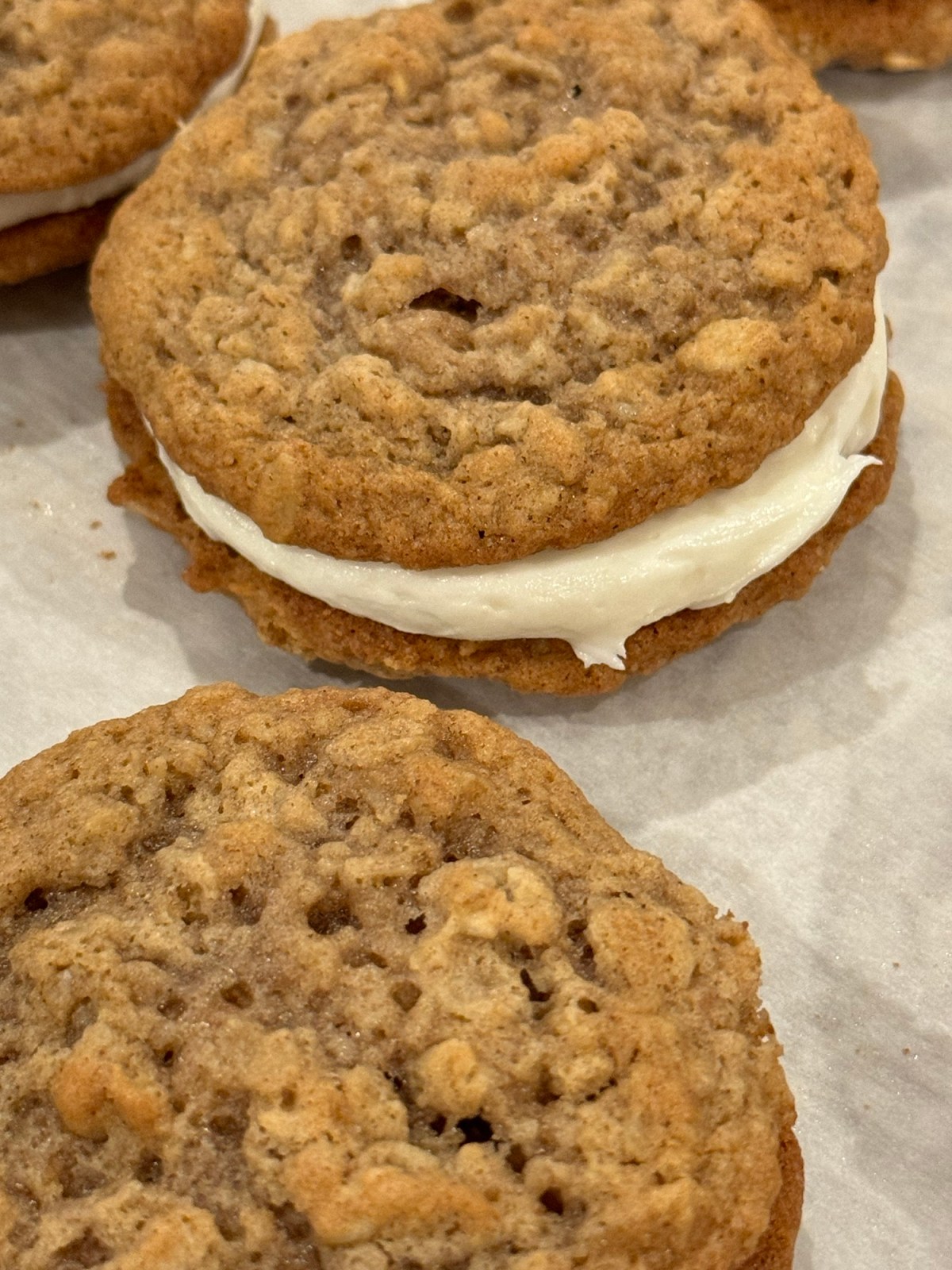
Thursday is ‘Cookie Day’ at BeeHive where I consider it my mission to fill our assisted living memory care home with the amazing aroma of freshly baked cookies. In a world where memories are fading day by day, homemade cookies have a way of sparking memories from the personal baking experiences of yesteryear. My cookie recipe rotation includes classic favorites like chocolate chip, Snickerdoodles, peanut butter, and oatmeal raisin. When it’s oatmeal raisin’s turn on the menu, I sometimes make a special batch of thinner oatmeal cookies without raisins, adding just a hint of molasses.
I use Amanda Rettke’s recipe for “Oatmeal Cream Pies” found on her wonderful I Am Baker website. This cookie dough does require some chill time in the fridge. Rather than chilling the whole bowl of dough, I pre-scoop all of my cookies into uniform balls straight onto a few cookie sheets with only a tiny bit of space between each dough ball. I then slide the cookie sheets into a fridge and let them chill for about 30 minutes to an hour while I clean up my work station.
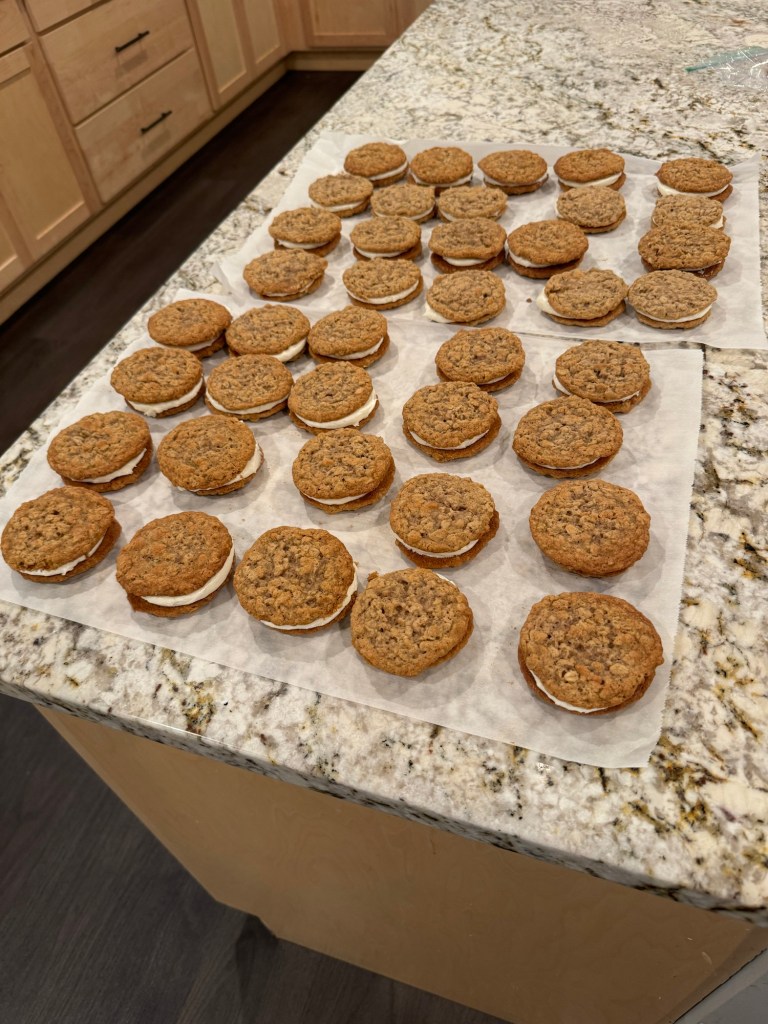
When it’s time to bake, I just place those chilled dough balls on a parchment-lined cookie sheet, spacing them appropriately so they can flatten and spread as they bake. As you can see in the photos, I do not use a cooling rack. After the cookies have cooled a bit on the cookie sheet, I slide the parchment paper straight onto the countertops to let them finish cooling.
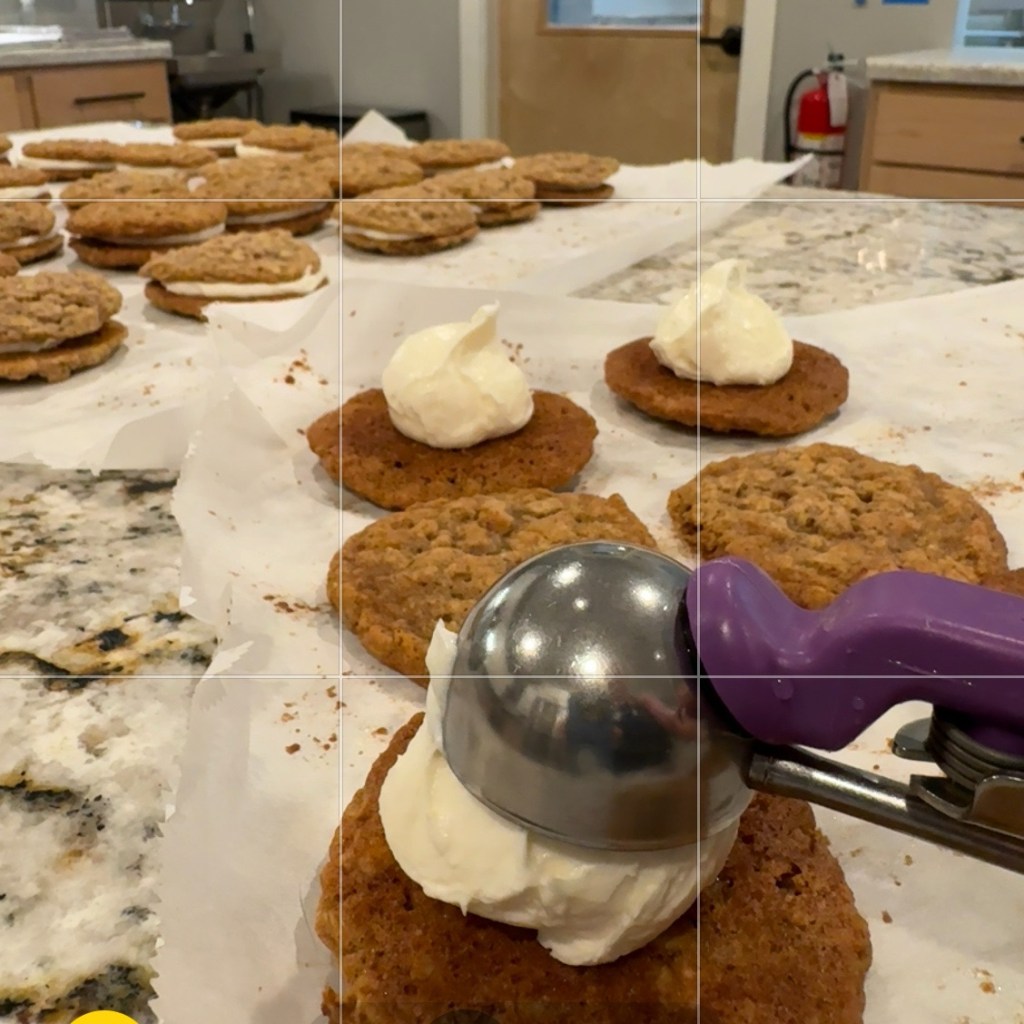
Scooping delicious marshmallow-filled oatmeal cookies reminiscent of classic lunchbox treats.
While dozens of cookies are cooling on every available countertop and flat surface, I then create a marshmallow filling to sandwich between pairs of the cookies. The result is reminiscent of Little Debbie Oatmeal Creme Pies — a popular lunchbox treat straight out of the 1960’s and still available today.
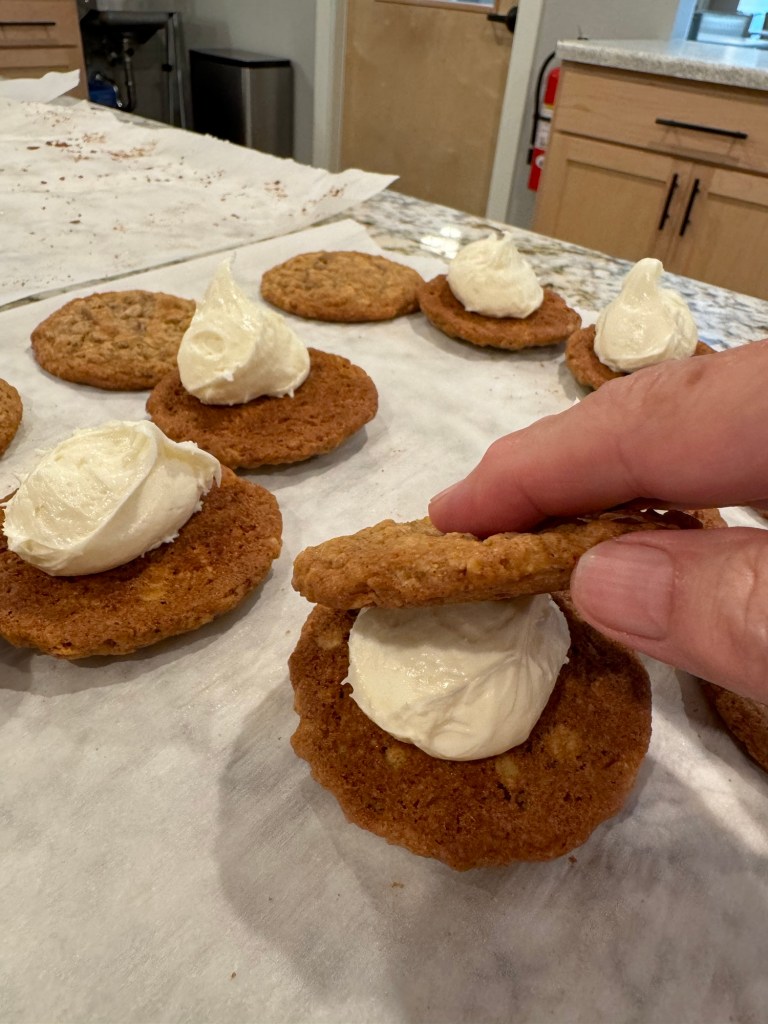
Since I use a cookie scoop, the cookies bake up fairly uniform in size, which makes the next step a little easier. I pair the cookies up and flip one of each pair upside down. Using a slightly smaller scoop, I add a dollop of marshmallow creme filling on one half (flat-side up), then top it with the other half and give it a little squish, stopping once the filling just reaches the edges of the cookie sandwich.
I let the cookies sit on the countertop to set up a bit until just before serving time. By this step in the cookie baking operation I usually have a little audience of residents standing at the window into the kitchen. They truly enjoy watching me bake and eagerly anticipate getting to eat the cookies after their lunch.
A delicious nostalgic treat that just might bring back fond memories.
It is my heart’s desire that the nostalgic aroma and flavor of freshly baked cookies make our residents at Beehive Homes of Oregon feel like they are at home.
May this little missive of mine encourage someone navigating a similar road in life.
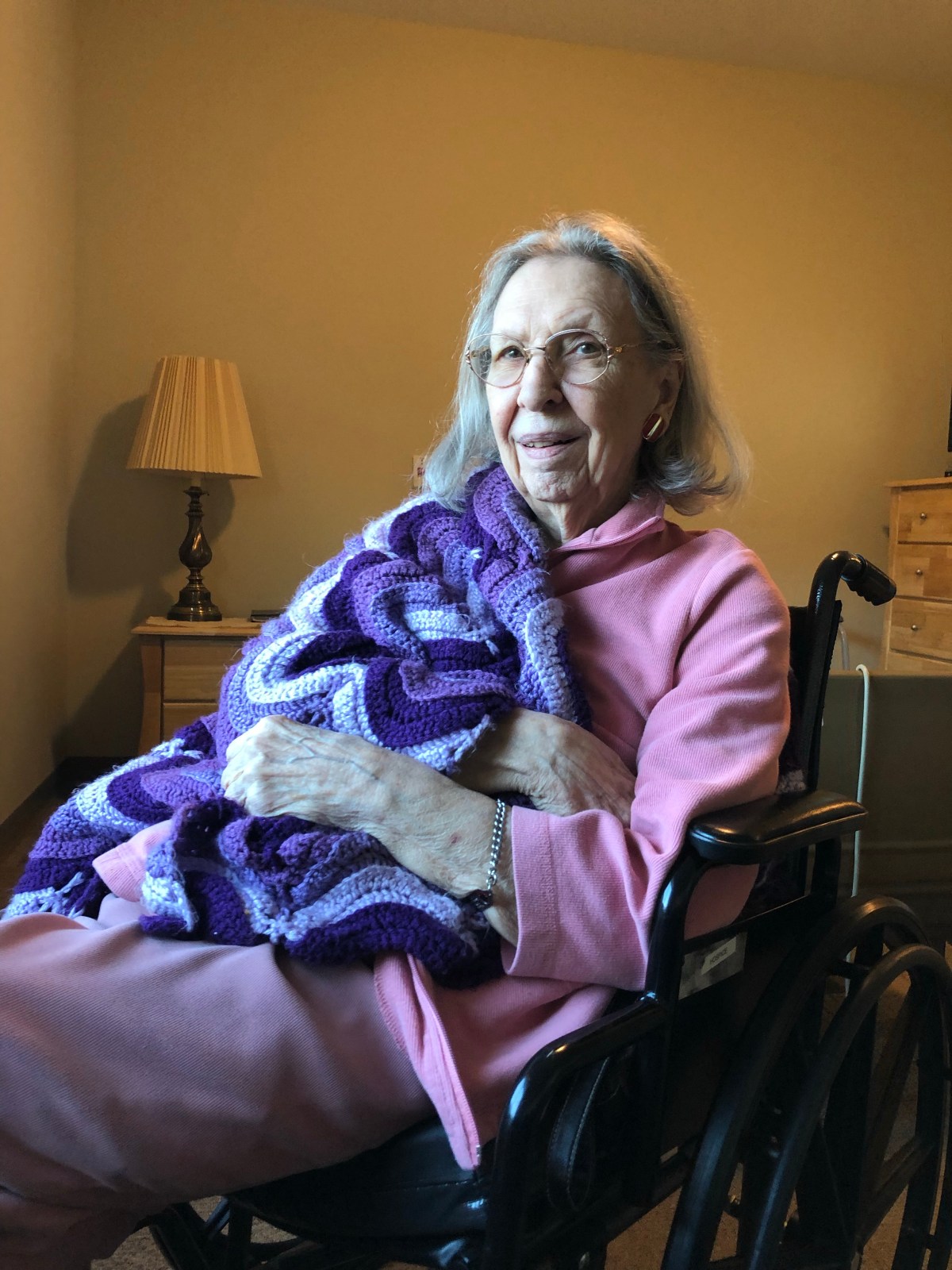
Engaging in conversations with the family members is one of my favorite things to do as I work on preparing desserts in the kitchen of BeeHive Assisted Living and Memory Care. Since both my mom and my brother have lived there, my heart knows what they are experiencing as they partner with Beehive to care for someone that they love. It has now been five years since my sweet momma left behind the shackles of her earthly body and mind and quietly moved into her heavenly home.
I’m sharing the post that follows in honor of my mom–a little reminisce of things mom and I experienced in the early days of her stay at BeeHive. When I wrote the post that follows back in 2019, mom was living in BeeHive’s first building. In the months that followed, she would sit at her bedroom window watching as the second neighboring building was constructed. God has blessed and a third building is now nearing completion. My prayer for BeeHive is that many more families will experience the care that my loved ones and I received. May this little missive of mine encourage someone navigating a similar road in life.
We’re back from our Hawaiian adventure with Mia. What a grand adventure.
Now I am settling back into the comfort of life’s routine. Sleeping in my own bed with my favorite pillow. Spending Sunday with our church family. Doing laundry in my own washing machine and not having to put $7.00 worth of quarters into the machine for each load!
Today I slept in until my body woke me up….and was almost late for work. It brought me joy being in BeeHive’s kitchen baking up treats for our residents again (many thanks to Karen who filled in for me while I was away).
In the midst of my baking joy, my heart remembered that my journey with BeeHive began 5 years ago today. March 25, 2019 was the day I accepted the help of BeeHive in caring for my mother in her journey Home with Alzheimer’s.
Facebook confirmed that memory with two reminisce posts. Many of my friends and family were praying as I moved Momma out of my home and into her new bedroom at BeeHive. We arrived just in time for lunch. While mom and I ate lunch, Wayne and Beth moved mom’s things into her new room, setting it up much like her bedroom in my home. After lunch, I walked mom into her new space and she settled right in and was soon napping.
I sat in her room watching her sleep for a bit, then met with Gina to go over some move-in details. When we were finished, I was not quite sure what to do with myself. I wrote about that here…
Momma would live here for the last 14 months of her sojourn on earth. Here she would be loved and cared for with the level of care I could not provide. She had friends around her, good food, fun activities, someone to help her every hour of the day or night, and someone to help her to shower (something I couldn’t offer her at my house).
Placing her in assisted living memory care was a hard decision. And the right decision.
I have three reasons why I would make this excellent article required reading for anyone even remotely involved in dementia care:
My mother had Alzheimer’s. I wish I would have been able to read this while I was caring for my mother with Alzheimer’s.
My mom lived in assisted living memory care for the last year of her life. She received fantastic care, but this would have been very helpful training for her caregivers.
My brother has vascular dementia and currently lives in a skilled nursing facility (a nursing home). I wish that everyone who works there would read this–it would be so helpful.
If you are a caregiver for a loved one with dementia (or some other form of life-altering illness), there may come a day when you realize you need to consider other options for providing the best care. Perhaps the post that follows will be helpful as you wrestle with that important decision.
I typically bake at BeeHive Assisted Living and Memory Care on Mondays and Thursdays. I don’t like tantalizing people with the aroma of fresh baked goods and then saying, “Sorry, that’s for tomorrow.” So, Monday is my coffee cake day and Thursday is the day for fresh from the oven baked cookies.
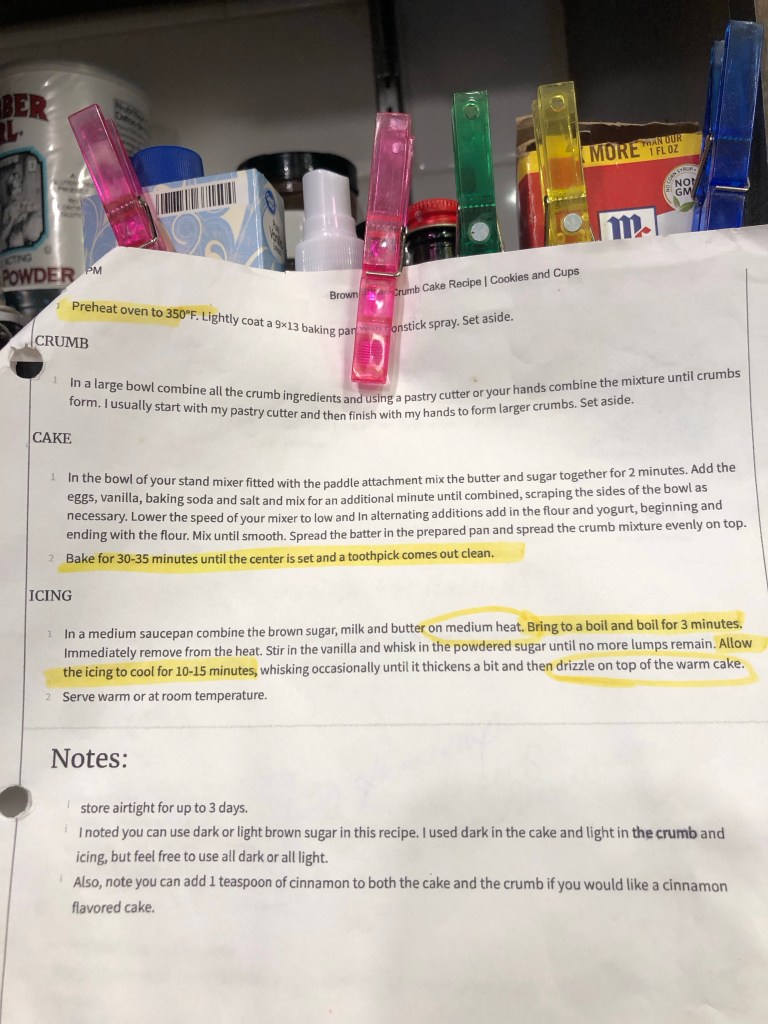
I have developed a general 4-week plan, so many desserts repeat every 4 weeks, rarely repeating a particular dessert during that time. It’s SO fun. Today, I’m going to share the recipe for Brown Sugar Crumb Cake.
My copy of the recipe — my scribbles and all.
I’d like to give a shoutout and huge word of thanks to Shelly Jaronsky. I found Shelly’s recipe via Pinterest on her sweet website Cookies and Cups. I encourage you to check out the other yummy recipes on her site too. If you’d like to print your own copy of this brown sugar amazingness, just click here.
Shelly’s recipe description of this cake says it all:
The ULTIMATE Crumb Cake Recipe!! Brown Sugar Crumb Cake is a brown sugar twist on your usual coffee cake! It’s a rich and soft brown sugar cake topped with a thick layer of brown sugar crumbs AND a brown sugar icing!
Coffee cake batter
I’m baking for 32 people, so make two 9×13″ pans of this recipe. I double the cake batter recipe, substituting sour cream for the Greek yogurt. I generally use light brown sugar; but, if I happen to have dark brown sugar, I use half dark and half light. I’m also very generous with vanilla extract, adding an extra teaspoon. A big scoop helps me distribute the double batch of batter evenly between the two pans.
Brown Sugar Streusel
A double recipe of this brown sugar streusel deliciousness would be amazing, but a single recipe will amply cover both coffee cakes with crumbs. For the best crumb, make sure your butter is cold. I use a bench scraper to slice each stick lengthwise, then cut into small cubes. A pastry cutter works beautifully in the task of cutting the butter into the sugar/flour mixture. It’s ready when you can lightly squeeze a handful of the crumbs and they hold together.
Bake these at 350 for 25-30 minutes, or until it tests done. It might need a few extra minutes, but be careful you don’t overbake it. While it’s baking, make up a batch of the Caramel Topping.
Caramel Topping
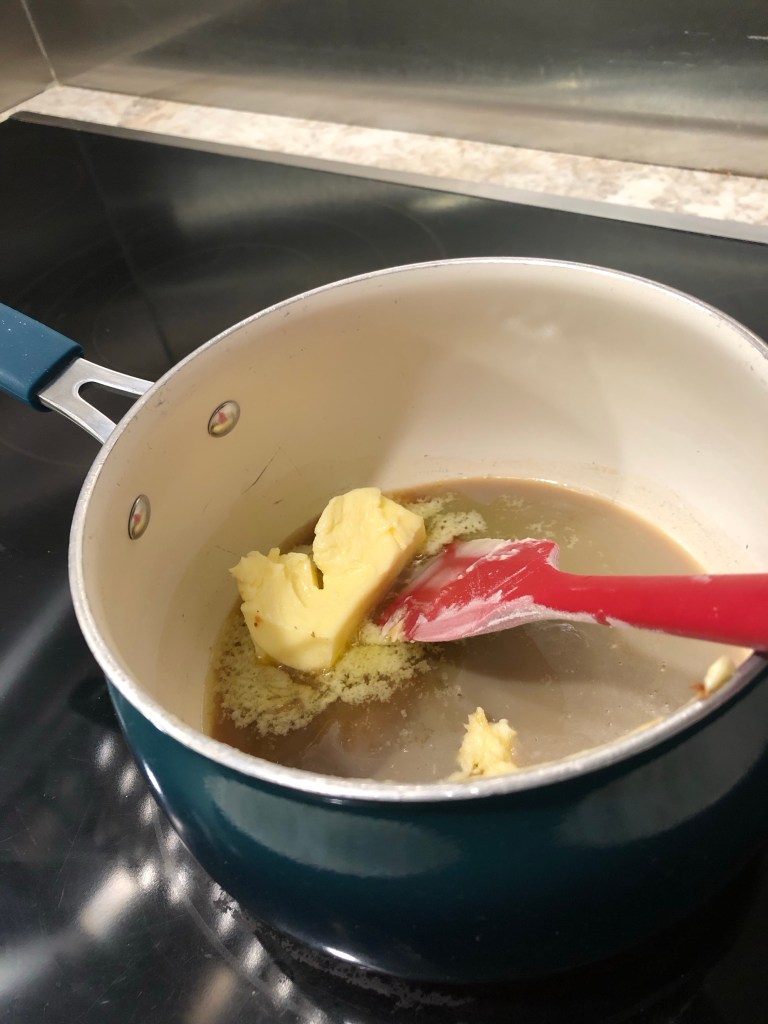
You can go ahead and make a double batch, but as with the streusel, I find that a single batch of the caramel topping is enough to generously drizzle over both cakes while they are still warm.
It’s always a good sign when it gets real quiet in our dining room when dessert is served. That means the dessert is being enjoyed. There are smiles all around and a few thumbs up from happy diners.
I am blessed to be a part-time baker at BeeHive Assisted Living and Memory Care in Oregon, Wisconsin. It’s my joy to see my desserts put a smile on the faces of our residents. I thought it would be fun to share a few recipes with my readers. Enjoy!
Recipes which begin with a graham cracker or cookie crust are some of my personal favorites to create. Banana Split Torte is actually a no-bake recipe, so perfect for summers–but I make it once a month all year-round because it’s a BeeHive favorite. Since many of our residents are experiencing short-term memory loss in its various forms, I like to choose vintage recipes they might remember from their younger days. This one fits the bill. Most of the ladies remember taking this classic to potlucks and family gatherings.
There are three days each week where refrigerator space is available (the days just before grocery shopping day), so those are the days I choose to prepare dessert recipes which require refrigeration. It can be prepared one day in advance. Making it too far ahead will mean the bananas will begin to brown–still tasty, but not as appealing to the eye.
The pineapple can be sweetened or unsweetened, according to your preference, but make sure it is well-drained. Don’t just dump it in a colander and call it done. Press the juices out. I also like to count out the number of cherries I need for garnish and drain the juice off of them too by setting them on a paper towel so that the juices can bleed off. It makes for a prettier presentation later.
I’ve included the recipe I use as a guide. I make two 9×13 pans and cut each dessert into 16-18 servings. You can most certainly divide this recipe in half for a single 9×13 dessert.
Recipes are a guide. Use your common sense, personal experience and tastes to tweak the recipe, as you’ll see in this photo of my recipe page (above).
The Graham Cracker Crust
Kudos to you if you can make a decent graham cracker crust out of 1/3 cup margarine and 3 cups of graham crackers crumbs like this recipe states. I personally want a dessert crust that’s not going to fall apart when cut. If that’s your goal too, use 2 sticks of melted butter, 3 cups of graham cracker crumbs and 1/2 cup of granulated sugar. Toss the mixture well. Split the buttery crumbs evenly between the two pans. To get a firmly pressed and smooth crust, I use a wide spatula to press the crumbs into place, then pop them into the fridge to firm up a bit while I prepare the filling. [Note: you can substitute crushed Nilla Wafers for the graham crackers–just omit the 1/2 cup of sugar.]
Cream Cheese Filling
Here’s my tweak on the filling. I cream 3 packages (8 oz each) of softened cream cheese with 1 stick of softened butter. Then I add at least 2 teaspoons of vanilla…probably more like 1 tablespoon (because I’m really into vanilla). Next, I dump about 3 1/2 cups of powdered sugar (confectioner’s sugar) into the bowl with the creamed butter and cheese. Turn the mixer on very low to stir in the powdered sugar then turn that mixer up to medium-high and let it do its thing for about 5 minutes, scraping that bowl a few times to make sure all of the ingredients reach the super-fluffy and wonderful stage. Yep, it’s kinda like a thick layer of frosting. Yes, you can leave the butter out, but be forewarned. If you do something as crazy as that to save calories, you’ll sacrifice a lot of amazingness and will probably need to add the milk I crossed off the recipe to get it to a good spreading consistency.
For maximum fluff, beat at medium-high speed at least 5 minutes
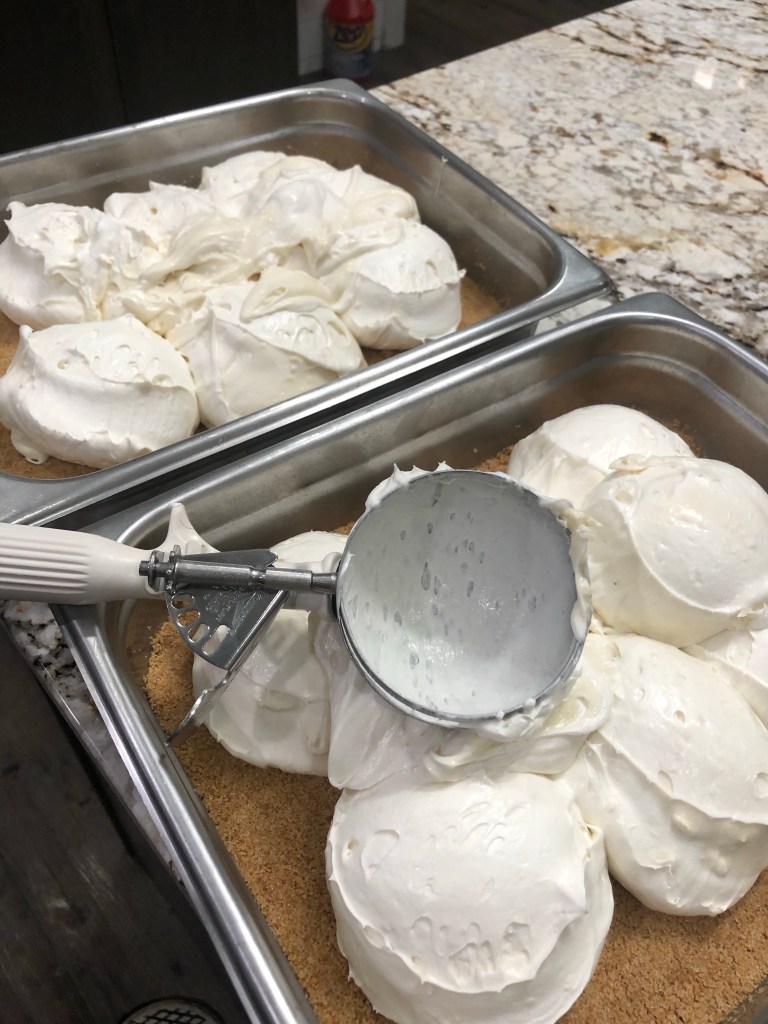
Once you have a bowlful of silky cream cheese fluff, remove those crusts from the fridge. I then use a cookie or ice-cream scoop to evenly distribute globs of that cream cheese fluff around in the pans, then smooth it around with a small silicone or offset spatula.
A different dessert, but this is the technique I use for distributing the filling.
Banana Split Topping Layer
Now’s the time to slice those bananas into little coins and sprinkle a tablespoon or two of lemon juice over them. Toss the bananas around a bit in the lemon juice (this helps prevent browning). Using 3 bananas per pan (4 if the bananas are small), I lay the banana coins all over the top of that yummy cream cheese filling. [As you can see in my scribbles on the recipe, I sometimes make a “patriotic” version of this dessert, substituting fresh blueberries and strawberries for the bananas. Equally delicious.] Once you’ve got those bananas distributed evenly, cover the top with crushed pineapple.
Don’t cheat the people who like the edge pieces–get that fruity goodness to the edge of the pan!
The last layer
The last layer is your whipped topping. At work, I use Cool Whip or something of that nature. This dessert is extra-delicious if you top it with sweetened whipped heavy cream. If you go the homemade route, be sure to stabilize the whip cream if the dessert will not be served the same day.
The last thing I do is drag the tip of a knife through the whipped topping to create a grid for the cherries. Not everyone has mastered the skill of cutting 9×13 desserts into equal pieces, so I like to give the kitchen staff a little visual guide. The grid also helps me in placement of the well-drained maraschino cherries. Cover this dessert and tuck that amazingness back into your fridge again to chill for a few hours if you’re serving same day, or overnight for something to look forward to tomorrow.
The grid varies depending upon how many servings I need
At serving time, follow the grid marks and cut your pretty dessert into servings. I guarantee, there will be no leftovers. That is, unless you’re making it for yourself. If that’s the case, you might want to save a piece or two for tomorrow.
Written with love and great admiration for all those who are caring for a loved one who is facing Alzheimer’s or any other diagnosis that spells memory loss. I write from my experience of caring for my sweet mother in her later years with Alzheimer’s.
Here’s the next in a series of posts inspired by A-Z Caregiving Tips (pictured below). A diagnosis of cognitive impairment or memory loss presents caregiving challenges, each as varied as the person experiencing it. Alzheimer’s was the diagnosis that spelled memory loss for my sweet mom. You can read my previous posts for my tips on A – L. It seems I have a lot to say about “M,” so I will focus on that for this week.
Make new ways I can be of service to others
Mom was a nurse. A dedicated and amazing nurse. Even after she retired from her long career in nursing, she still practiced nursing in an unofficial way as she came alongside family and friends as they went through their physical trials in life. She was dad’s constant companion whenever he faced any of his cancers and surgeries. She served her friends as the requisite driver and responsible party when those friends faced day surgeries of various types. If someone was hospitalized, she was almost always one of the first visitors. Several of her friends had her come along to their surgeon’s or oncologist’s office when they were going to receive their scary diagnosis. Mom knew just the right questions to ask and how to help her friends through the difficult days ahead.
The time came when Mom was the patient with symptoms of short-term memory loss. I’m sure she knew something was amiss long before I started noticing memory blips. Who knows how many years she wrestled with that knowledge alone? Based upon dated notes and lists I found here and there, I would say for a few years.
Although Mom forgot many things, the experiences of her lifetime still served as a guide in her daily interactions. Even after mom moved in with me and then later into assisted living memory care, I routinely saw the nurse in mom present when she’d notice someone wasn’t feeling well and then do her best to make sure they were cared for appropriately.
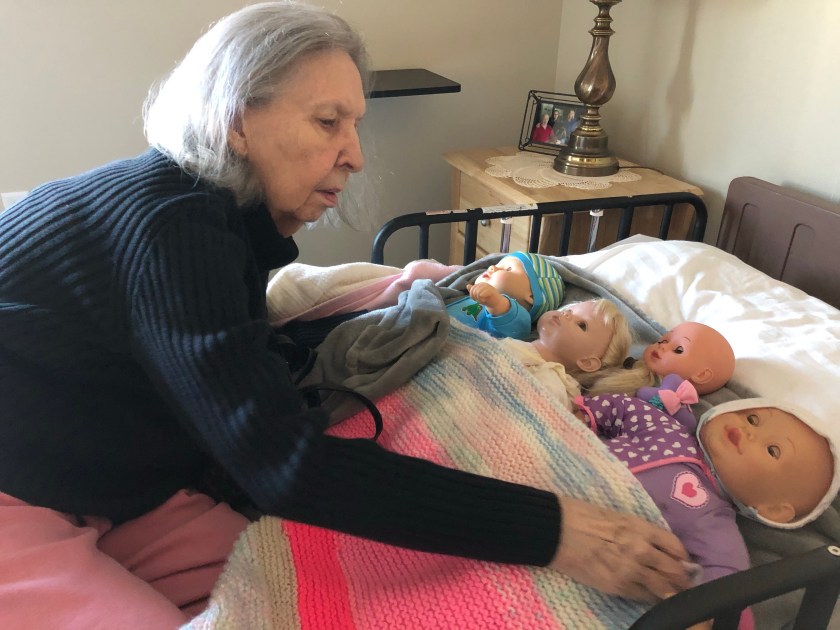
Momma lovingly putting her “babies” to bed
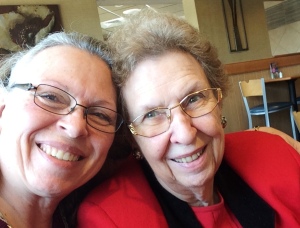
She usually couldn’t remember she was my mom, but I saw the loving mother in her displayed in the way she cared for dolls. It was like a special window into her past which allowed me the privilege of seeing what she may have been like when she mothered me as a baby. (Mom and me in this photo.)
Let me share just a few photos of her doing things which made her feel useful during her years spent living with dementia.
I’m thinking now of a resident at the assisted living memory care home where my mom lived for her last 14 months of life. June was usually the first one up every morning. She took very seriously her job of raising the window shades at the start of the day. The staff would then present her with a large basket filled with freshly laundered clothing protectors (bibs) and towels. June took great pride in folding them.
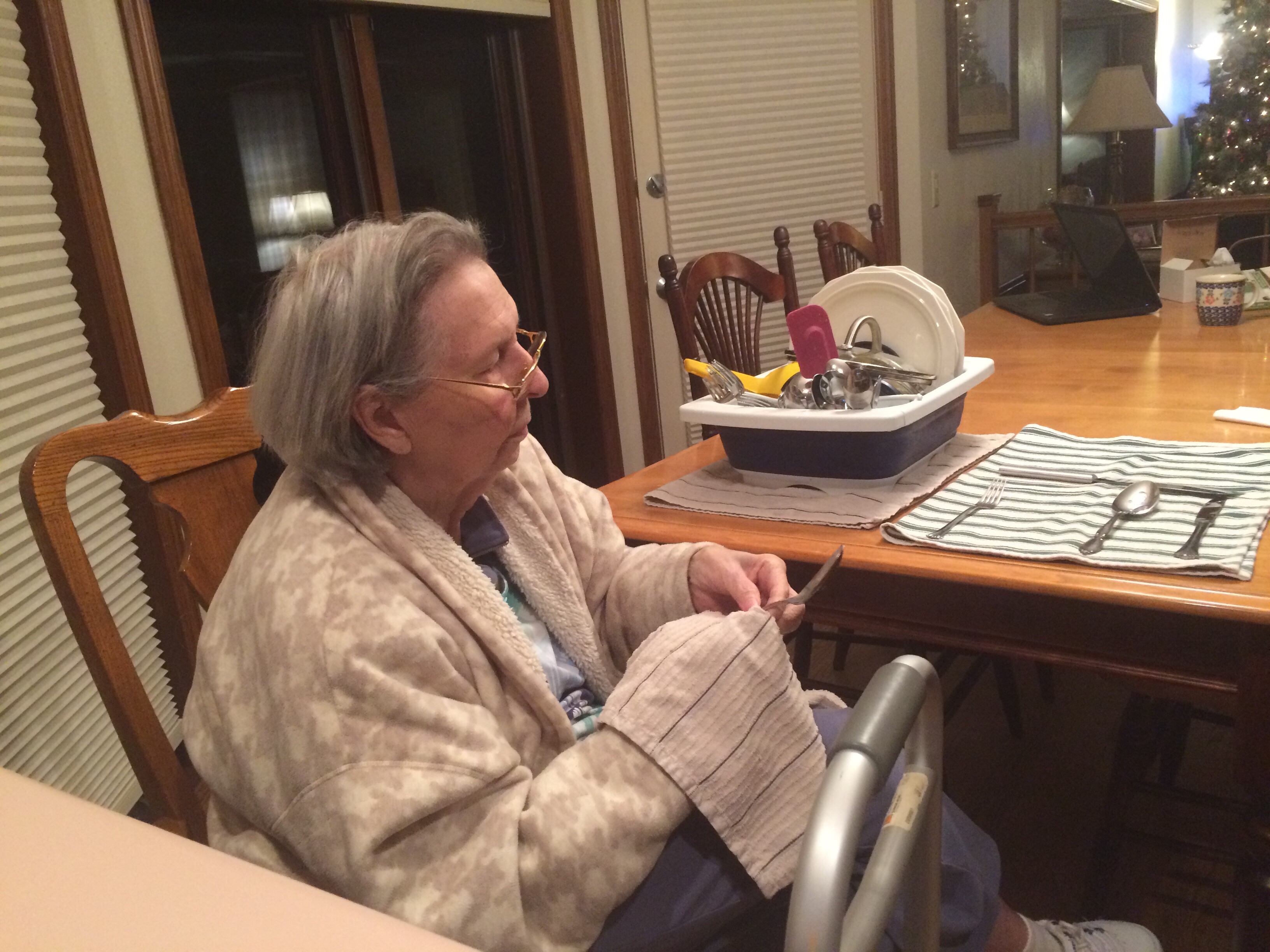
My mom would do the same thing when she was living with us for a few years. She loved to fold laundry, especially when it was warm out of the dryer. The warmth felt good on her arthritic hands. She would also dry dishes for us. Her legs were unsteady, so I would set her up with everything she needed at her place at the kitchen table. Mom had also been into gardening, so I would occasionally try to get her outdoors to help me. She especially enjoyed deadheading and cutting back spent foliage. Her specialty, however, was sweeping. She couldn’t stand to see even one leaf on the deck or porch, so we’d arm her with a broom and she’d happily sweep for quite some time.
I can’t talk about this subject without thinking of Heather, an amazing blogger I follow who cared for her sweet mother too. Heather’s mum, Margaret, had been an artist, so Heather would play to her mum’s interests and strengths by creating art therapy projects for her to work on throughout the day. They even opened an Etsy shop in order to sell some of her ‘Made by Mum’ projects, donating a portion of their profit to the Alzheimer’s Society. Heather’s amazing website Creative Carer is filled with photos and tutorials, a link to her very helpful and inspiring blog, and oodles of practical ideas for caregivers who desire to keep their loved one meaningfully engaged.
I write from my experience of caring for my sweet mother in her later years with Alzheimer’s. I hope that what I write will be an encouragement to those who are caring for someone they love.
Before you read this post, you might want read the A-Z Caregiving Tips (pictured below) which inspired me to write about my own experience related to these tips.
A diagnosis of cognitive impairment or memory loss presents caregiving challenges, each as varied as the person experiencing it. Alzheimer’s was the diagnosis that spelled memory loss for my sweet mom. I have already presented my experience with tips A – I, so let’s move right on to my take on J, K & L.
J just redirect me pleasantly if I keep repeating myself.
When memory loss becomes apparent to family and friends, it’s the repetition of stories which oftentimes raises the warning flag that something is amiss. Mom had several stories that would frequently replay. There was one she would tell about why she loves ice cream. Other repetitious stories related to how she acquired some of the items she owned, including three blue flowerpots and a purple tablecloth. I loved each of the stories and, as I mentioned in my last post, now I wish I had recorded her telling them.
Now, there’s nothing wrong with telling family stories around the dinner table. We all do it. It’s one of the best parts of gathering around the table for a shared meal. But, when the same story keeps looping during the same meal, that’s when things get a little tricky. It’s easy to hurt our loved ones by saying, “You already told me that a hundred times, Mom!” We’re tempted to roll our eyes and inwardly groan, “Oh no! Here we go again.”
That is where the art of pleasant redirection comes into play. In the world of dementia caregiving, there are many opportunities to practice this act of gently helping a forgetful loved one refocus their attention on something else.
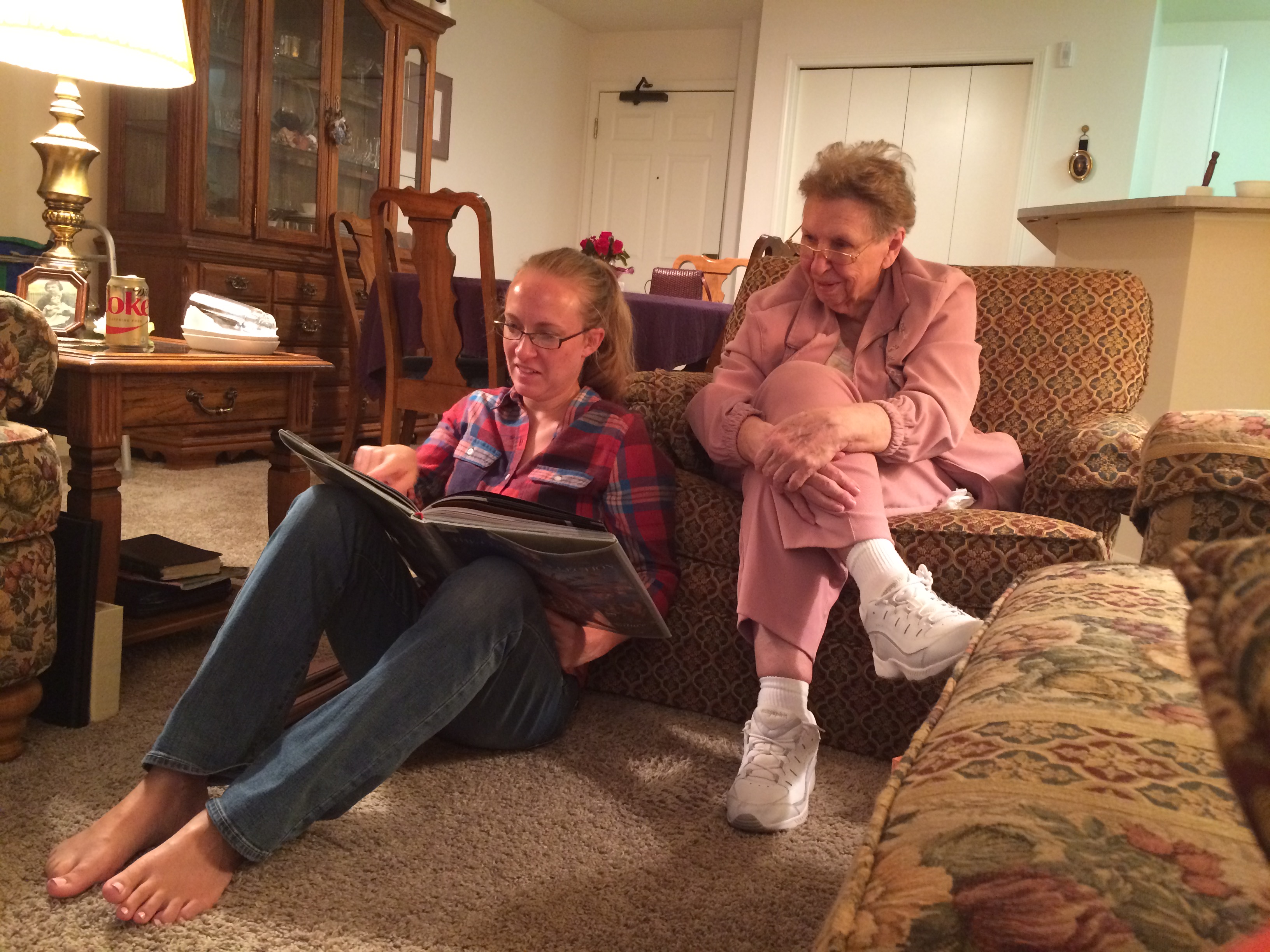
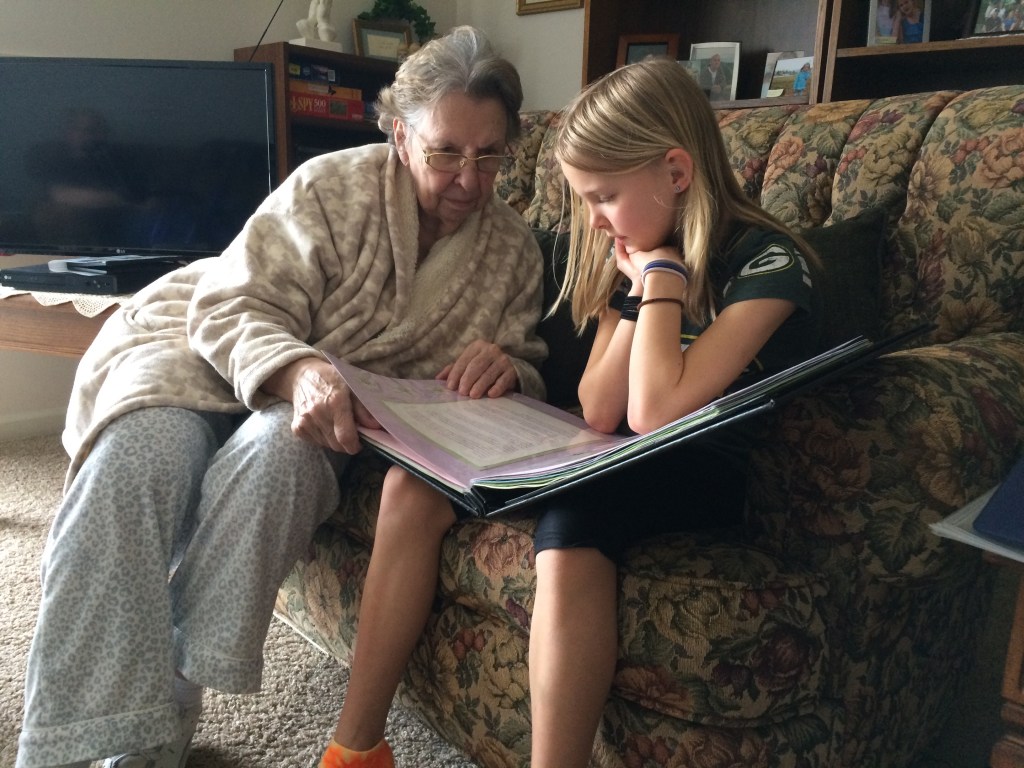
My granddaughter provided one of the best examples of gentle redirection that I have ever seen. My mom found my to-do list on the kitchen table. Thinking it was her own list, mom kept reading the list over and over again, worrying about getting it all done. Violet (who was probably 12 years old at the time) brought a photo album to the table and sat next to her great-grandmother. In one stealth move, Violet opened the photo album and placed it in front of her GGma as she simultaneously slid the list away from view. Then she started paging through the album and talking about the photos. My Mom’s worries melted away and she was immediately engaged in this new direction of thought.
In fact, photo albums and picture books are one of the greatest tools in the toolbox of dementia redirection.
Sometimes, mom would ask the same question repeatedly. One such question had to do with her finances–something she couldn’t handle on her own anymore, but continued to worry about. My husband handled her finances for her and greatly helped alleviate this worry by creating a single page monthly statement which listed all of her financial bottom-line numbers in one place. Mom could read this over and over to her heart’s content. [I explained more about this in Alzheimer’s and Money Worries, which may be of help to anyone going through this stage with a loved one.] If mom was having a fretful moment about money, we could hand her this statement, which we kept on a clipboard. She would sit and read (and re-read) it for a very long while and would often comment about how helpful it was to her.
K Know that closing my eyes may be me trying to find my words.
Word finding is one of the earlier struggles I noticed in my mom’s journey with Alzheimer’s. It’s a problem I am wrestling with these days too. I have noticed that when I am struggling to figure out which word I want to use during a conversation, my family and friends will often provide the word for me during my long pause. Most of the time I appreciate the help; other times it just deepens my awareness and the inkling I have that my later years of life are headed in the same direction of memory loss that my mom experienced.
In fact, photo albums and picture books are one of the greatest tools in the toolbox of dementia redirection.
I don’t remember mom closing her eyes when she was trying to think of what she was going to say–at least not in the earlier stages. I remember that she would avert her eyes upwards and away, as if she was searching the corners of her mind for what she wanted to say. I do this too. I have also noticed something in my own pause to search for the words. By the time I’m ready to add my words to table talk conversation, the direction of the conversation has moved on to something else. It’s frustrating, but it reminds me of something important when engaging in conversation with my memory-challenged friends at my workplace. Don’t be in such a rush–wait for them to answer.
L Listen with me to music and dance tunes.
Mom would rather sit quietly and read a book or magazine than dance or listen to music. It’s not that mom didn’t like music; rather, her hearing deficit made listening to music more than a little bit challenging. While this point doesn’t apply much to my mom, it does bring to mind my work place. I work as a baker in an assisted living memory care home and am sometimes surprised by the music being played in the background for our residents. Sometimes I think the music chosen reflects the preference of the caregiver on duty, rather than the tastes of the generation being served.
The other thing I’ve noticed is that the radio or television in our care home is oftentimes playing too softly. The younger folks who work as the caregivers don’t seem to take into account the need for extra volume in this older population. Nor do we pay enough attention to what is being broadcast on the television in our common spaces. It’s much better, for instance, to choose a classic movie from the era in which these folks lived, rather than a talk show featuring four women arguing their views. Better (in my opinion) to choose a nature show over a scary, blood and guts movie.
Don’t get me wrong–our care home is fantastic and is blessed with a number of great caregivers. But, there is one caregiver who I find to be absolutely delightful. She will put on music the residents love and engage in a little song and dance. She’ll even make up her own tune or sing a familiar jingle, even if she’s just passing through the room on her way to her next task. If they’re having an exercise class, she’ll join in and spread her own brand of love, laughter, song and encouragement. Marnie makes the residents smile (and me too).
The world of memory care caregivers needs more Marnies.




















 Barefoot Lily Lady