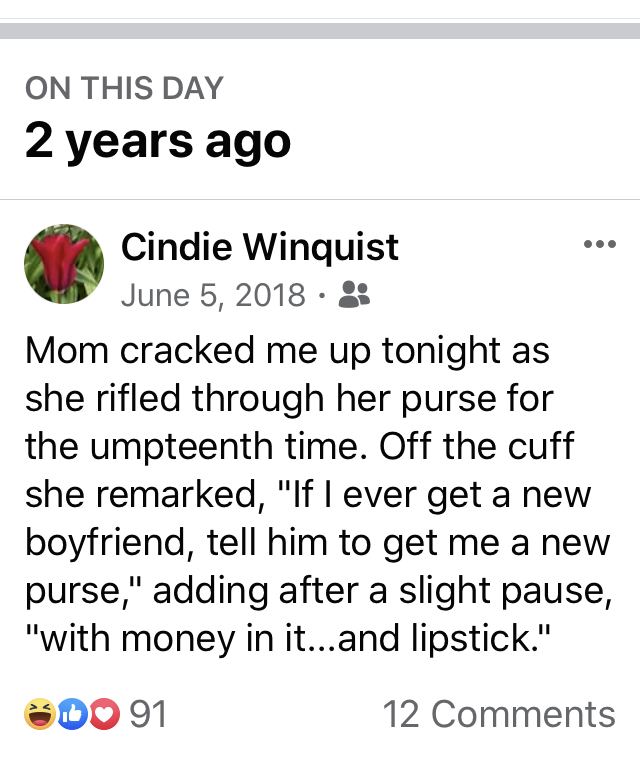
I had to laugh when I stumbled once again upon this screenshot. Oh, my sweet momma could have me in stitches.
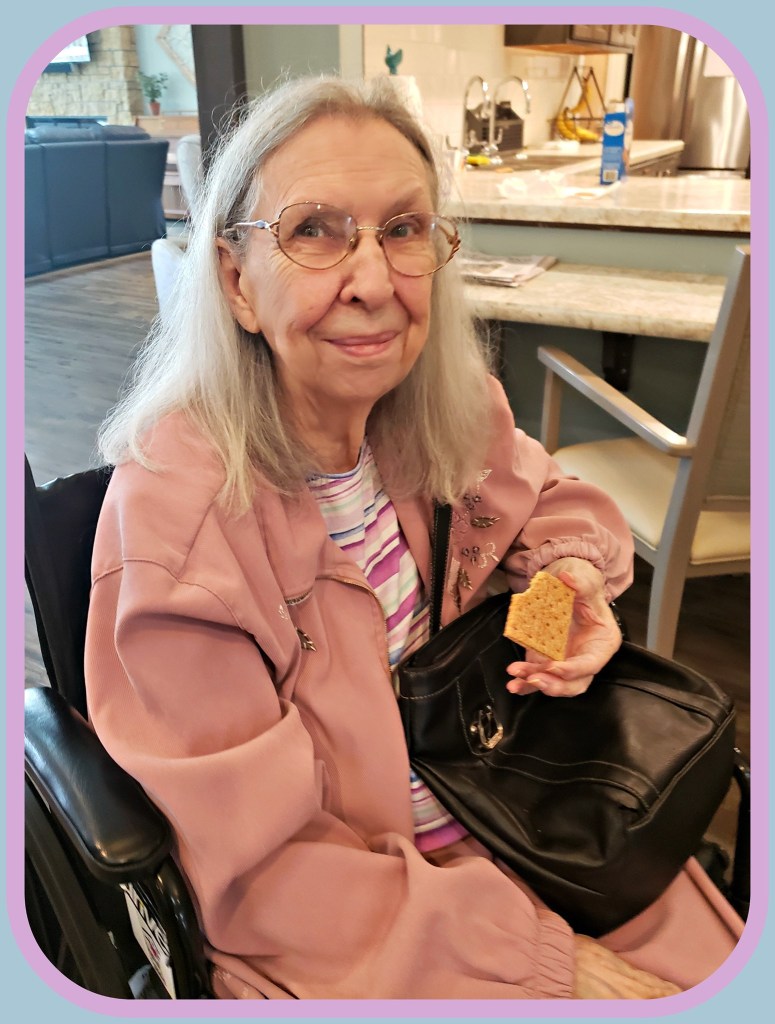
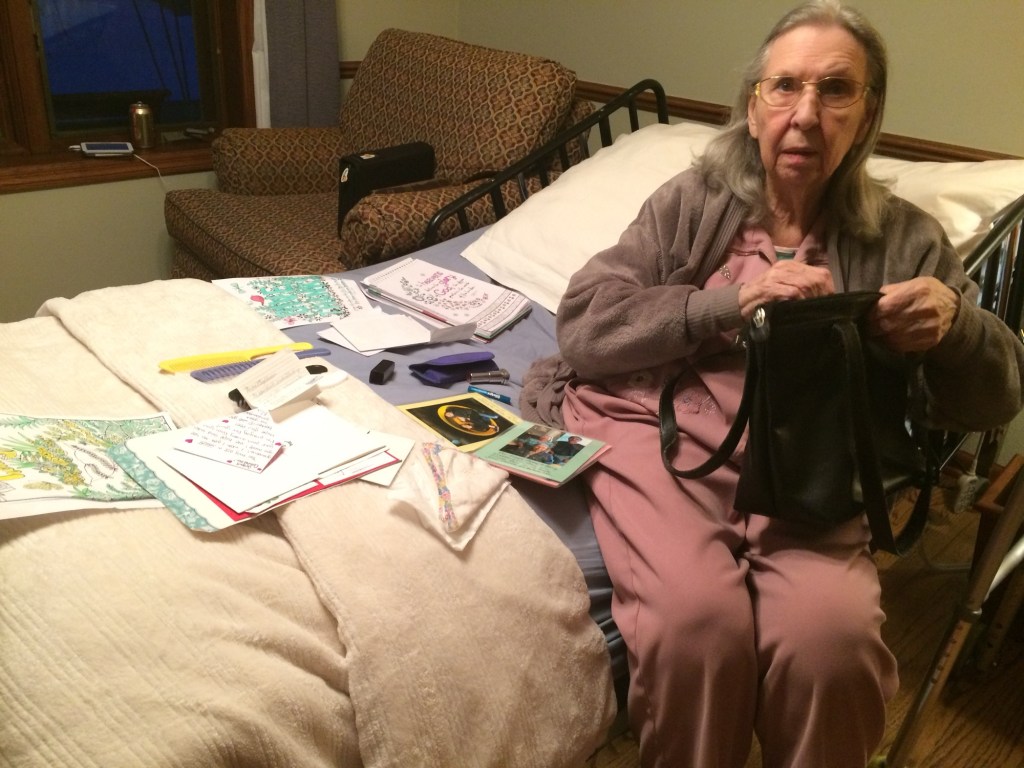
Her purse came with her for snack time at Beehive, oftentimes carrying an extra snack or two given to her by the caregivers. I mean, who could resist giving this pretty lady an extra snack or two?
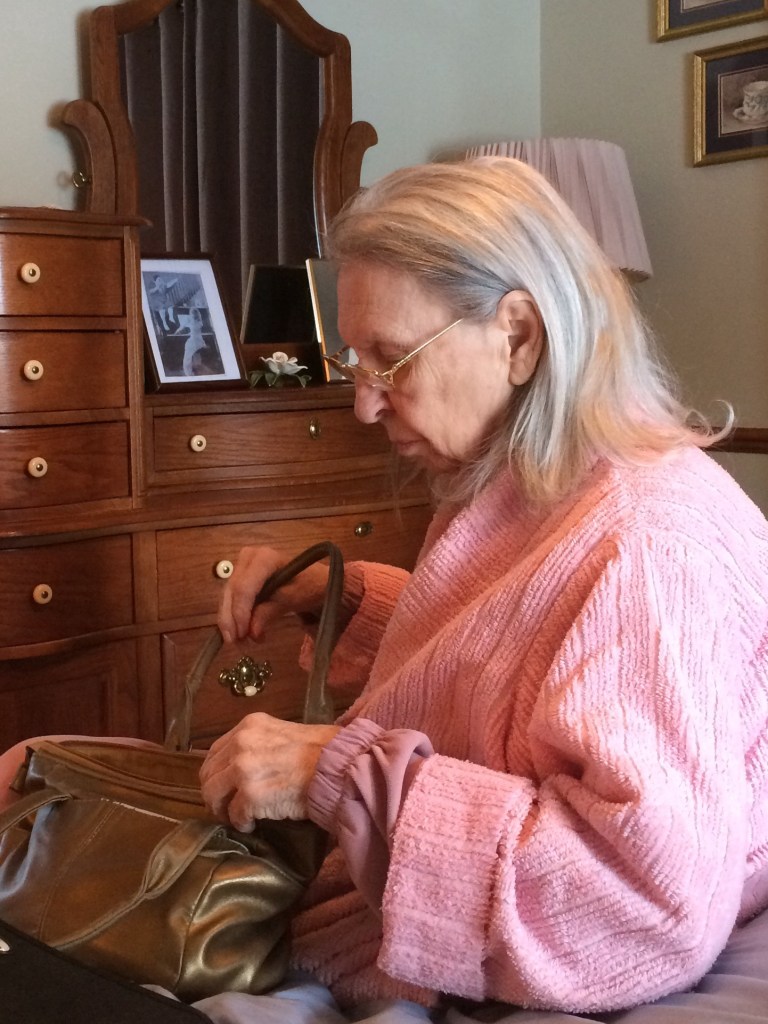
Whether living with me, or living at Beehive Homes of Oregon (WI), momma’s purse was always within reach. Sorting through her purse was a favorite middle of the night activity, so I tried to keep it stocked with all kinds of treasures and little things to sort and discover over and over again.
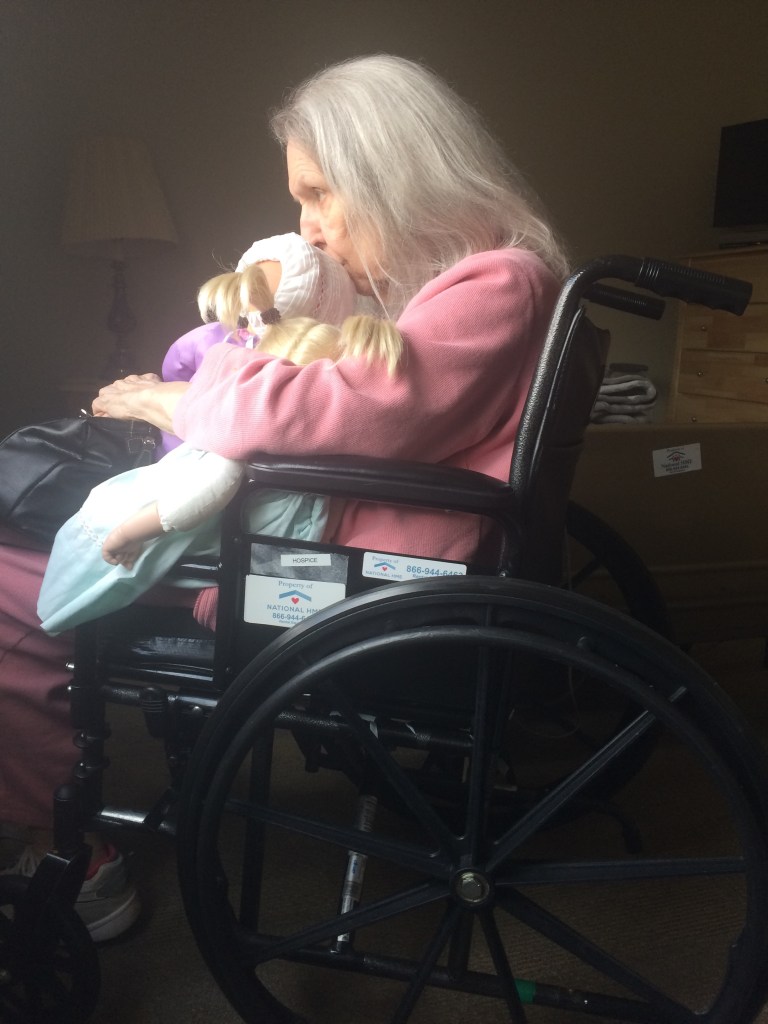
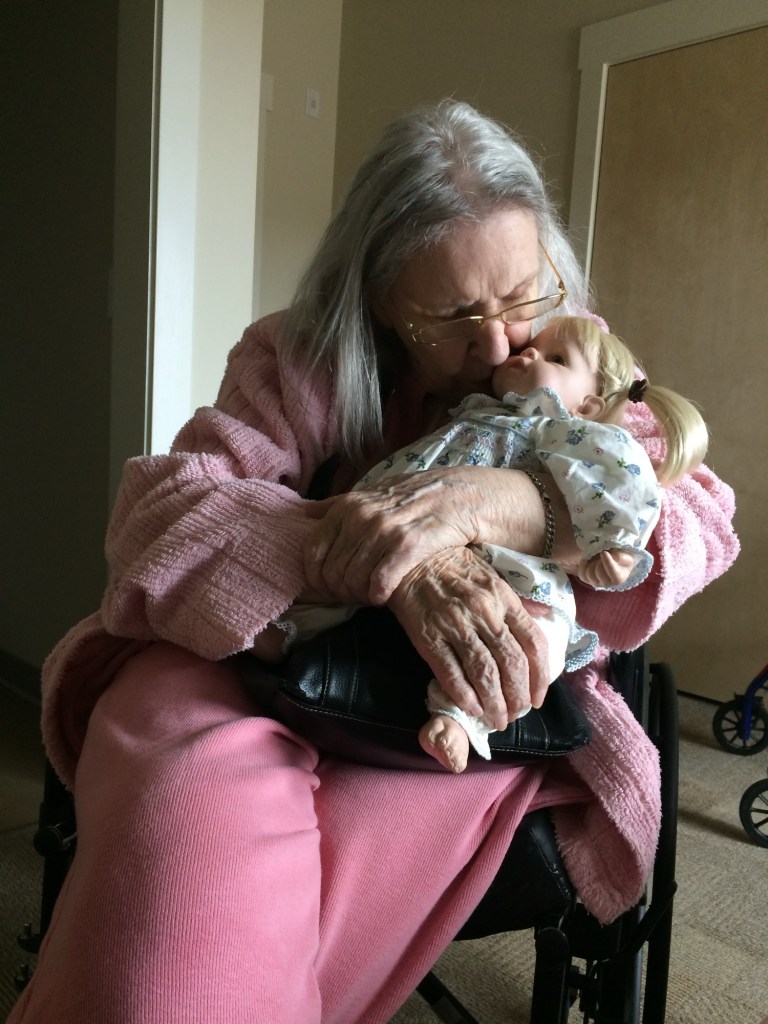
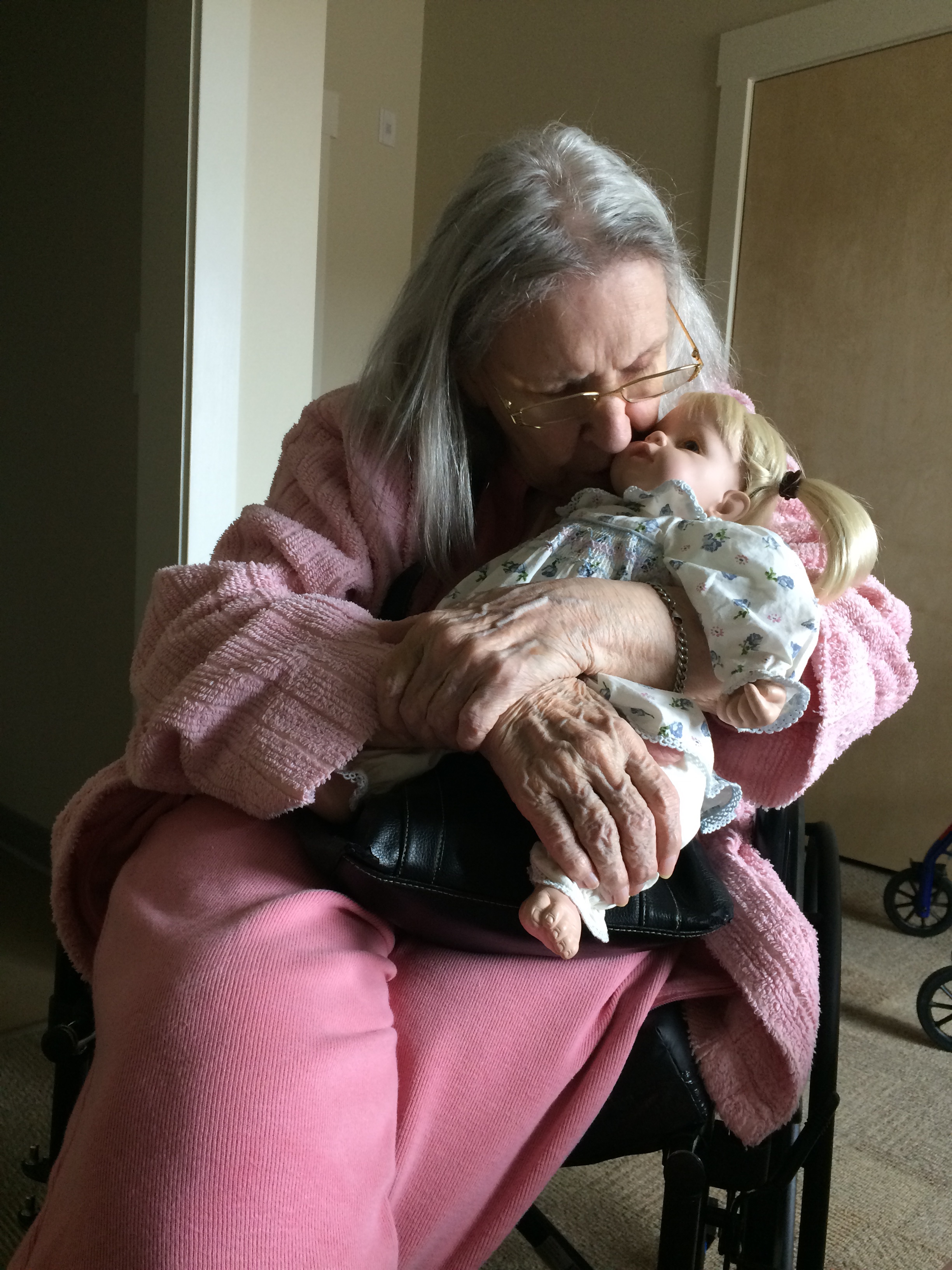
Momma and her babies
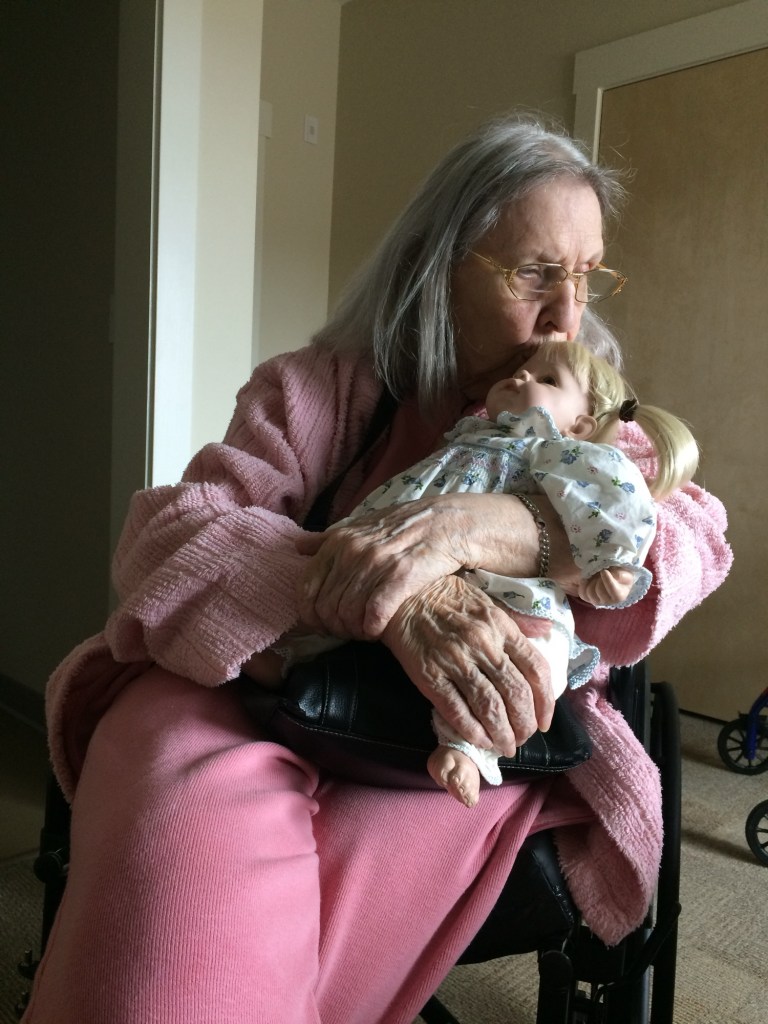
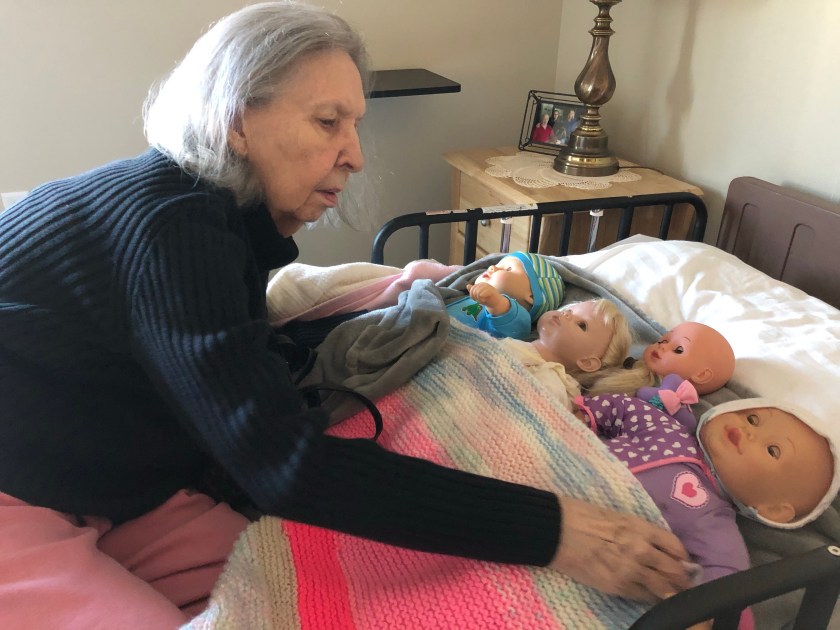
Momma always seemed to have her purse along when she was caring for her baby, Dolly. The purse would usually be in her lap with her baby sitting on top. I treasure the sweet memories of my momma loving on Dolly. They gave me little glimpses of the love and gentle kisses I know she once bestowed on me.
Never leave home without it
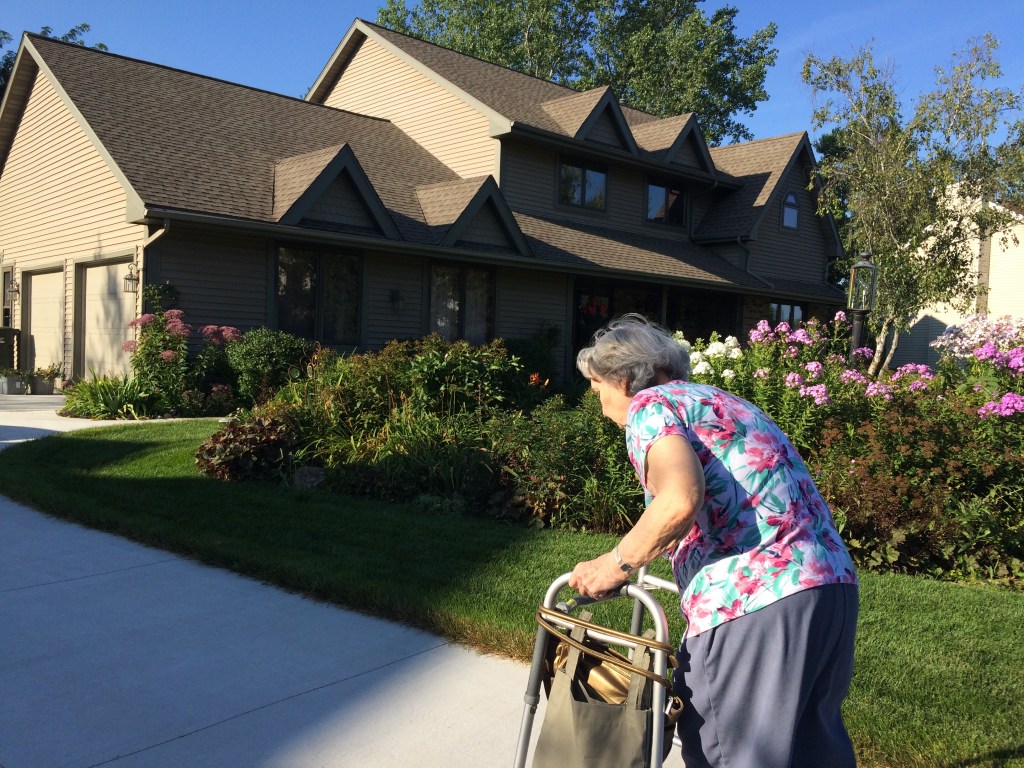
A woman never wants to leave the house without her purse, you know. We even rigged her walker so she could take her purse with her on our little walks to the mailbox and back.
An early sign of cognitive decline
Momma’s purse held one of the earliest signs of cognitive decline. I remember a day when I was visiting mom and helping her search for her lost checkbook. Her purse was one of those multiple zippered pocket contraptions that seemed to always swallow her car keys, wallet, hearing aides, and checkbook. As I once again searched the pockets she had already searched, I found both the lost checkbook and a list written in my mom’s familiar cursive hand. The list told a story of something else that was lost–the names of her very best friends at church. My sweet momma had taken her church bulletin and had practiced recalling and writing their names over and over again, willing herself to never forget them again.
Why are mirrors often difficult for people with dementia?
My mom didn’t seem to have anxiety or fear when she viewed herself in a mirror, but I could tell she was wary of the person in the image. Momma was always gracious and hospitable, so it didn’t surprise me that she would sometimes think the image peering back at her in the mirror was someone visiting her home. I believe mom viewed herself as younger than her mirror image, so didn’t think that she was that older woman in the mirror. Mom’s mirror confusion was evidenced by her sometimes having an entirely sweet little chat with the other person.
The only time I noticed heightened concern was when mom would see her reflection in the mirror on her way into the bathroom–a place where most people prefer privacy. She would occasionally think the bathroom was occupied and then turn around and say something like, “Oh, I’m so sorry. I didn’t know you were in here. I’ll come back later.”
Entirely sweet too, but sometimes this would lead to missed opportunities to make it to the bathroom on time.
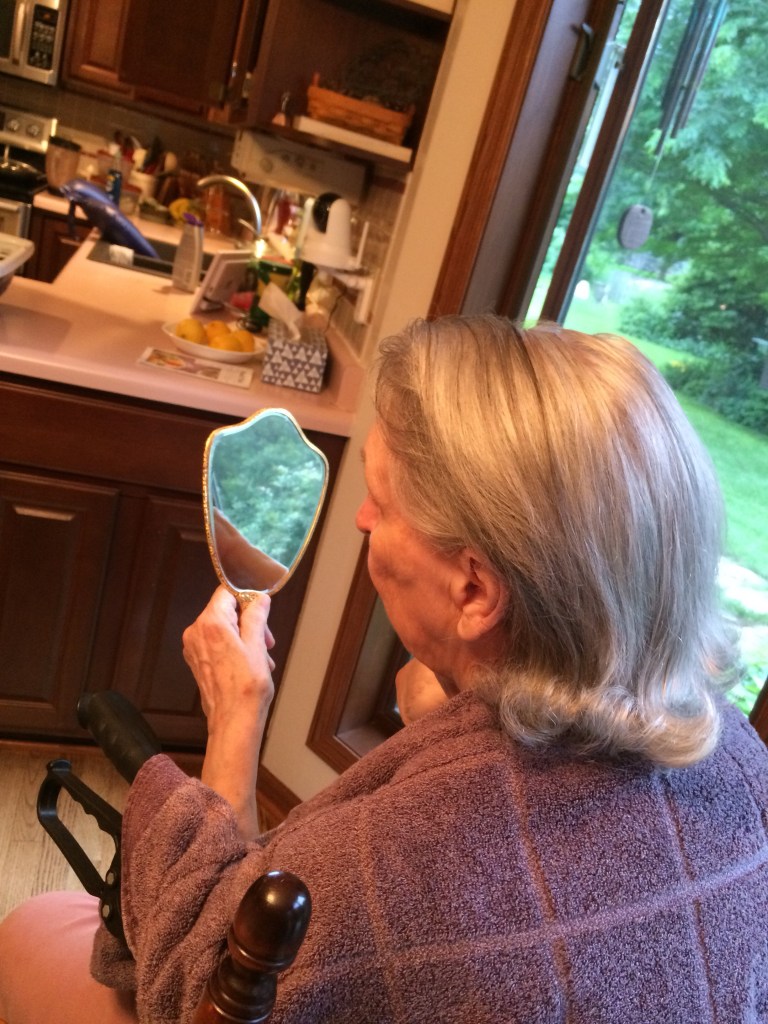
Interesting note–her little hand mirror didn’t seem to cause any perception problems at all. Perhaps it was because it could be tucked away in a drawer if she didn’t want to look at her image any longer.Maybe it was because the image was just of her face and not her stooped over and aging body. I don’t know, but her hand mirror remained a prized possession well into her journey with dementia.
Visual perception problems can be challenging for those caring for someone they love who is dealing with dementia. I hope that Dr. Natali’s brief video will give you insight into this dementia behavior and practical suggestions for this stage of your caregiving journey.
Time to revisit my little series of A-Z Caregiving Tips. The photo below is the article which inspired me to make my own A-to-Z list. Let me pick up where I left off and invite you to join me this week for R and S.
Repeat gently, looking toward me if I miss hearing something.
One thing we caregivers do a lot is repeat ourselves. When our loved ones have trouble understanding what we say, it’s important to repeat things. It’s also important to communicate in a way that includes facial expressions, which provide important information for our loved ones. Because my mom was also very hard of hearing, she relied even more heavily on my facial expressions.
The person who has dementia needs you to sit down on their level, look them in the eyes with all gentleness as you speak. I say “gentleness” because it is very easy to have a look of annoyance or irritation when you feel like you’re repeating something for the umpteenth time. Caregivers must be aware that the non-verbal messages we communicate with our body language and facial expressions speak louder than the actual words we speak.
Facial expressions can be difficult for people with hearing problems to understand when we’re moving. Think about how often we call out to someone in another room during the day. Or when we talk to someone in passing as we’re busy with other things. If you’d like more information on this topic, click here for another great resource.
(With all respect to the original author of this list, I didn’t quite see how standing up for the environment relates to caregiving, so let me proffer my own version of the letter S.)
Step back and take a break.
Being a caregiver can be very stressful. I often felt overwhelmed while taking care of my mom. During those moments, I had to take a step back and take a break from all the pressure. For me, that meant leaving my mom with my husband for an hour or two so I could go to the gym. Sometimes he called me back home, but most of the time, I was able to enjoy some time for myself and relax.
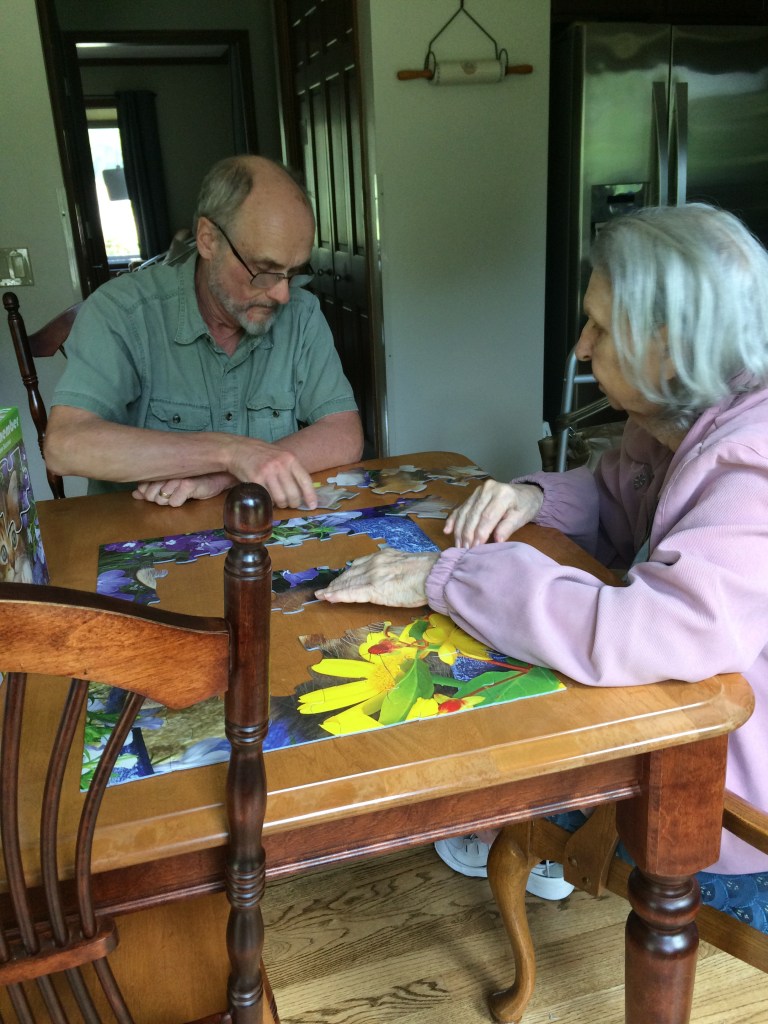
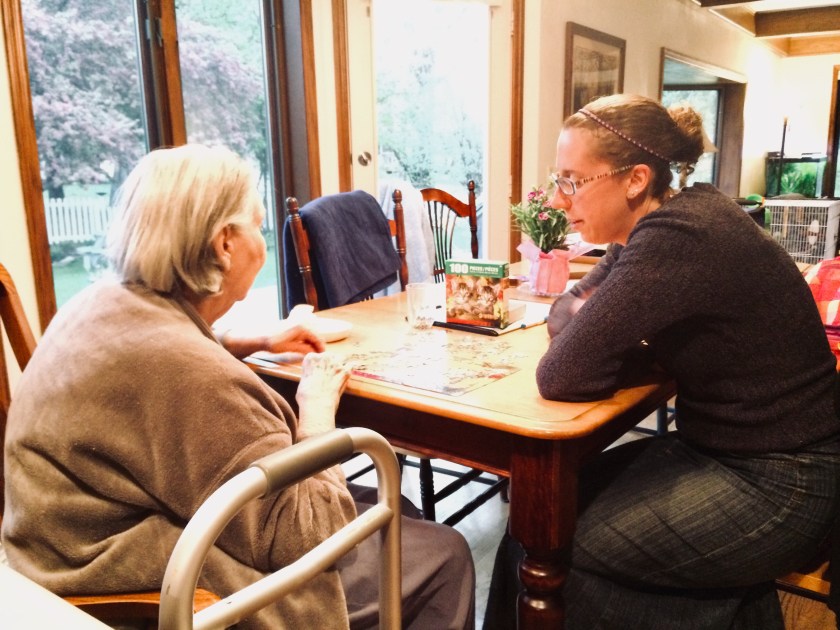
My husband working a puzzle with mom.
It bothers me when I hear caregivers lament that they have no one to help them. I know that it is too often the case; but more often than not, the reality of the situation is that they (we) are afraid to ask for help–or reticent to accept help when it is offered.
I believed I was the best person to take care of my mom, but I also realized that I wasn’t the only one who could do it. It was important for my well-being to take a little break sometimes. I would reach out to our church’s private Facebook page and ask for someone to spend time with my mom for a few hours so I could do something else. Most of the time, someone was willing to help.
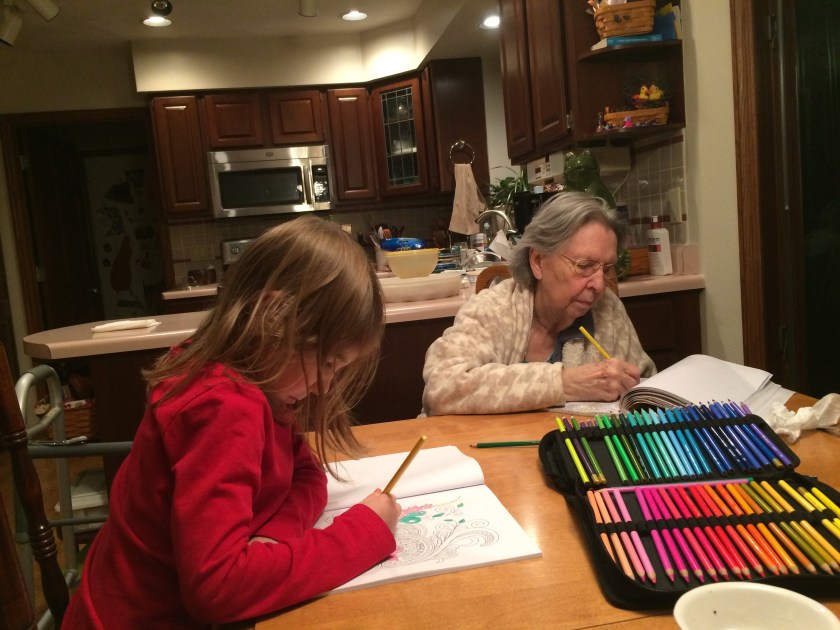
There were times when a friend would say something like, “Hey, my daughter and I would like to stop by on Monday to color with your mom. What time would be good for you?”
I learned two important lessons: Ask for help, and never refuse an offer of help.
If you are a caregiver for a loved one with dementia (or some other form of life-altering illness), there may come a day when you realize you need to consider other options for providing the best care. Perhaps the post that follows will be helpful as you wrestle with that important decision.
If you ever had the pleasure of knowing my mom, you would probably describe her as one of the kindest and most caring people you have ever met. Her sweetness was a predominant character quality, even as Alzheimer’s claimed more of her memories and abilities. I’ve written about her loving care for doll babies, and about how the nurse came out in her so often in her last year of life in assisted living memory care. Here are a few photos of her sweet self.
Sometimes, however, momma wasn’t so sweet. She’d take a swing at my head when I was kneeling in front of her trying to help her tie her shoes. She once threw a frozen dinner at my brother when he was sick in bed and started screaming at him. We theorize that she was just so very frustrated that she couldn’t remember how to work a microwave anymore–she wanted to help him, but didn’t know how. In assisted living memory care, a mean streak would occasionally surface when someone was assisting her with a shower. Mom wasn’t one to use profanity, but would very occasionally let angry words fly when someone was just trying to help her.
It wasn’t mom. It was what Alzheimer’s was doing as it ravaged her brain.
It can be very stressful for the caregiver when someone they love suddenly becomes combative and aggressive. Sometimes there are physical reasons why a loved one is lashing out – like pain, or a urinary tract infection, or frustrations over not being able to physically do something (like tie her own shoes, or stand without assistance).
Timing
For my momma, it was sometimes the timing of what she was being requested to do. We learned very early on that it was futile to awaken her for a meal or a shower—that was just begging for angry outbursts and uncontrollable tears. Sometimes she’d refuse food at mealtimes. We learned it was best to just let her be—she would often forget she was mad and be sweet as pie when you reintroduced the same plate of food a few minutes later.
Speaking of pie, we also learned that if we would “lead with sweet” by serving mom’s dessert at the beginning of her meal, she’d eat her dessert and then just keep going. It also helped to let mom bring Dolly with her to meals. Dolly didn’t eat much, but sometimes needed her face washed after meals.
Fear
Sadly, my mom oftentimes became very agitated and fearful at the prospect of taking a shower. This is VERY common. I first noticed it in the moderate stage of dementia. If a shower was suggested, she’d have every reason in the world not to do it now. She generally used stall tactics, like, “Later.” Or, “I already showered before you got here.” As the disease progressed, there would be no question about it—mom would NEED a shower. One of the wisest things I ever did as a caregiver was to hire help for bathing. I was extremely thankful for the aides who came to assist with this need. Their training prepared them for the ups and downs of performing the necessary hygiene tasks, and each aide had tricks up her sleeve as to how to help alleviate mom’s fear and anxiety.
There were times when even the aides were unsuccessful. Sometimes the best we could do was give mom a bed-bath or a quick wipe-down. I found it really convenient and helpful to use these disposable washcloths–they could be warmed in the microwave, which mom found very soothing.
My heart goes out to you caregivers who are dealing with combative and aggressive behavior with your loved one. Every situation is different, but I hope my experience with mom will help someone else get through this. If you’d like more information, you might want to check out this informative and helpful article, “Dealing with Aggressive Behavior”.
Here’s the next in a series of Tuesday’s Caregiving Tips posts inspired by A-Z Caregiving Tips (an article in Alzheimer’s Today pictured below). A diagnosis of cognitive impairment or memory loss presents caregiving challenges, each as varied as the person experiencing it. Alzheimer’s was the diagnosis that spelled memory loss for my sweet mom. You can read my previous posts for my personal tips on A – O. Today I am sharing my thoughts about “P” and “Q.” Thanks for stopping by to read my blog. Readers, you are most welcome (and encouraged) to share your own tips and observations about dementia caregiving in the comments below.
If the generation before me said, “Mind your p’s and q’s”, it was usually said in a firm tone of voice. It meant be polite and mind your manners–it might also mean to watch your language. Today we have come to the letters ‘P’ and ‘Q’ in our alphabet-inspired suggestions for dealing with loved ones with dementia. Both letters speak to watching what we say–‘P’ encourages us to fashion our conversations in an encouraging way, and ‘Q’ reminds us to omit certain words in order to help our loved one avoid the embarrassment of not being able to remember a person or specific event. Both are equally valuable tools in the toolbox for good caregiver communication.
Please affirm what I contributed and still do contribute.
I feel like I’ve covered this in previous posts, but it probably can’t be overstated. For as long as my sweet Momma was able, it was important to let her tell and retell her stories of her years as a nurse. The day would come when she could no longer recount those stories. At that point, it became my turn to tell her the stories I remembered her telling me. One such conversation went something like this:
Momma, I remember when the whole city of Milwaukee was snowed in and you stayed at the hospital and worked three days in a row because no one could get to work on the deep, snow-drifted roads. Then someone gave you a ride home on a snowmobile. First, you had them take you to the grocery store so you could buy your family food to eat, then he took you the rest of the way home. I remember that, even though you were very tired, you fixed us supper, then slept for a very long time.
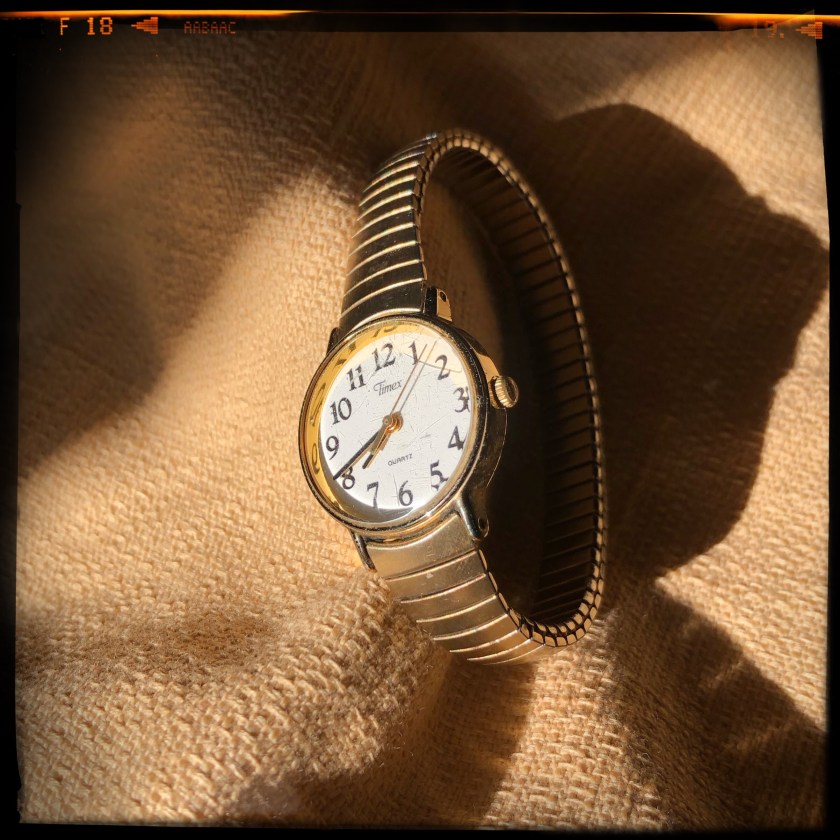
The story was actually a confabulation — a mixture of truth and her own version of the truth. As a nurse, she had always worn a watch with a sweep-second hand so she could take pulses the old-fashioned way. Momma still liked to wear the last watch she owned as a nurse. There came a day when neither story lingered in her mind. It was my turn to point to her watch and help her recapture that story, if only for a moment.
Oh, how my mom loved to work with children–her own and the children of others. In addition to being a very involved mom, she was also a leader of a local Brownie troop. Later, she would work for many years as the secretary for the Awana girls’ club. Her grandchildren adored her. No doubt the open-fridge policy had something to do with their love of spending time at their grandparents’ home, but their teenage years were nurtured and fed in more ways that food because mom and dad gave each of them a housekey and made sure they knew they were always welcome.
For my part, I loved to reminisce with mom about some of the special ways she blessed our family. I would show her photos of some of the fun times she had when working with kids in the Awana program.
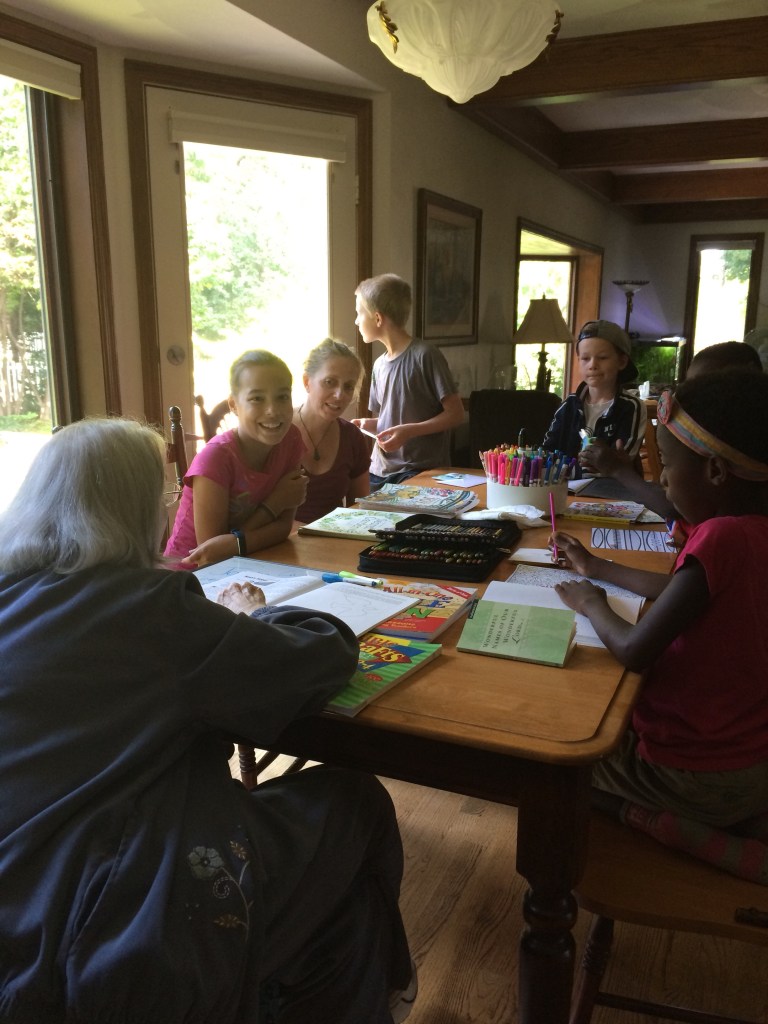
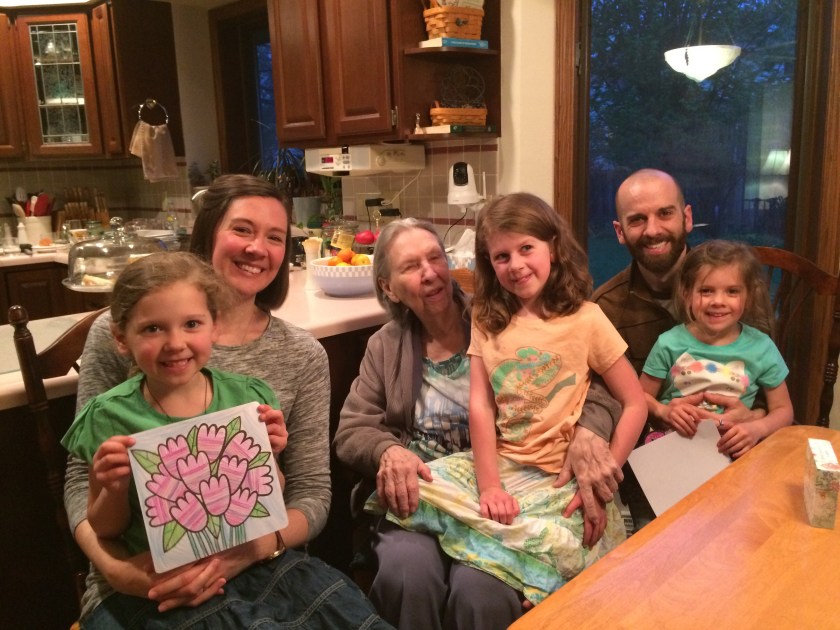
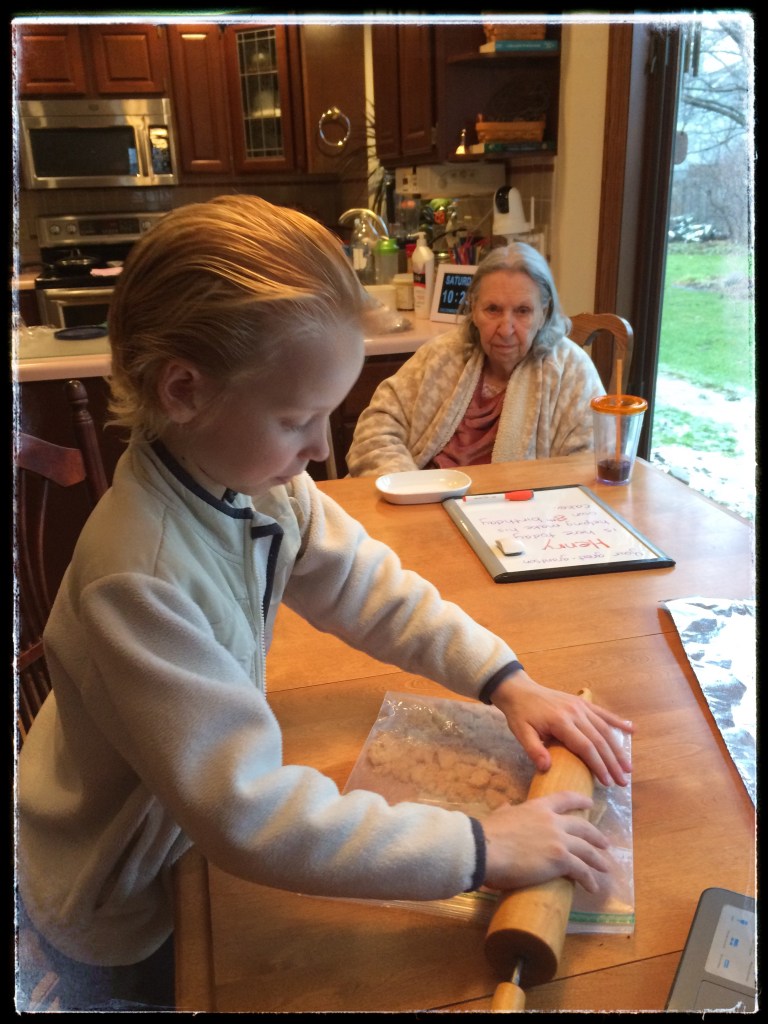
One way I helped mom feel like she was still contributing something valuable was by inviting families with young children to come and share a meal with us. I would tell mom that the kids were hoping she’d teach them something about coloring, or help them with a hard puzzle. She delighted in those times around the kitchen table. As they colored, she’d proffer her wisdom in how to hold the crayon or colored pencil in such a way as to shade the color onto the paper evenly. If she was working on a puzzle with her little friends, she’d share a tip and demonstrate how to put puzzle pieces in color groupings to make it easier to find the piece needed.
Quit quizzing me with Who, What, Where and When questions. I would add Why to the questions we needn’t ask.
In the earliest stages of Alzheimer’s, mom seemed to struggle with the Who questions the most, followed by Where. Names which had been familiar would drop off her radar. As I spent more time with my mom, I learned not to ask her who she had lunch with on Sunday, or who taught the discipleship class she attended. As the names of family started to slip, I learned to slip the name of the person we were with into the conversation so that mom could be reminded of the name.
For instance, as her neighbor and friend, Gisela, was approaching to have a chat with mom in the front yard, I’d greet Gisela by name. Later in the conversation, I’d say something like, “So, Gisela, you and mom have lived in this neighborhood together for over 50 years, haven’t you?” Then the conversation could continue with mom and Gisela reminiscing about old times.
Minding our p’s and q’s in dementia caregiving helps ensure a smoother passage on the labyrinthian road in life marked by memory loss. Thus far in medical research, there are no fixes for this formidable detour of the mind. Caregivers with a well-equipped “caregiving toolbox” can bring roadside assistance and a little extra joy along the way.
What happens when you want to remember something, but absolutely know you won’t? You write it down. For the individual experiencing short term memory loss, lists sometimes become a source of frustration. A caregiving daughter shares her view on helping her momma remember, while guarding her fragile dignity.
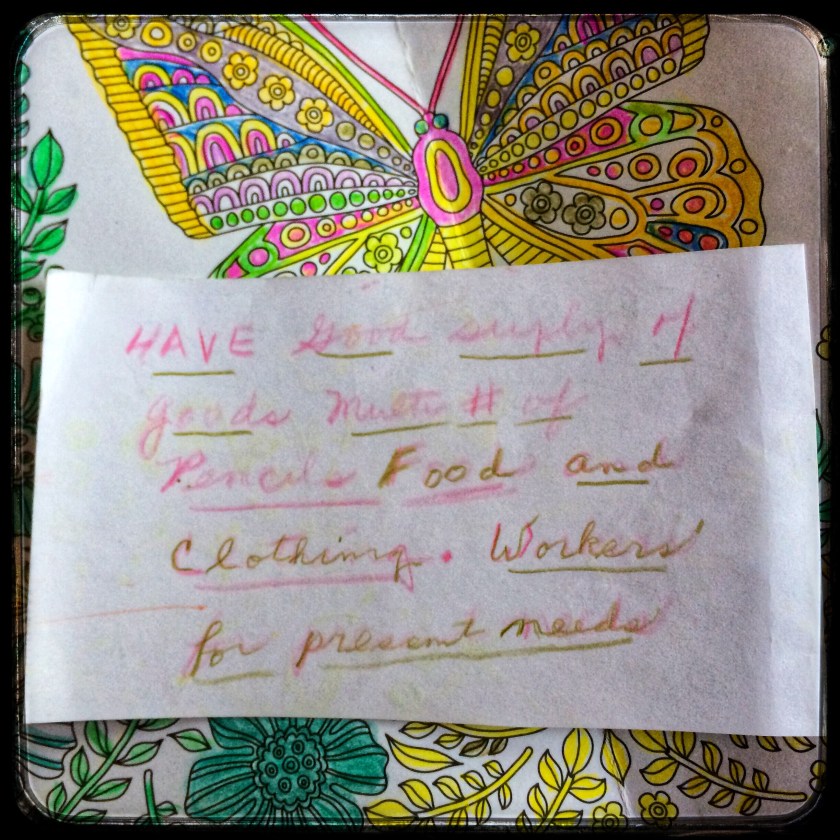
One of mom’s little notes…I was considered one of the “workers.”
Journal entry from June 7, 2016
Quite often these days, Momma will ask me to buy her a notebook the next time I go to the store, declaring that she can never find any paper on which to write her lists. I know for a fact that she has umpteen notebooks and pads of paper squirreled away all over her apartment home.
Mom is at what her doctor calls the “moderate stage” of dementia where she is keenly aware that she is losing her ability to recall information and is trying her hardest to keep random pieces of information that won’t stay filed away in her brain in a place where she can easily retrieve them. Her lists are her safety net helping her capture not only her to-do list, but the stray thoughts, ideas, and necessities of life.
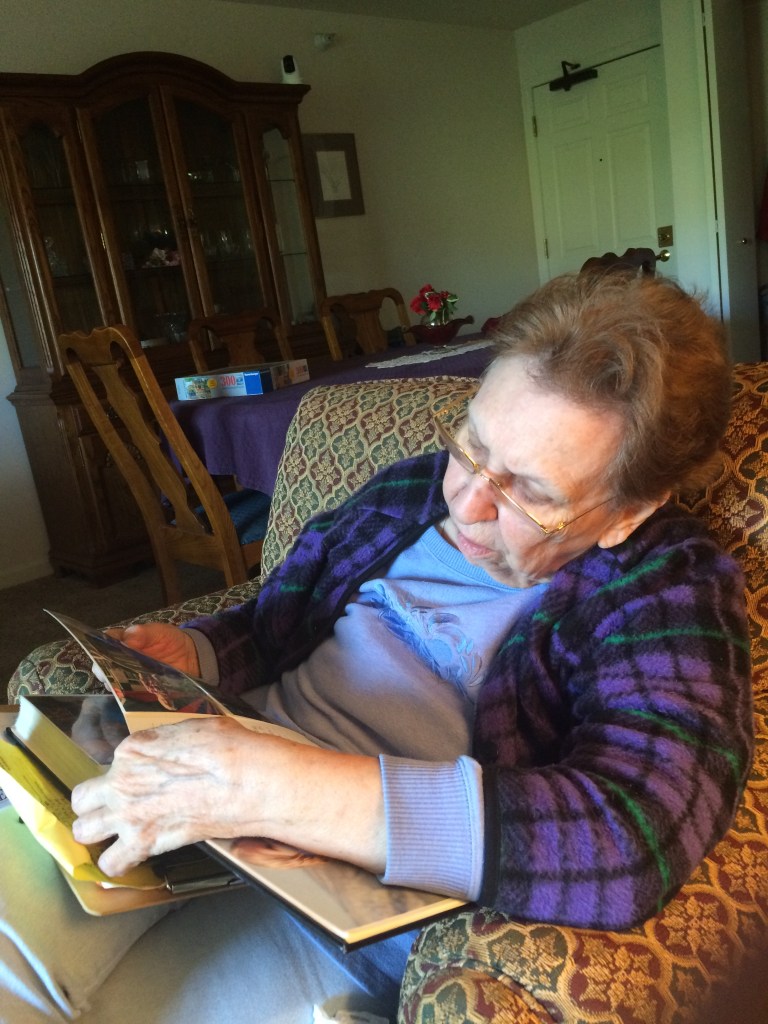
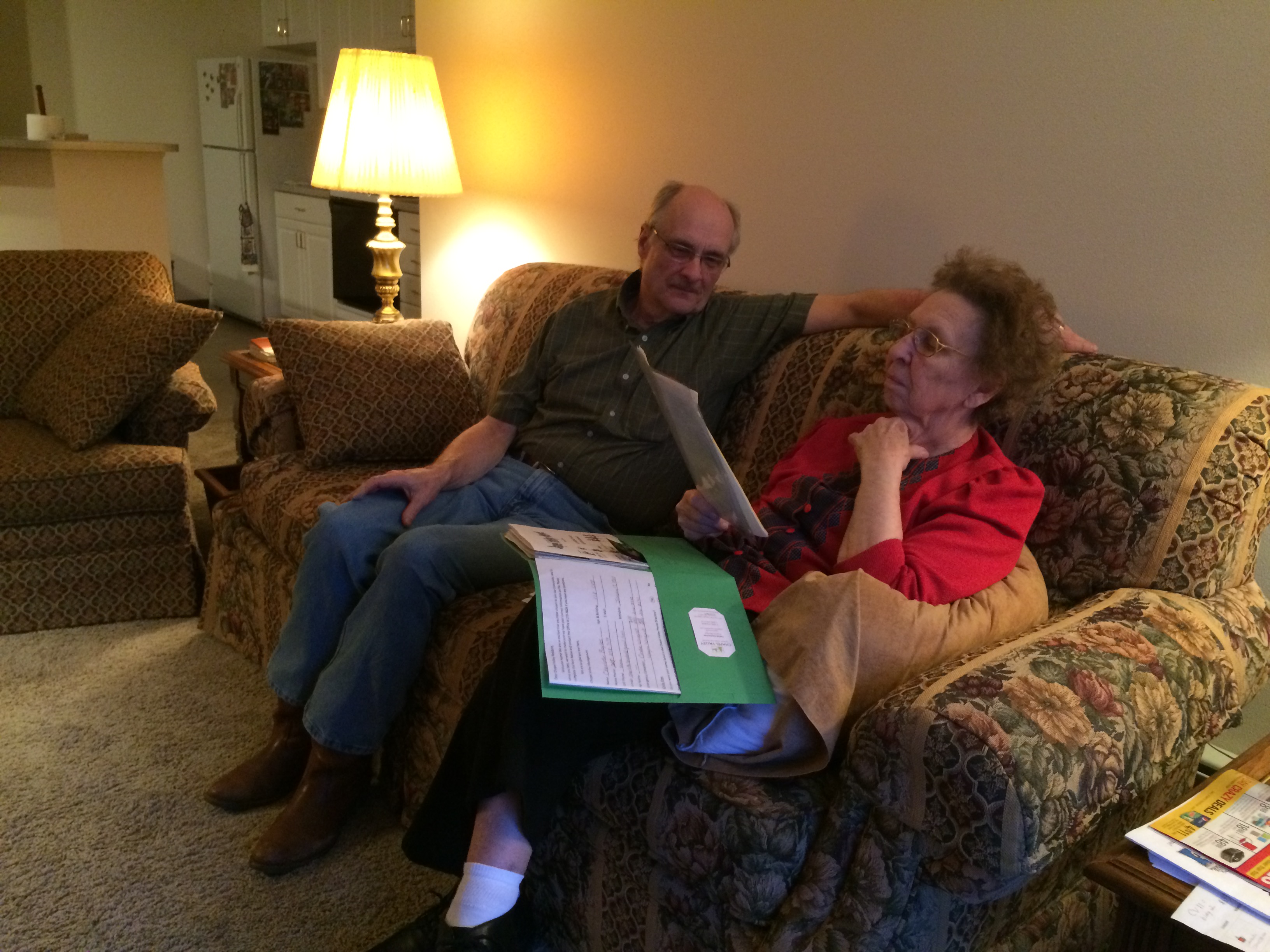
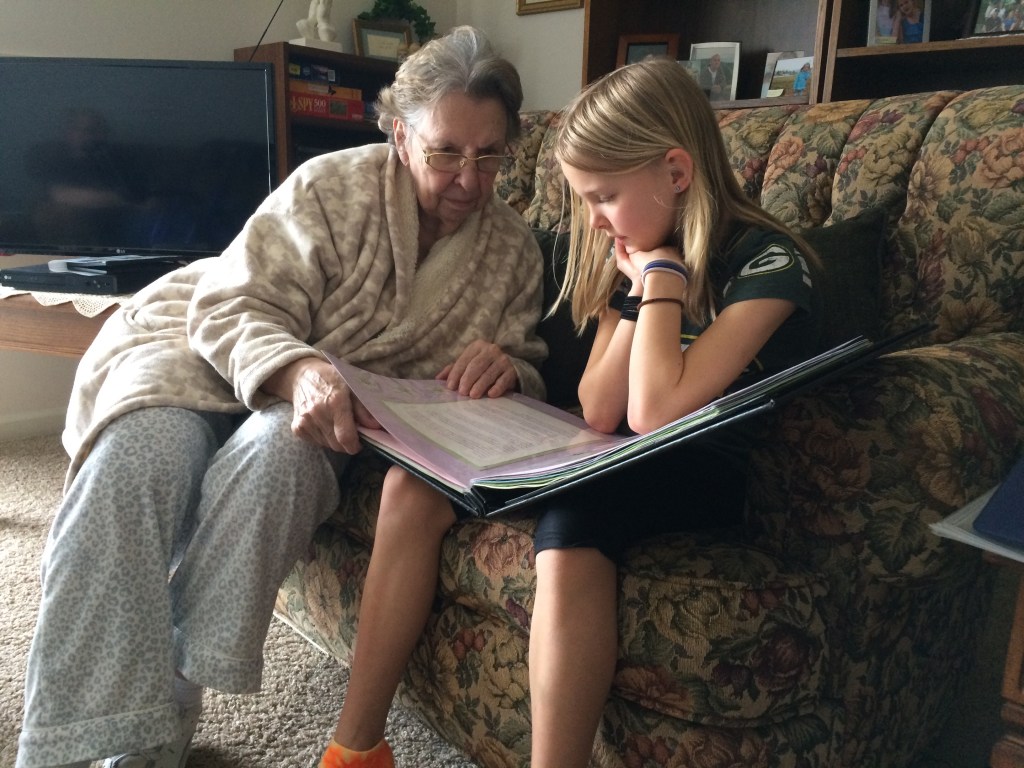
She’s enjoying a photo album which has lots of captions written in the margins. Underneath, you can see her clipboard with a few of her important pages of notes.
Once in awhile, mom asks me to take her shopping. Shopping excursions to Walmart or Walgreens invariably result in Mom tossing a new package of legal pads or a brightly colored spiral bound notebook into her shopping cart. She insists she is all out of them and there is no convincing her otherwise. Rather than bringing a sense of order to her world, the multiplicity of lists bring chaos to her sense of order as she tries in vain to gather her thoughts into one place.
I have since gathered most of those notepads/books into one cabinet in her apartment. One thing is certain–she has no need for more notepads. Rather, under her watchful eye, I acquiesce to mom’s request and jot down a note for myself on a shopping list, assuring her I will purchase a notebook for her on my next trip to the store.
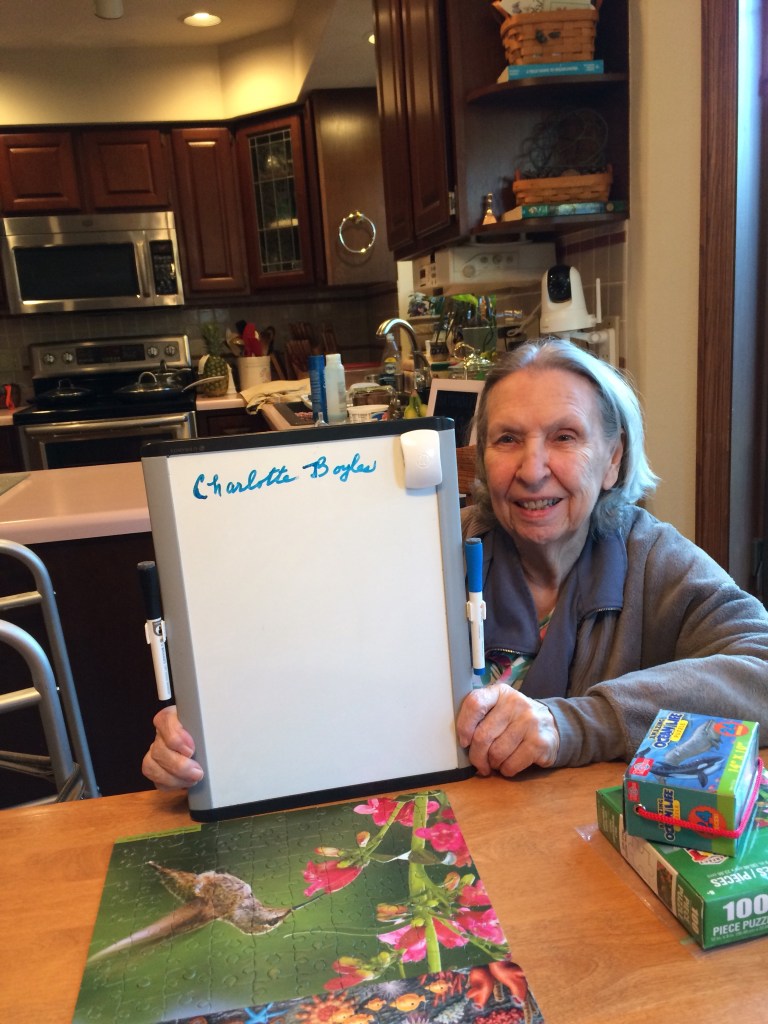
This whiteboard was one way we tried to help her gather her thoughts.
You may be wondering, why not tell her the truth? Why the charade? Why not just tell her that she has plenty of notebooks? Right or wrong, I believe I am honoring my mom when I later “find” one of her notebooks and we can cross the “notebook for Mom” off my list. It gives mom the fleeting pleasure of having one of her requests granted, and I receive the gratification of pleasing my mother and guarding her fragile dignity.
Here’s the next in a series of Tuesday’s Caregiving Tips posts inspired by A-Z Caregiving Tips (an article in Alzheimer’s Today pictured below). A diagnosis of cognitive impairment or memory loss presents caregiving challenges, each as varied as the person experiencing it. Alzheimer’s was the diagnosis that spelled memory loss for my sweet mom. You can read my previous posts for my personal tips on A – M. Today I am sharing my thoughts about “N” and will add my own “O,” since the article did not address that particular letter. Thanks for stopping by to read my blog – the “likes” and “comments” of my readers feed my motivation to write.
N – Note that I take your words literally, so avoid teasing and sarcasm.
In the early stage of memory loss, mom would sometimes take “just kidding” comments quite literally. Likewise, when mom reached what was thought to be the stage of “moderately severe” memory loss, it seemed that her ability to understand and appreciate sarcastic humor and irony disappeared too. This was especially noticeable in social “table talk” situations.
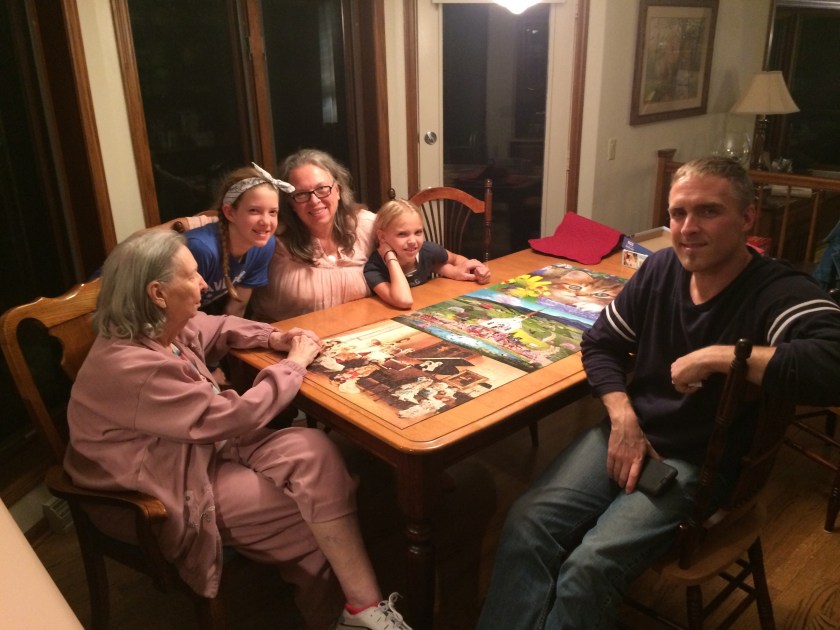
Mom enjoying putting together puzzles (3 in one evening!) with the help of her grandson Matt and her great-granddaughters Mia and Noelle. Puzzles were helpful in guiding enjoyable conversations with mom.
Teasing and sarcasm are part and parcel of family gatherings such as Thanksgiving. We like to tell stories on one another and kid each other about silly things we’ve done lately. We sometimes use tongue in cheek jesting during our bantering around the table. Mom always had a quiet sense of humor–she would appreciate a good joke, but usually was not the one to tell it. She’d smile at the kids. But now, while she herself could often say something witty, there was no understanding of the “punch line” to someone else’s joke and a blank look at any attempt at humor.
Turning off the humor at the table isn’t the answer, but understanding how our loved one with dementia might be processing the conversation can be helpful in making the conversation inclusive for them too. Our bigger family dinners (e.g. Thanksgiving and birthdays) were the most confusing for my sweet mom. She would sometimes leave the table and go to the quietness of her room. When that would happen, family would go in an visit her one on one. She enjoyed that experience much more.
Another helpful tactic was to do something mom enjoyed at the table. Working on a puzzle or coloring became a unifying factor in conversation for her.
O – Own up to your mistakes in caregiving, but don’t beat yourself up about them. Mercy is new every morning.
I freely admit to making a lot of mistakes in caregiving. I recall days when my voice carried more than a little annoyance in it and harsh words would fly. Days when I was anxious and weary and my facial expressions did not communicate Christ-like love and compassion. There were times when I would confuse mom by asking if she remembered something when I knew full well that she couldn’t–or, similarly, when I would expect her to remember something we had already talked about. One of the hidden grace gifts of Alzheimer’s is that momma wouldn’t stay hurt and mad at me for long. She would soon forget my blunders and I would have another opportunity for a do-over in caregiving.
Likewise, in other relationships, there were times when I did not express my appreciation freely enough. I’m thinking of a time when I made my sister feel bad about how she handled a caregiving situation, rather than being gracious and knowing she did what she thought was best when she was taking a turn at caring for our mom. It’s sometimes easier to see the mistakes and failure of others than it is to see the same problem in our own lives.
It’s a wonderful thing for me as a believer in Christ to know that His steadfast love for me will never cease. Never. Ever. His mercy will never come to an end. Never. Ever. I praise God for His faithfulness in providing a daily (constant) supply of love and mercy. Knowing and believing the truth expressed in Lamentations 3:22-24 helped me through many times when I felt like a dismal failure as a caregiving daughter.
The steadfast love of the Lord never ceases; his mercies never come to an end; they are new every morning; great is your faithfulness. “The Lord is my portion,” says my soul, “therefore I will hope in him.” (Lamentations 3:22–24)
Written with love and great admiration for all those who are caring for a loved one who is facing Alzheimer’s or any other diagnosis that spells memory loss. I write from my experience of caring for my sweet mother in her later years with Alzheimer’s.
Here’s the next in a series of posts inspired by A-Z Caregiving Tips (pictured below). A diagnosis of cognitive impairment or memory loss presents caregiving challenges, each as varied as the person experiencing it. Alzheimer’s was the diagnosis that spelled memory loss for my sweet mom. You can read my previous posts for my tips on A – L. It seems I have a lot to say about “M,” so I will focus on that for this week.
Make new ways I can be of service to others
Mom was a nurse. A dedicated and amazing nurse. Even after she retired from her long career in nursing, she still practiced nursing in an unofficial way as she came alongside family and friends as they went through their physical trials in life. She was dad’s constant companion whenever he faced any of his cancers and surgeries. She served her friends as the requisite driver and responsible party when those friends faced day surgeries of various types. If someone was hospitalized, she was almost always one of the first visitors. Several of her friends had her come along to their surgeon’s or oncologist’s office when they were going to receive their scary diagnosis. Mom knew just the right questions to ask and how to help her friends through the difficult days ahead.
The time came when Mom was the patient with symptoms of short-term memory loss. I’m sure she knew something was amiss long before I started noticing memory blips. Who knows how many years she wrestled with that knowledge alone? Based upon dated notes and lists I found here and there, I would say for a few years.
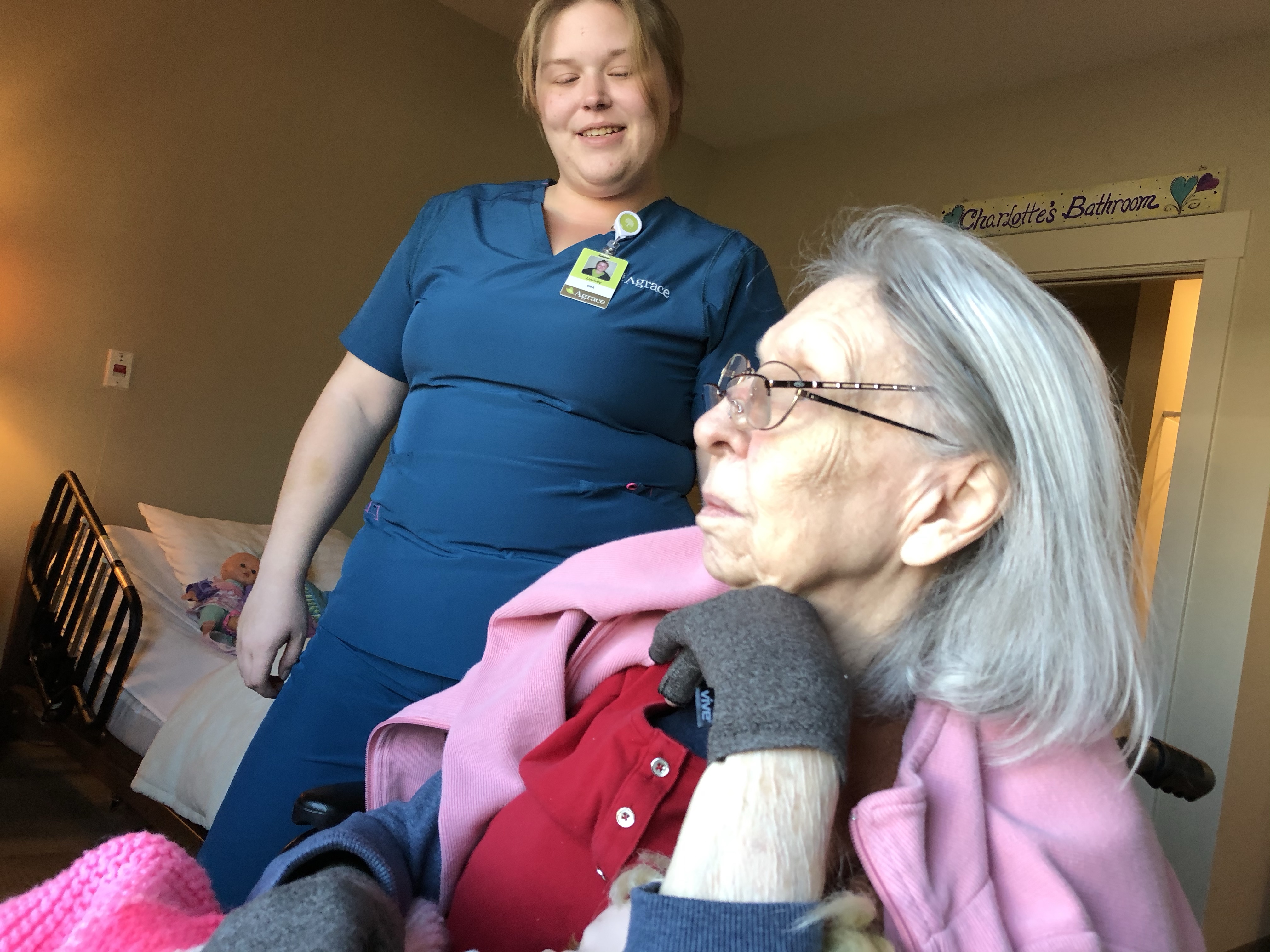
Although Mom forgot many things, the experiences of her lifetime still served as a guide in her daily interactions. Even after mom moved in with me and then later into assisted living memory care, I routinely saw the nurse in mom present when she’d notice someone wasn’t feeling well and then do her best to make sure they were cared for appropriately.
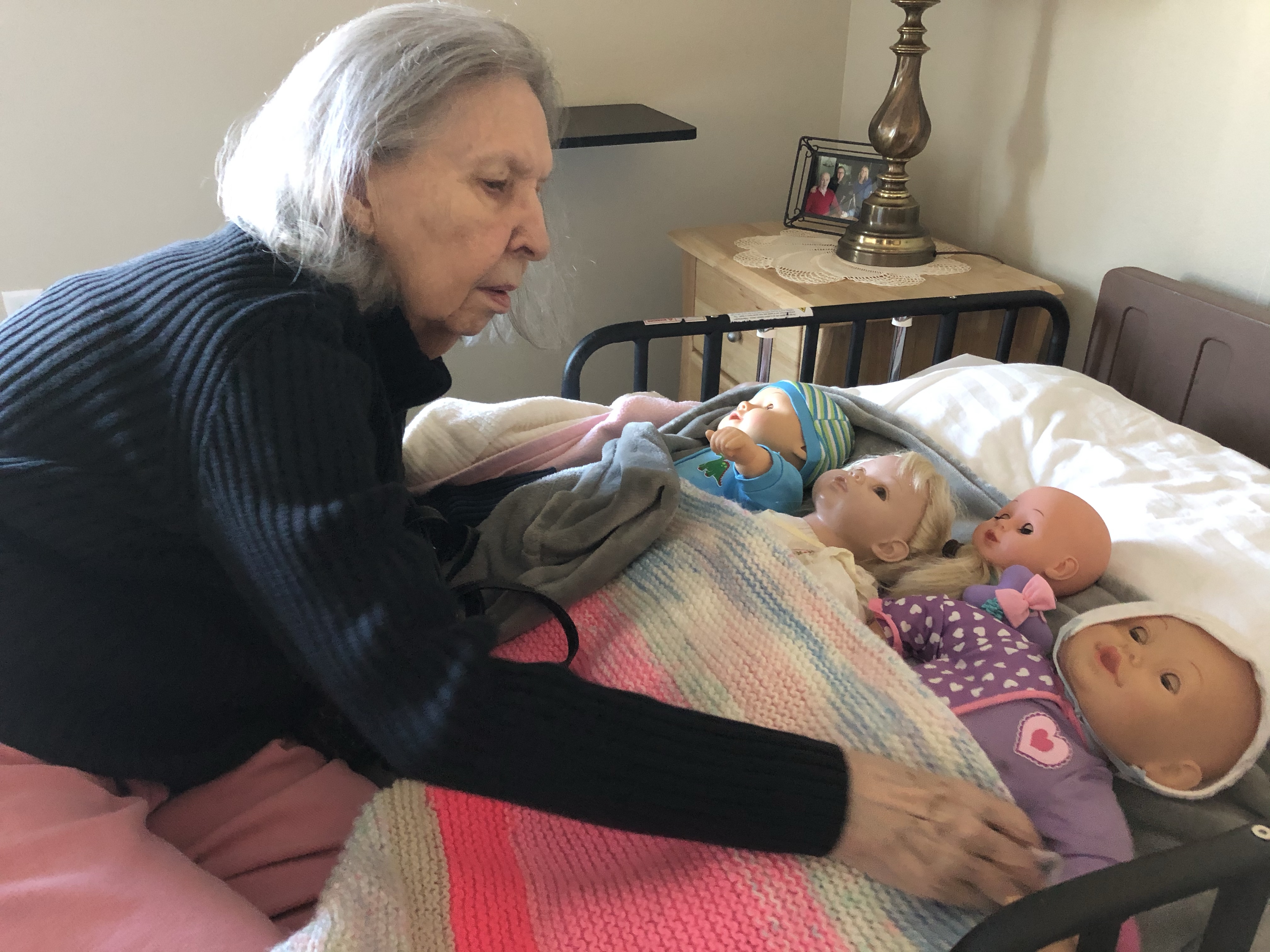
Momma lovingly putting her “babies” to bed
She usually couldn’t remember she was my mom, but I saw the loving mother in her displayed in the way she cared for dolls. It was like a special window into her past which allowed me the privilege of seeing what she may have been like when she mothered me as a baby. (Mom and me in this photo.)
Let me share just a few photos of her doing things which made her feel useful during her years spent living with dementia.
I’m thinking now of a resident at the assisted living memory care home where my mom lived for her last 14 months of life. June was usually the first one up every morning. She took very seriously her job of raising the window shades at the start of the day. The staff would then present her with a large basket filled with freshly laundered clothing protectors (bibs) and towels. June took great pride in folding them.
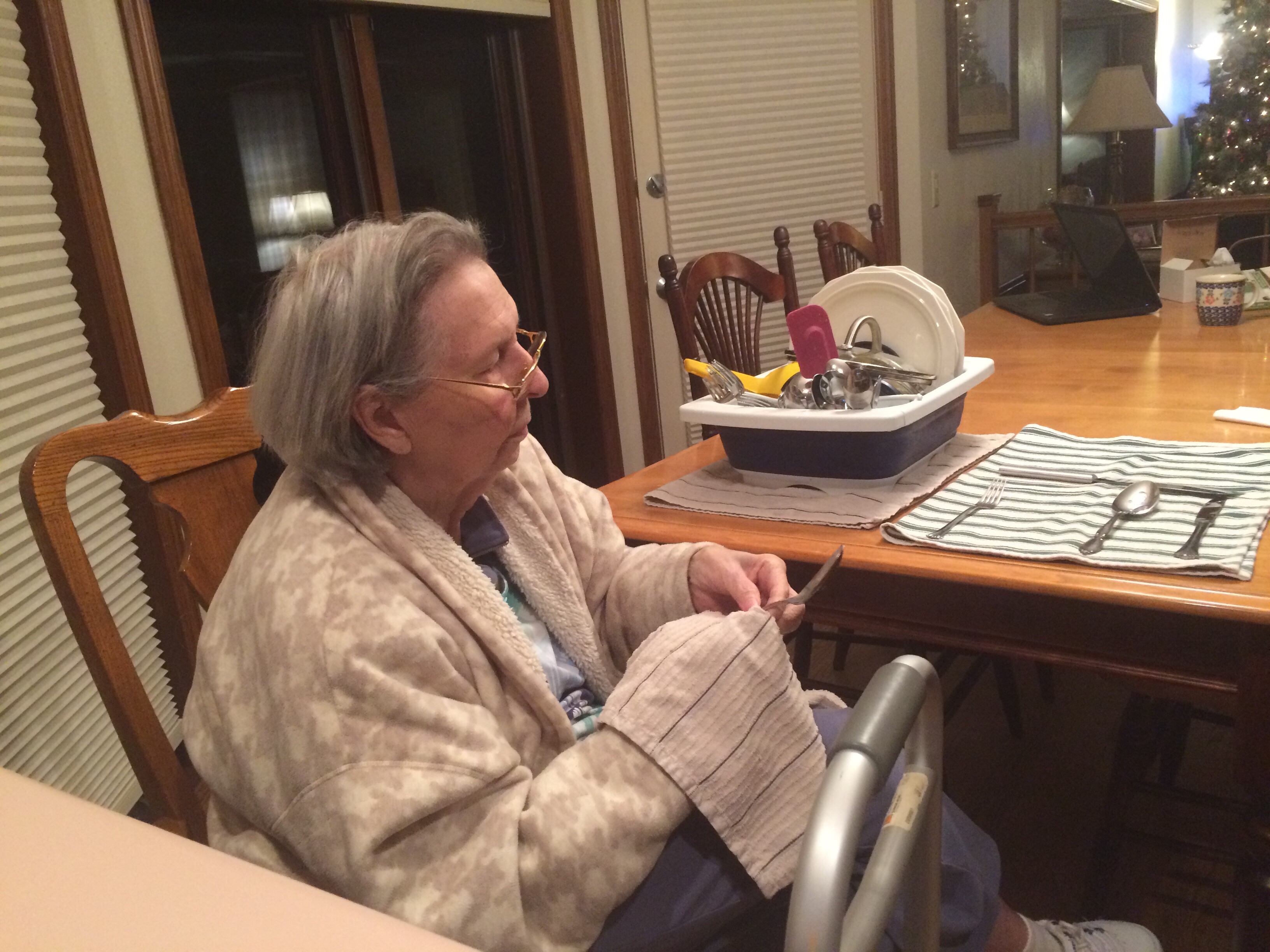
My mom would do the same thing when she was living with us for a few years. She loved to fold laundry, especially when it was warm out of the dryer. The warmth felt good on her arthritic hands. She would also dry dishes for us. Her legs were unsteady, so I would set her up with everything she needed at her place at the kitchen table. Mom had also been into gardening, so I would occasionally try to get her outdoors to help me. She especially enjoyed deadheading and cutting back spent foliage. Her specialty, however, was sweeping. She couldn’t stand to see even one leaf on the deck or porch, so we’d arm her with a broom and she’d happily sweep for quite some time.
I can’t talk about this subject without thinking of Heather, an amazing blogger I follow who cared for her sweet mother too. Heather’s mum, Margaret, had been an artist, so Heather would play to her mum’s interests and strengths by creating art therapy projects for her to work on throughout the day. They even opened an Etsy shop in order to sell some of her ‘Made by Mum’ projects, donating a portion of their profit to the Alzheimer’s Society. Heather’s amazing website Creative Carer is filled with photos and tutorials, a link to her very helpful and inspiring blog, and oodles of practical ideas for caregivers who desire to keep their loved one meaningfully engaged.
I write from my experience of caring for my sweet mother in her later years with Alzheimer’s. I hope that what I write will be an encouragement to those who are caring for someone they love.
Before you read this post, you might want read the A-Z Caregiving Tips (pictured below) which inspired me to write about my own experience related to these tips.
A diagnosis of cognitive impairment or memory loss presents caregiving challenges, each as varied as the person experiencing it. Alzheimer’s was the diagnosis that spelled memory loss for my sweet mom. I have already presented my experience with tips A – I, so let’s move right on to my take on J, K & L.
J just redirect me pleasantly if I keep repeating myself.
When memory loss becomes apparent to family and friends, it’s the repetition of stories which oftentimes raises the warning flag that something is amiss. Mom had several stories that would frequently replay. There was one she would tell about why she loves ice cream. Other repetitious stories related to how she acquired some of the items she owned, including three blue flowerpots and a purple tablecloth. I loved each of the stories and, as I mentioned in my last post, now I wish I had recorded her telling them.
Now, there’s nothing wrong with telling family stories around the dinner table. We all do it. It’s one of the best parts of gathering around the table for a shared meal. But, when the same story keeps looping during the same meal, that’s when things get a little tricky. It’s easy to hurt our loved ones by saying, “You already told me that a hundred times, Mom!” We’re tempted to roll our eyes and inwardly groan, “Oh no! Here we go again.”
That is where the art of pleasant redirection comes into play. In the world of dementia caregiving, there are many opportunities to practice this act of gently helping a forgetful loved one refocus their attention on something else.
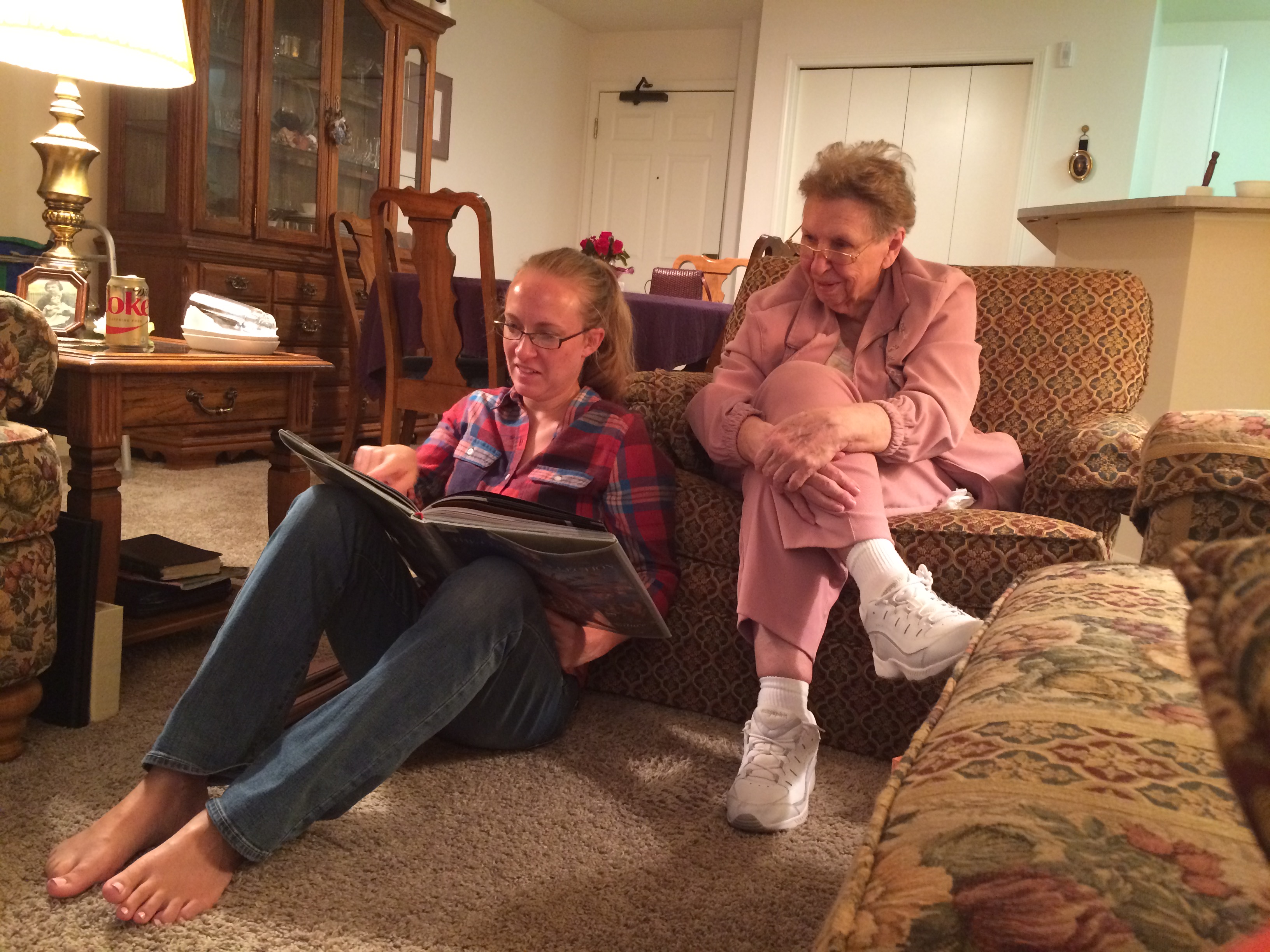
My granddaughter provided one of the best examples of gentle redirection that I have ever seen. My mom found my to-do list on the kitchen table. Thinking it was her own list, mom kept reading the list over and over again, worrying about getting it all done. Violet (who was probably 12 years old at the time) brought a photo album to the table and sat next to her great-grandmother. In one stealth move, Violet opened the photo album and placed it in front of her GGma as she simultaneously slid the list away from view. Then she started paging through the album and talking about the photos. My Mom’s worries melted away and she was immediately engaged in this new direction of thought.
In fact, photo albums and picture books are one of the greatest tools in the toolbox of dementia redirection.
Sometimes, mom would ask the same question repeatedly. One such question had to do with her finances–something she couldn’t handle on her own anymore, but continued to worry about. My husband handled her finances for her and greatly helped alleviate this worry by creating a single page monthly statement which listed all of her financial bottom-line numbers in one place. Mom could read this over and over to her heart’s content. [I explained more about this in Alzheimer’s and Money Worries, which may be of help to anyone going through this stage with a loved one.] If mom was having a fretful moment about money, we could hand her this statement, which we kept on a clipboard. She would sit and read (and re-read) it for a very long while and would often comment about how helpful it was to her.
K Know that closing my eyes may be me trying to find my words.
Word finding is one of the earlier struggles I noticed in my mom’s journey with Alzheimer’s. It’s a problem I am wrestling with these days too. I have noticed that when I am struggling to figure out which word I want to use during a conversation, my family and friends will often provide the word for me during my long pause. Most of the time I appreciate the help; other times it just deepens my awareness and the inkling I have that my later years of life are headed in the same direction of memory loss that my mom experienced.
In fact, photo albums and picture books are one of the greatest tools in the toolbox of dementia redirection.
I don’t remember mom closing her eyes when she was trying to think of what she was going to say–at least not in the earlier stages. I remember that she would avert her eyes upwards and away, as if she was searching the corners of her mind for what she wanted to say. I do this too. I have also noticed something in my own pause to search for the words. By the time I’m ready to add my words to table talk conversation, the direction of the conversation has moved on to something else. It’s frustrating, but it reminds me of something important when engaging in conversation with my memory-challenged friends at my workplace. Don’t be in such a rush–wait for them to answer.
L Listen with me to music and dance tunes.
Mom would rather sit quietly and read a book or magazine than dance or listen to music. It’s not that mom didn’t like music; rather, her hearing deficit made listening to music more than a little bit challenging. While this point doesn’t apply much to my mom, it does bring to mind my work place. I work as a baker in an assisted living memory care home and am sometimes surprised by the music being played in the background for our residents. Sometimes I think the music chosen reflects the preference of the caregiver on duty, rather than the tastes of the generation being served.
The other thing I’ve noticed is that the radio or television in our care home is oftentimes playing too softly. The younger folks who work as the caregivers don’t seem to take into account the need for extra volume in this older population. Nor do we pay enough attention to what is being broadcast on the television in our common spaces. It’s much better, for instance, to choose a classic movie from the era in which these folks lived, rather than a talk show featuring four women arguing their views. Better (in my opinion) to choose a nature show over a scary, blood and guts movie.
Don’t get me wrong–our care home is fantastic and is blessed with a number of great caregivers. But, there is one caregiver who I find to be absolutely delightful. She will put on music the residents love and engage in a little song and dance. She’ll even make up her own tune or sing a familiar jingle, even if she’s just passing through the room on her way to her next task. If they’re having an exercise class, she’ll join in and spread her own brand of love, laughter, song and encouragement. Marnie makes the residents smile (and me too).
The world of memory care caregivers needs more Marnies.



















 Barefoot Lily Lady