I confess that I haven’t read any of this author’s books, so am not sure of the author’s context for this quote. I do know that his philosophy of life leans toward encouraging simple, minimalistic living. Its something to which I aspire, especially since I have reached the summit of decade six and am now careening at breakneck speed toward number seven. However, each time I read, “Be a curator of your life,” something strikes me as being untrue in my life. While I do make choices each and every day to simplify my life, I’m not so sure I am (or even want to be) my life’s curator.
God is a better Curator of my life.
As I look back over the past several years, I see things in it that I wouldn’t choose, but He allowed. I’ve seen family relationships crumble — not something I orchestrated or desired, but even that hardship passed the muster of His divine curatorship in my life for my ultimate good and His glory.
On this day in 2020, my life took an expected turn which left me with more unexpected feelings than I ever dreamed possible. It was the day my momma met Jesus face to face. It was fully expected–I knew in my heart she would be leaving. When my sweet momma breathed her last, my role as her daughter, friend and caregiver suddenly ended. While the weight of years of caring for her was now lifted from my shoulders, I also felt an unexpected void that my “purpose” as mom’s caregiver had previously filled. Even in the midst of incredible grief, my sadness was wrapped in the grateful realization that my loving God had edited and rearranged my life in a way I could never have planned so that I could walk my sweet momma Home.
The heart of man plans his way, but the Lord establishes his steps.
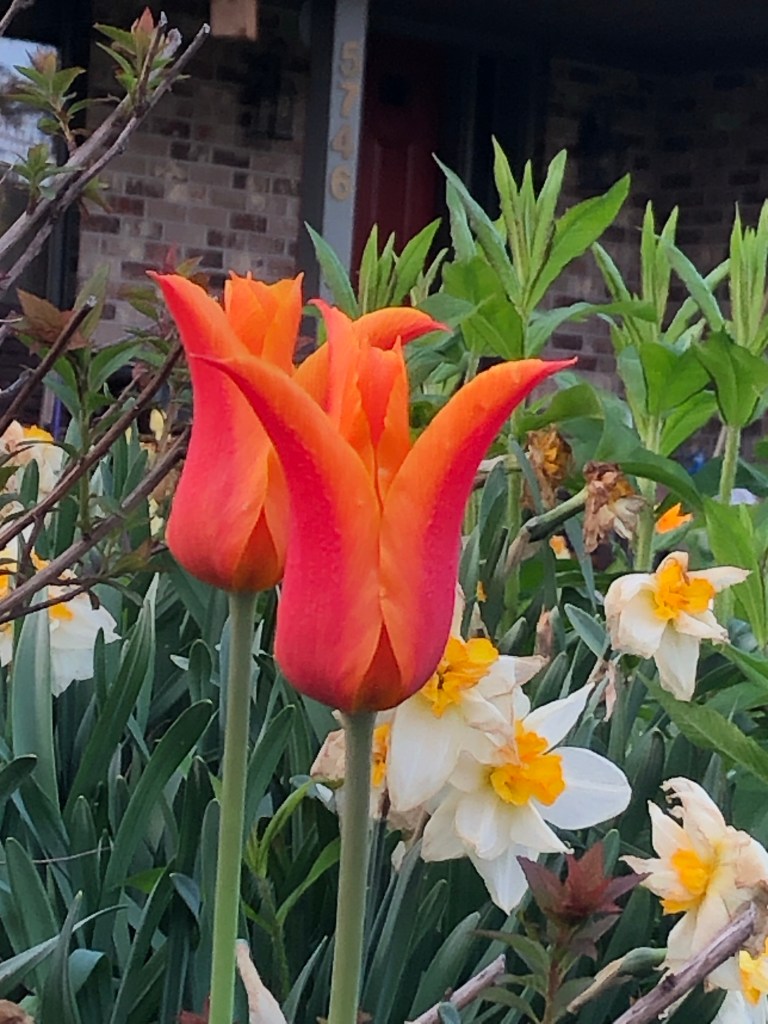
I am joining Jim and my gardening friends worldwide for a little Six on Saturday garden update. Wisconsin has been slow on the draw declaring it Spring, but I think it’s finally arrived. Spring has sprung in all its tulip, daffodil, and flowering tree wonderfulness. So, come along with me for a little tour of six(-ish) things happening in my garden–then hop on the virtual garden club tour bus via Jim’s blog at https://gardenruminations.co.uk/2023/05/13/six-on-saturday-13-5-2023/ and wander through a few more gardens.
Coffee in hand, I have been sitting in my favorite chair taking a break from today’s gardening endeavors. The knees of my blue jeans are wet and a bit muddied because I should have made an extra trip to the garage to retrieve my knee cushion (but didn’t). My cushion is an old seat cushion from my brother’s wheelchair and has served me well for several years now. It’s nice and cushy for my aging knees, and big enough to provide a dry place for me to sit when the grass is wet with morning dew. [I am making a mental note to grab it when I go back outside in a few minutes.]
I chose the east side of my house as my focus for today’s weeding and cleanup endeavors. In years past, it has been the side of the house which few people see. However, this year we took down two unhealthy spruce trees in our front yard, giving passersby an unobstructed view of a flowerbed which had previously been fairly well hidden. I have decided to put a little extra effort into this garden space and see if I can make something special out of it–something which my neighbors can enjoy.
But now, at this moment, it’s overgrown with lamium (a noxious weed disguised as a plant), and many weeds and over-wintered, water-soaked hosta leaves. As I pull my hand rake through the tangled bed of yuck, the green shoots of this year’s floral promise are slowly uncovered.
There, under last season’s detritus, are the green tips of an emerging hosta, alongside the peony my dad dug for me from his garden a few decades ago.
As I cleared away last year’s fallen leaves, I found this lovely patch of pulmonaria bedazzled with pink and blue little bells. Even when the flowering finishes, I just love the fuzzy, bespeckled leaves. [Take a gander here if you’d like more photos and info about the pros and cons of this lovely plant.]
April weather is absolutely crazy in Wisconsin. Spring? Summer? Winter? It can’t make up its mind! One day I’m working barefoot in my garden–the next day snow squalls are springing up here and there, or hail is pelting the house. Our crazy weather reminds me that life is unpredictably subject to change without advance notice. In this earthly body, I have this moment and this breath–and have no guarantee of the next. This thought encourages me to make every moment and every breath that I can a beautiful one and to make sure my heart is ready for that first breath of heaven.
For we know that if the tent that is our earthly home is destroyed, we have a building from God, a house not made with hands, eternal in the heavens. ~ 2 Cor. 5:1 (ESV)
Here’s the next in a series of Tuesday’s Caregiving Tips posts inspired by A-Z Caregiving Tips (an article in Alzheimer’s Today pictured below). A diagnosis of cognitive impairment or memory loss presents caregiving challenges, each as varied as the person experiencing it. Alzheimer’s was the diagnosis that spelled memory loss for my sweet mom. You can read my previous posts for my personal tips on A – O. Today I am sharing my thoughts about “P” and “Q.” Thanks for stopping by to read my blog. Readers, you are most welcome (and encouraged) to share your own tips and observations about dementia caregiving in the comments below.
If the generation before me said, “Mind your p’s and q’s”, it was usually said in a firm tone of voice. It meant be polite and mind your manners–it might also mean to watch your language. Today we have come to the letters ‘P’ and ‘Q’ in our alphabet-inspired suggestions for dealing with loved ones with dementia. Both letters speak to watching what we say–‘P’ encourages us to fashion our conversations in an encouraging way, and ‘Q’ reminds us to omit certain words in order to help our loved one avoid the embarrassment of not being able to remember a person or specific event. Both are equally valuable tools in the toolbox for good caregiver communication.
Please affirm what I contributed and still do contribute.
I feel like I’ve covered this in previous posts, but it probably can’t be overstated. For as long as my sweet Momma was able, it was important to let her tell and retell her stories of her years as a nurse. The day would come when she could no longer recount those stories. At that point, it became my turn to tell her the stories I remembered her telling me. One such conversation went something like this:
Momma, I remember when the whole city of Milwaukee was snowed in and you stayed at the hospital and worked three days in a row because no one could get to work on the deep, snow-drifted roads. Then someone gave you a ride home on a snowmobile. First, you had them take you to the grocery store so you could buy your family food to eat, then he took you the rest of the way home. I remember that, even though you were very tired, you fixed us supper, then slept for a very long time.
The story was actually a confabulation — a mixture of truth and her own version of the truth. As a nurse, she had always worn a watch with a sweep-second hand so she could take pulses the old-fashioned way. Momma still liked to wear the last watch she owned as a nurse. There came a day when neither story lingered in her mind. It was my turn to point to her watch and help her recapture that story, if only for a moment.
Oh, how my mom loved to work with children–her own and the children of others. In addition to being a very involved mom, she was also a leader of a local Brownie troop. Later, she would work for many years as the secretary for the Awana girls’ club. Her grandchildren adored her. No doubt the open-fridge policy had something to do with their love of spending time at their grandparents’ home, but their teenage years were nurtured and fed in more ways that food because mom and dad gave each of them a housekey and made sure they knew they were always welcome.
For my part, I loved to reminisce with mom about some of the special ways she blessed our family. I would show her photos of some of the fun times she had when working with kids in the Awana program.
One way I helped mom feel like she was still contributing something valuable was by inviting families with young children to come and share a meal with us. I would tell mom that the kids were hoping she’d teach them something about coloring, or help them with a hard puzzle. She delighted in those times around the kitchen table. As they colored, she’d proffer her wisdom in how to hold the crayon or colored pencil in such a way as to shade the color onto the paper evenly. If she was working on a puzzle with her little friends, she’d share a tip and demonstrate how to put puzzle pieces in color groupings to make it easier to find the piece needed.
Quit quizzing me with Who, What, Where and When questions. I would add Why to the questions we needn’t ask.
In the earliest stages of Alzheimer’s, mom seemed to struggle with the Who questions the most, followed by Where. Names which had been familiar would drop off her radar. As I spent more time with my mom, I learned not to ask her who she had lunch with on Sunday, or who taught the discipleship class she attended. As the names of family started to slip, I learned to slip the name of the person we were with into the conversation so that mom could be reminded of the name.
For instance, as her neighbor and friend, Gisela, was approaching to have a chat with mom in the front yard, I’d greet Gisela by name. Later in the conversation, I’d say something like, “So, Gisela, you and mom have lived in this neighborhood together for over 50 years, haven’t you?” Then the conversation could continue with mom and Gisela reminiscing about old times.
Minding our p’s and q’s in dementia caregiving helps ensure a smoother passage on the labyrinthian road in life marked by memory loss. Thus far in medical research, there are no fixes for this formidable detour of the mind. Caregivers with a well-equipped “caregiving toolbox” can bring roadside assistance and a little extra joy along the way.
My husband knows I would much prefer a new plant for my garden over cut flowers–but the fragrant bouquet he gave me on Valentine’s Day was certainly a lovely way to remind me of his love for me and fill the wintery gap between now and the time when I can play in the dirt outside.
A breath of Spring and the hope of barefoot gardening days ahead.
As my Valentine’s Day flowers begin to droop and fade, I am reminded that Valentine’s Day can be difficult for some. In my personal circle of friends and family, several were bereaved of a loving spouse in the past year or two. Others are going through a valley experience in life and wondering whether their Valentine will be there to love on next year. None of us knows whether we have the next breath. Romantic love is wonderful, but temporary. Finding ways to express Christ-like love is the best. I love Paul Tripp’s article filled with 23 ideas for sharing love with others in 2023.
Did you have a wonderfully romantic Valentine’s Day? Or was any reference to romance or marriage painful for you this year? Maybe it was fun, flirty, and a celebration of the good season you are in. Or perhaps you had a conflict-filled week, and Valentine’s Day felt fake, forced, and a cover up.
Personally, I love romance. I am way over on the romantic end of the emotional spectrum. I do think romance, romantic gestures, gifts, dates, and surprises are an important ingredient in a healthy marriage.
But romance is not love. Romance is not a fruit of the Spirit. You can be a follower of Jesus, filled with Holy Spirit, lacking romance yet incarnating the love of Christ.
This is love: “Not that we have loved God but that he loved us and sent his Son to be the propitiation for our sins. Beloved, if God so loved us, we also ought to love one another” (1 John 4:10-11, ESV).
Regardless of your marital status, here are 23 ways to express cruciform love—”in the shape of the Cross” love—in 2023.
1. Love is willing self-sacrifice for the good of another that does not require reciprocation or that the person being loved is deserving. 2. Love is being willing to have your life complicated by the needs and struggles of another without impatience or anger. 3. Love is actively fighting the temptation to be critical and judgmental toward another, while looking for ways to encourage and praise. 4. Love is the daily commitment to resist the needless moments of conflict that come from pointing out and responding to minor offenses. 5. Love is being lovingly honest and humbly approachable in times of misunderstanding, and being more committed to unity and love than you are to winning, accusing, or being right. 6. Love is a daily commitment to admit your sin, weakness, and failure and to resist the temptation to offer an excuse or shift the blame. 7. Love means being willing, when confronted by another, to examine your heart rather than rising to your defense or shifting the focus. 8. Love is a daily commitment to grow in love so that the love you offer to another is increasingly selfless, mature, and patient. 9. Love is being unwilling to do what is wrong when you have been wronged but to look for concrete and specific ways to overcome evil with good. 10. Love is being a good student of another, looking for their physical, emotional, and spiritual needs so that in some way you can remove the burden, support them as they carry it, or encourage them along the way. 11. Love means being willing to invest the time necessary to discuss, examine, and understand the problems that you face in your relationship, staying on task until the problem is removed or you have agreed upon a strategy of response. 12. Love is always being willing to ask for forgiveness and always being committed to grant forgiveness when it is requested. 13. Love is recognizing the high value of trust in a relationship and being faithful to your promises and true to your word. 14. Love is speaking kindly and gently, even in moments of disagreement, refusing to attack the other person’s character or assault his or her intelligence. 15. Love is being unwilling to flatter, lie, manipulate, or deceive in any way in order to co-opt another into giving you what you want or doing something your way. 16. Love is being unwilling to ask another to be the source of your identity, meaning and purpose, or inner sense of well-being, while simultaneously refusing to be the source of theirs. 17. Love is the willingness to have less free time, less sleep, and a busier schedule in order to be faithful to what God has called you to be and to do in that relationship. 18. Love is a commitment to say no to selfish instincts and to do everything that is within your ability to promote real unity, functional understanding, and active love in your relationship. 19. Love is staying faithful to your commitment to treat another with appreciation, respect, and grace, even in moments when he or she doesn’t seem to deserve it or is unwilling to reciprocate. 20. Love is the willingness to make regular and costly sacrifices for the sake of your relationship without asking anything in return or using your sacrifices to place the other person in your debt. 21. Love is being unwilling to make any personal decision or choice that would harm your relationship, hurt the other person, or weaken the bond of trust between you. 22. Love is refusing to be self-focused or demanding but instead looking for specific ways to serve, support, and encourage, even when you are busy or tired. 23. Love is daily admitting to yourself, the other person, and God that you are not able to love this way without God’s protecting, providing, forgiving, rescuing, and delivering grace. We love because he first loved us! God bless, Paul David Tripp
There are people in my life I am having great difficulty loving as I should. This list reminded me of ways I can show Christ-like love to these prickly-hard-to-love people. I plan to print it and put it in my prayer journal as a guide, not only to prayer, but for putting love into action.
My hope and prayer is that this post will encourage someone who reads this to greater love in your circle of people who need His love.
In talking with other caregivers, I realize all the more keenly how incredibly blessed I was to have an amazing support system. In a recent post, I (re)shared with my readers how my loving church family came alongside me to help me in caring for my sweet mom. Today I am (re)sharing another note that I wrote and published on Facebook in 2017–which was the year mom’s Alzheimer’s disease dramatically advanced.
You’ve put years of your life on “pause” so that you can provide the care your loved one deserved during the worst years of their life. Then, all at once, it seems, what you’ve known would happen all along finally happens.
They’re gone.
Yet, when it comes time to hit the “play button” and get on with your life, you discover you’re not the same person you were. The all-encompassing caregiving experience has changed your life.
So, you may ask, what has changed?
In addition to knowing more about Alzheimer’s than I ever dreamed possible, I have a whole new skill set. I work with certified nursing assistants and am continually amazed at how much of what they have learned in their training I learned by necessity.
I’m much more assertive than I was prior to caring for my mom. I learned this by being an advocate for my mom and my brother with their physicians and healthcare insurance providers. I learned to speak up for what was right while making countless phone calls to people and organizations who were preying on mom and helping her spend her modest pension and Social Security income. My newly acquired boldness helped me to relentlessly insist upon a refund from the companies taking hundreds of dollars from her every month.
Another thing has changed too. My eyesight. My physical vision is changing due to a pair of cataracts, but the vision I’m talking about isn’t physical.
It’s an internal ability to see the caregivers around me more clearly than ever.
Not long ago, my hubby took me out for lunch. I saw the caregiving granddaughter sitting in the corner with her memory-challenged grandma. While others probably tuned it out, I heard her gently answering her grandma’s myriad questions — over and over again. I heard this precious granddaughter sharing and resharing the “news” of her pregnancy and the baby who would arrive in July – to the beautiful and heartrending delight of that baby’s great-grandma. I could see that granddaughter rewinding bits and pieces of her conversation: that she lived just down the block from her grandma, the names and ages of her children, what they were doing in school, and all of the details about which her grandmother was curious.
With caring for Momma behind me, and eyes that are now wide open to the world of dementia caregivers, it’s my heartfelt desire to press life’s “play button” again—this time purposefully engaging with and caring for the caregivers I encounter all around me.
I am a caregiving daughter forever changed by Alzheimer’s.