

I just came from the post office and feel like I need to share an update related to the bumpy road of paperwork related to redetermining my brother’s Medicaid status. In my last post, I shared that I felt somewhat alone in the task of coming up with answers to the who, what, when, why and where questions on the lengthy MADR form (Medicaid Disability Redetermination Report).
Continue reading “How Big is this Problem? Part 2”Tag: Caregiver
Sowing Financial Wisdom
My financial advisor shares his wisdom concerning Social Security.

Financial stuff is not my usual topic to write about. I’m more about gardening, as my blogger handle suggests. From time to time, I also write about Alzheimer’s caregiving, a topic about which I am passionate due to my experience in caring for my mother and my brother. I occasionally share slices of life, like a biblical truth gleaned from my study of scripture, a fun thing I experienced with my grandkids, or a tasty recipe I’d like to share. I can barely write a check and keep a checkbook balanced, so I’m not the person you want to ask for financial advice. Conversely, my husband loves to juggle numbers in a spreadsheet and writes about financial matters with great regularity. He recently wrote an informative article on a subject which I’ve been pondering lately.
Continue reading “Sowing Financial Wisdom”Rewind: The Love of a Grandchild

My granddaughter Violet is serving the Lord as a counselor at Camp Fairwood this summer, as she did last year. The three years prior to that, she served on the kitchen staff. She loves it, as did I when I was on the staff as a teenager many moons ago. It blesses my heart knowing she is walking by faith and serving her Savior each summer. But, I do miss her.
Violet is the grandkid who was very prolific in writing sweet notes to me throughout her growing up years. I kept some of them in the places she hid them, just so I can enjoy stumbling upon them from time to time. They always bring a smile to my face and joy to my heart. I’ve saved all of the other notes in a big glass brandy snifter, including the little notes from the story I am reposting below.
Go ahead. Write a note to someone you love. I promise you’ll make their day.
Alzheimer’s Caregiver: Dealing with Aggressive Behavior

If you ever had the pleasure of knowing my mom, you would probably describe her as one of the kindest and most caring people you have ever met. Her sweetness was a predominant character quality, even as Alzheimer’s claimed more of her memories and abilities. I’ve written about her loving care for doll babies, and about how the nurse came out in her so often in her last year of life in assisted living memory care. Here are a few photos of her sweet self.
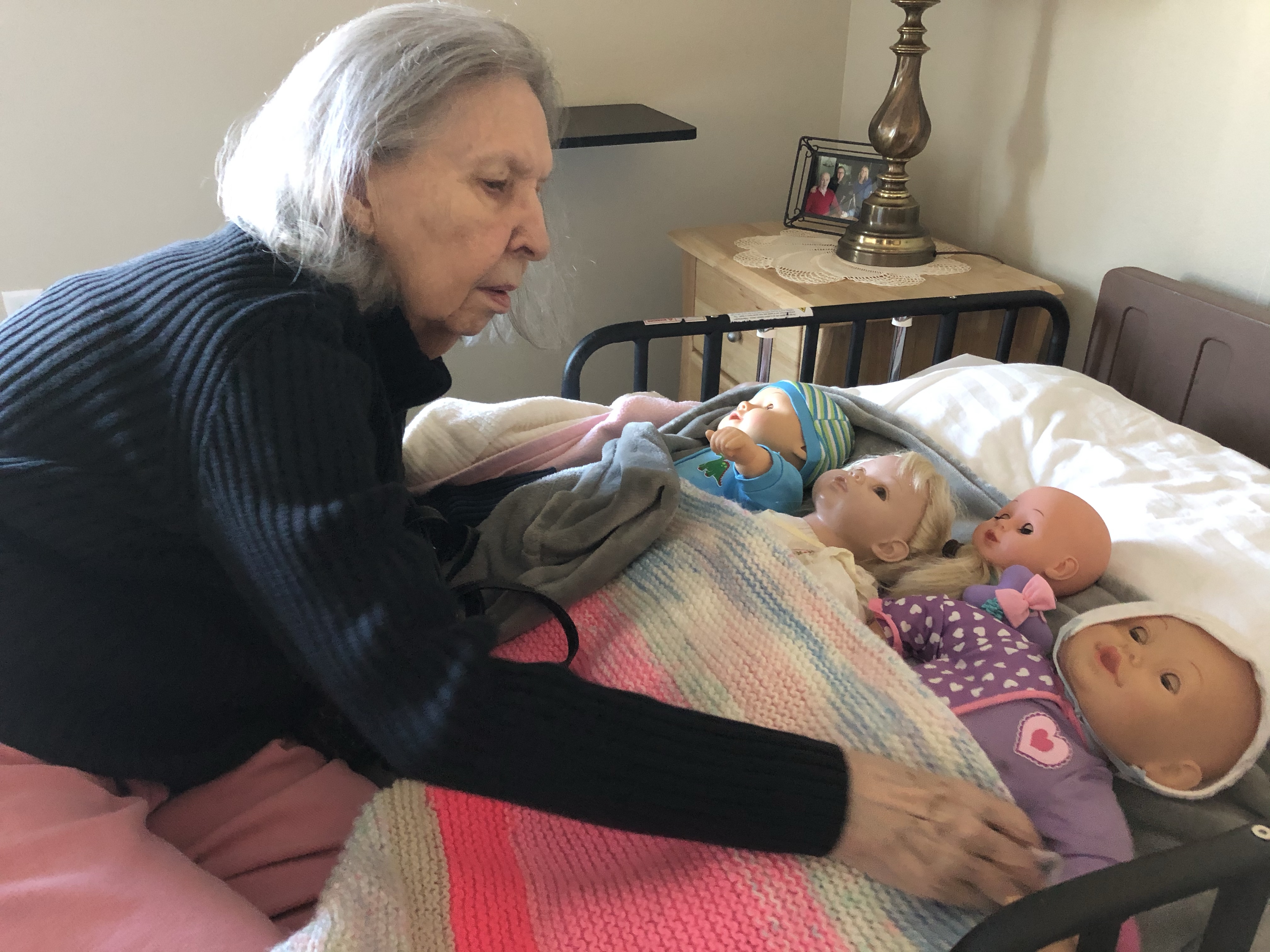


Sometimes, however, momma wasn’t so sweet. She’d take a swing at my head when I was kneeling in front of her trying to help her tie her shoes. She once threw a frozen dinner at my brother when he was sick in bed and started screaming at him. We theorize that she was just so very frustrated that she couldn’t remember how to work a microwave anymore–she wanted to help him, but didn’t know how. In assisted living memory care, a mean streak would occasionally surface when someone was assisting her with a shower. Mom wasn’t one to use profanity, but would very occasionally let angry words fly when someone was just trying to help her.

It wasn’t mom. It was what Alzheimer’s was doing as it ravaged her brain.
It can be very stressful for the caregiver when someone they love suddenly becomes combative and aggressive. Sometimes there are physical reasons why a loved one is lashing out – like pain, or a urinary tract infection, or frustrations over not being able to physically do something (like tie her own shoes, or stand without assistance).
Timing
For my momma, it was sometimes the timing of what she was being requested to do. We learned very early on that it was futile to awaken her for a meal or a shower—that was just begging for angry outbursts and uncontrollable tears. Sometimes she’d refuse food at mealtimes. We learned it was best to just let her be—she would often forget she was mad and be sweet as pie when you reintroduced the same plate of food a few minutes later.

Speaking of pie, we also learned that if we would “lead with sweet” by serving mom’s dessert at the beginning of her meal, she’d eat her dessert and then just keep going. It also helped to let mom bring Dolly with her to meals. Dolly didn’t eat much, but sometimes needed her face washed after meals.
Fear
Sadly, my mom oftentimes became very agitated and fearful at the prospect of taking a shower. This is VERY common. I first noticed it in the moderate stage of dementia. If a shower was suggested, she’d have every reason in the world not to do it now. She generally used stall tactics, like, “Later.” Or, “I already showered before you got here.” As the disease progressed, there would be no question about it—mom would NEED a shower. One of the wisest things I ever did as a caregiver was to hire help for bathing. I was extremely thankful for the aides who came to assist with this need. Their training prepared them for the ups and downs of performing the necessary hygiene tasks, and each aide had tricks up her sleeve as to how to help alleviate mom’s fear and anxiety.
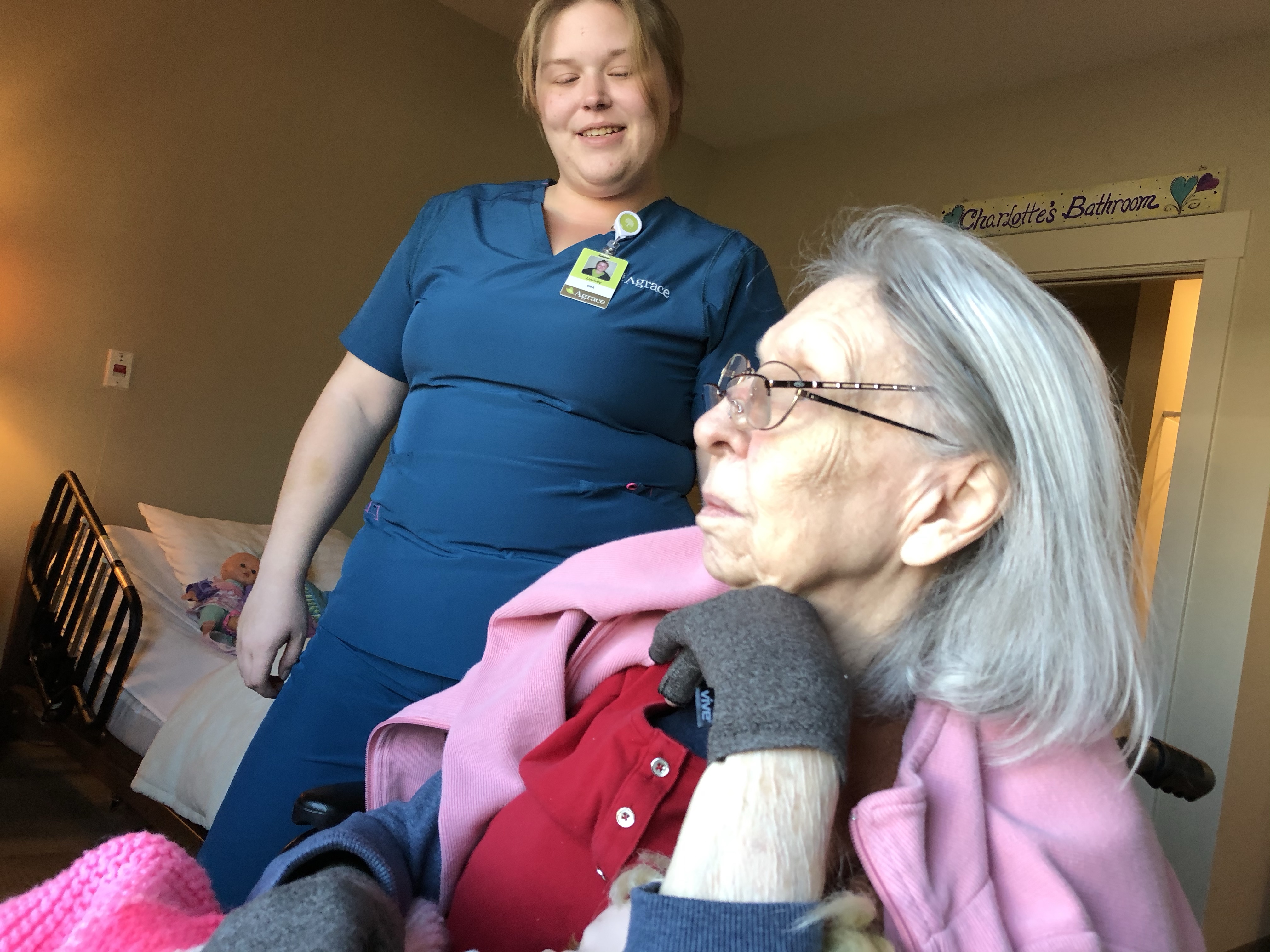
There were times when even the aides were unsuccessful. Sometimes the best we could do was give mom a bed-bath or a quick wipe-down. I found it really convenient and helpful to use these disposable washcloths–they could be warmed in the microwave, which mom found very soothing.

My heart goes out to you caregivers who are dealing with combative and aggressive behavior with your loved one. Every situation is different, but I hope my experience with mom will help someone else get through this. If you’d like more information, you might want to check out this informative and helpful article, “Dealing with Aggressive Behavior”.
Curating Life
I’ve seen this meme floating around on social media a bit lately.

I confess that I haven’t read any of this author’s books, so am not sure of the author’s context for this quote. I do know that his philosophy of life leans toward encouraging simple, minimalistic living. Its something to which I aspire, especially since I have reached the summit of decade six and am now careening at breakneck speed toward number seven. However, each time I read, “Be a curator of your life,” something strikes me as being untrue in my life. While I do make choices each and every day to simplify my life, I’m not so sure I am (or even want to be) my life’s curator.
God is a better Curator of my life.
As I look back over the past several years, I see things in it that I wouldn’t choose, but He allowed. I’ve seen family relationships crumble — not something I orchestrated or desired, but even that hardship passed the muster of His divine curatorship in my life for my ultimate good and His glory.
On this day in 2020, my life took an expected turn which left me with more unexpected feelings than I ever dreamed possible. It was the day my momma met Jesus face to face. It was fully expected–I knew in my heart she would be leaving. When my sweet momma breathed her last, my role as her daughter, friend and caregiver suddenly ended. While the weight of years of caring for her was now lifted from my shoulders, I also felt an unexpected void that my “purpose” as mom’s caregiver had previously filled. Even in the midst of incredible grief, my sadness was wrapped in the grateful realization that my loving God had edited and rearranged my life in a way I could never have planned so that I could walk my sweet momma Home.
The heart of man plans his way,
Proverbs 16:9 (ESV)
but the Lord establishes his steps.
A-Z Caregiving Tips (P & Q)
Here’s the next in a series of Tuesday’s Caregiving Tips posts inspired by A-Z Caregiving Tips (an article in Alzheimer’s Today pictured below). A diagnosis of cognitive impairment or memory loss presents caregiving challenges, each as varied as the person experiencing it. Alzheimer’s was the diagnosis that spelled memory loss for my sweet mom. You can read my previous posts for my personal tips on A – O. Today I am sharing my thoughts about “P” and “Q.” Thanks for stopping by to read my blog. Readers, you are most welcome (and encouraged) to share your own tips and observations about dementia caregiving in the comments below.

If the generation before me said, “Mind your p’s and q’s”, it was usually said in a firm tone of voice. It meant be polite and mind your manners–it might also mean to watch your language. Today we have come to the letters ‘P’ and ‘Q’ in our alphabet-inspired suggestions for dealing with loved ones with dementia. Both letters speak to watching what we say–‘P’ encourages us to fashion our conversations in an encouraging way, and ‘Q’ reminds us to omit certain words in order to help our loved one avoid the embarrassment of not being able to remember a person or specific event. Both are equally valuable tools in the toolbox for good caregiver communication. 
Please affirm what I contributed and still do contribute.
I feel like I’ve covered this in previous posts, but it probably can’t be overstated. For as long as my sweet Momma was able, it was important to let her tell and retell her stories of her years as a nurse. The day would come when she could no longer recount those stories. At that point, it became my turn to tell her the stories I remembered her telling me. One such conversation went something like this:
Momma, I remember when the whole city of Milwaukee was snowed in and you stayed at the hospital and worked three days in a row because no one could get to work on the deep, snow-drifted roads. Then someone gave you a ride home on a snowmobile. First, you had them take you to the grocery store so you could buy your family food to eat, then he took you the rest of the way home. I remember that, even though you were very tired, you fixed us supper, then slept for a very long time.
Momma would tell and retell the story of her watch.
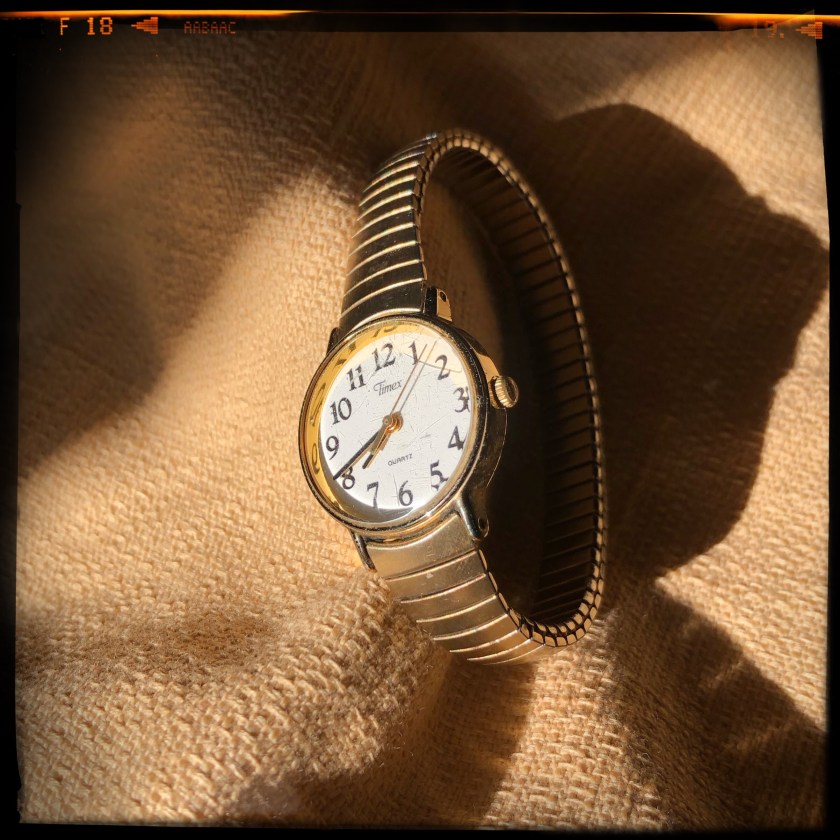
The story was actually a confabulation — a mixture of truth and her own version of the truth. As a nurse, she had always worn a watch with a sweep-second hand so she could take pulses the old-fashioned way. Momma still liked to wear the last watch she owned as a nurse. There came a day when neither story lingered in her mind. It was my turn to point to her watch and help her recapture that story, if only for a moment.
Oh, how my mom loved to work with children–her own and the children of others. In addition to being a very involved mom, she was also a leader of a local Brownie troop. Later, she would work for many years as the secretary for the Awana girls’ club. Her grandchildren adored her. No doubt the open-fridge policy had something to do with their love of spending time at their grandparents’ home, but their teenage years were nurtured and fed in more ways that food because mom and dad gave each of them a housekey and made sure they knew they were always welcome.
For my part, I loved to reminisce with mom about some of the special ways she blessed our family. I would show her photos of some of the fun times she had when working with kids in the Awana program.
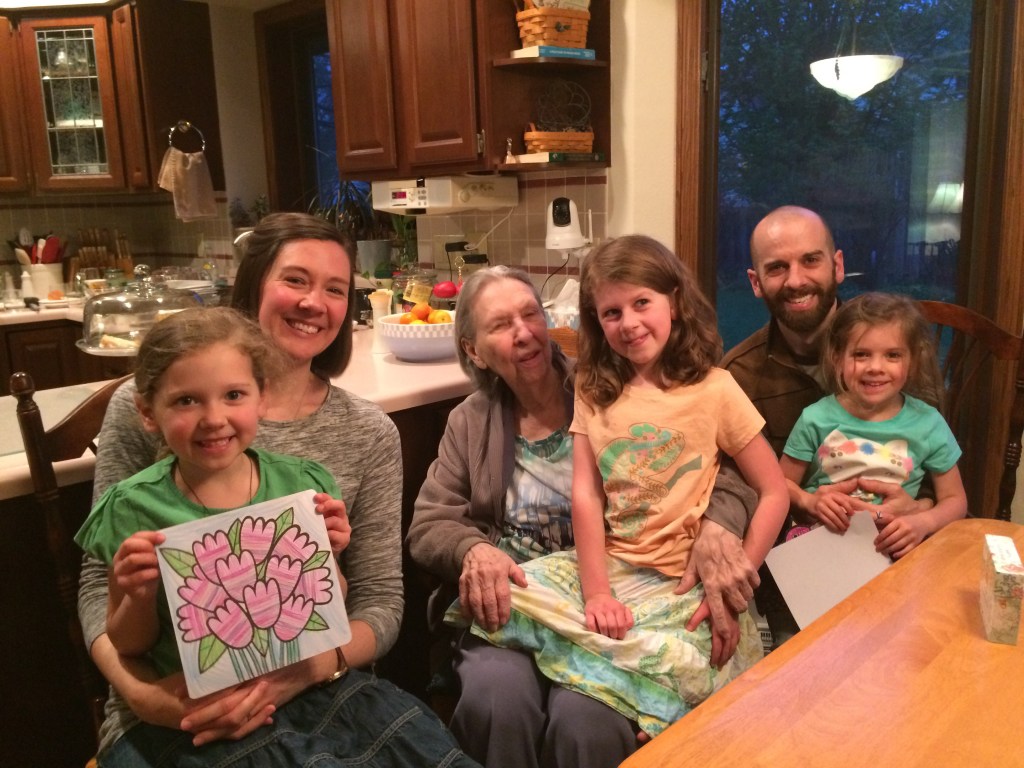
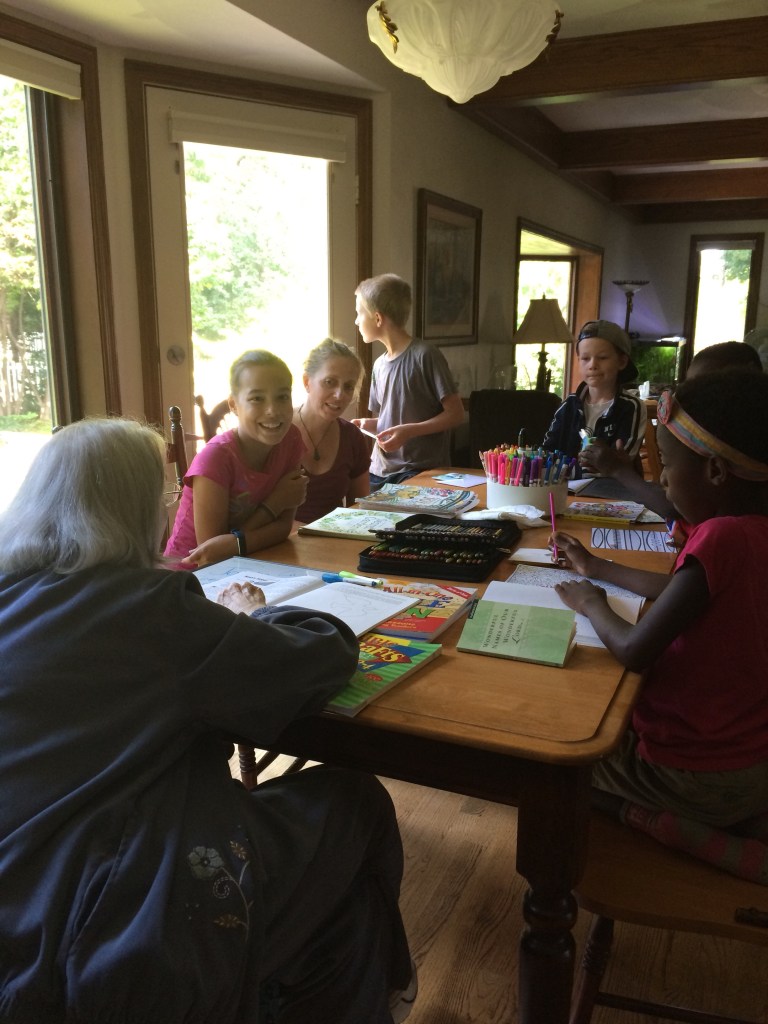
One way I helped mom feel like she was still contributing something valuable was by inviting families with young children to come and share a meal with us. I would tell mom that the kids were hoping she’d teach them something about coloring, or help them with a hard puzzle. She delighted in those times around the kitchen table. As they colored, she’d proffer her wisdom in how to hold the crayon or colored pencil in such a way as to shade the color onto the paper evenly. If she was working on a puzzle with her little friends, she’d share a tip and demonstrate how to put puzzle pieces in color groupings to make it easier to find the piece needed.

Quit quizzing me with Who, What, Where and When questions. I would add Why to the questions we needn’t ask.
In the earliest stages of Alzheimer’s, mom seemed to struggle with the Who questions the most, followed by Where. Names which had been familiar would drop off her radar. As I spent more time with my mom, I learned not to ask her who she had lunch with on Sunday, or who taught the discipleship class she attended. As the names of family started to slip, I learned to slip the name of the person we were with into the conversation so that mom could be reminded of the name.

For instance, as her neighbor and friend, Gisela, was approaching to have a chat with mom in the front yard, I’d greet Gisela by name. Later in the conversation, I’d say something like, “So, Gisela, you and mom have lived in this neighborhood together for over 50 years, haven’t you?” Then the conversation could continue with mom and Gisela reminiscing about old times.
Minding our p’s and q’s in dementia caregiving helps ensure a smoother passage on the labyrinthian road in life marked by memory loss. Thus far in medical research, there are no fixes for this formidable detour of the mind. Caregivers with a well-equipped “caregiving toolbox” can bring roadside assistance and a little extra joy along the way.
Rewind: The Family that Cares

In talking with other caregivers, I realize all the more keenly how incredibly blessed I was to have an amazing support system. In a recent post, I (re)shared with my readers how my loving church family came alongside me to help me in caring for my sweet mom. Today I am (re)sharing another note that I wrote and published on Facebook in 2017–which was the year mom’s Alzheimer’s disease dramatically advanced.
Continue reading “Rewind: The Family that Cares”Pressing the “Play Button” Again
You’ve put years of your life on “pause” so that you can provide the care your loved one deserved during the worst years of their life. Then, all at once, it seems, what you’ve known would happen all along finally happens.
They’re gone.
Yet, when it comes time to hit the “play button” and get on with your life, you discover you’re not the same person you were. The all-encompassing caregiving experience has changed your life.
So, you may ask, what has changed?
In addition to knowing more about Alzheimer’s than I ever dreamed possible, I have a whole new skill set. I work with certified nursing assistants and am continually amazed at how much of what they have learned in their training I learned by necessity.
I’m much more assertive than I was prior to caring for my mom. I learned this by being an advocate for my mom and my brother with their physicians and healthcare insurance providers. I learned to speak up for what was right while making countless phone calls to people and organizations who were preying on mom and helping her spend her modest pension and Social Security income. My newly acquired boldness helped me to relentlessly insist upon a refund from the companies taking hundreds of dollars from her every month.
Another thing has changed too. My eyesight. My physical vision is changing due to a pair of cataracts, but the vision I’m talking about isn’t physical.
It’s an internal ability to see the caregivers around me more clearly than ever.
Not long ago, my hubby took me out for lunch. I saw the caregiving granddaughter sitting in the corner with her memory-challenged grandma. While others probably tuned it out, I heard her gently answering her grandma’s myriad questions — over and over again. I heard this precious granddaughter sharing and resharing the “news” of her pregnancy and the baby who would arrive in July – to the beautiful and heartrending delight of that baby’s great-grandma. I could see that granddaughter rewinding bits and pieces of her conversation: that she lived just down the block from her grandma, the names and ages of her children, what they were doing in school, and all of the details about which her grandmother was curious.
With caring for Momma behind me, and eyes that are now wide open to the world of dementia caregivers, it’s my heartfelt desire to press life’s “play button” again—this time purposefully engaging with and caring for the caregivers I encounter all around me.
I am a caregiving daughter forever changed by Alzheimer’s.
Rewind: Caring for the Caregiver

Facebook occasionally reminds me of things I wrote in my pre-blogging days. It’s hard to believe that six years have passed since I wrote “Caring for the Caregiver,” a post born out of my personal experience in being the primary family caregiver for my sweet mother.
It is my prayer that this photo-filled memory of mine will inspire many to look for ways to love on caregivers “with actions and in truth.”
To read my ‘Caring for the Caregiver’ post, please click on this link: https://www.facebook.com/notes/419229092400187/
Becoming a Child Again

Mom is so focused on her coloring. I’ve been sitting at the table with her as she colored for the past few hours. I just stood up to move a bit and she looked up and said in a tone of surprise,
Cindie’s Caregiving Journal, February 11, 2018
“Oh hi! When did you get here?”
Sad, but sweet. Today I’ve been her mom. When I told her it was time to put her coloring away and get ready for bed, she stalled and pouted just like a child. “But I’m not tired! You always make me quit when I’m having fun!”
There are those who wonder why caregiving children speak to their memory-challenged parent like they are a child. Some also believe it to be a bit demeaning to provide child-like things for them to do as activities.
I get the concern. I’ve had that concern in the past too.
Not anymore.
Now that I have journeyed alongside my mother (who had Alzheimer’s), I totally get it.
As Alzheimer’s claimed more and more of her cognitive abilities, it seemed that mom traveled backward in time to a time when she was much younger. Toward the end, she became very childlike. She often thought I was her mom. There was no use in fighting the role reversal—it was part of the disease progression.
Like a child, mom enjoyed coloring. When I first introduced adult coloring books, her coloring was magnificent and her eye for color was impeccable. She stayed within the lines and had the art of “shading” down pat. Now, as I look through her coloring books, I can see the obvious regression in ability. In the beginning, mom would use all of her colors; toward the end, she settled in on yellow and green. In the beginning, mom’s color choices would closely approximate the true color of the object she was coloring. As the disease advanced, the coloring books I purchased for her were simpler, in keeping with her diminishing artistic abilities and instinct for color. Ultimately, in the last few months of her life, much like a child who colors everything in their favorite color, she would color everything yellow or green.
Correspondingly, mom’s behavior changed. She’d have times when she was unhappy about something and would throw a childlike tantrum. Tears, pitiful pouting face, crossed arms and all. Mom reverted to baby-like play on the floor, preferring to crawl about on the floor, rather than tootle around in her wheelchair. Like the child running out into a crowded room butt-naked, inhibitions over inappropriate public behavior goes by the wayside too.
On those days when mom thought I was her mom, I soon learned it was in mom’s best interest if I would just play that role. Putting on the soothing “mom voice” was part of it. Likewise, when encouraging her to do what needed to be done (like changing her clothing), it was necessary to communicate with her as I would with a young child or (sometimes) like a toddler, using what I’ll call “simple speak.”
So, dear reader who has never experienced the role of caregiver, please be gentle and understanding with the caregivers you know. Your caregiving friend is living in an upside-down world juggling sippy-cups, adult-size diapers and discreet diaper bags, mealtime feeding issues, and lack of good sleep. Believe me, your prayerful encouragement and friendship would mean the world to them.
 Barefoot Lily Lady