A Message from an Alzheimer’s Caregiver
I am pleased to share this relatable post written by Mary K. Doyle. She understands all too well the ups and downs of the Alzheimer’s caregiver.

I am pleased to share this relatable post written by Mary K. Doyle. She understands all too well the ups and downs of the Alzheimer’s caregiver.
We’re back from our Hawaiian adventure with Mia. What a grand adventure.
Now I am settling back into the comfort of life’s routine. Sleeping in my own bed with my favorite pillow. Spending Sunday with our church family. Doing laundry in my own washing machine and not having to put $7.00 worth of quarters into the machine for each load!
Today I slept in until my body woke me up….and was almost late for work. It brought me joy being in BeeHive’s kitchen baking up treats for our residents again (many thanks to Karen who filled in for me while I was away).
In the midst of my baking joy, my heart remembered that my journey with BeeHive began 5 years ago today. March 25, 2019 was the day I accepted the help of BeeHive in caring for my mother in her journey Home with Alzheimer’s.
Facebook confirmed that memory with two reminisce posts. Many of my friends and family were praying as I moved Momma out of my home and into her new bedroom at BeeHive. We arrived just in time for lunch. While mom and I ate lunch, Wayne and Beth moved mom’s things into her new room, setting it up much like her bedroom in my home. After lunch, I walked mom into her new space and she settled right in and was soon napping.

I sat in her room watching her sleep for a bit, then met with Gina to go over some move-in details. When we were finished, I was not quite sure what to do with myself. I wrote about that here…

Momma would live here for the last 14 months of her sojourn on earth. Here she would be loved and cared for with the level of care I could not provide. She had friends around her, good food, fun activities, someone to help her every hour of the day or night, and someone to help her to shower (something I couldn’t offer her at my house).
Placing her in assisted living memory care was a hard decision. And the right decision.
Thank you, BeeHive!
Just reminding myself of a little something my sweet momma wrote on this day back in 2016. Click on the link below to read what she wrote. May it bless your heart as much as it does mine.

It brings me joy when I find a little prayerful note written in my mother’s handwriting. Seeing what was on her heart and mind at certain times of …
A Prayer for Grace
I just came from the post office and feel like I need to share an update related to the bumpy road of paperwork related to redetermining my brother’s Medicaid status. In my last post, I shared that I felt somewhat alone in the task of coming up with answers to the who, what, when, why and where questions on the lengthy MADR form (Medicaid Disability Redetermination Report).
Continue reading “How Big is this Problem? Part 2”Every Friday a lovely lady named Kate hosts a community of bloggers for Five Minute Friday. One word prompt, set your timer for five minutes, and write (and resist the urge to edit).
This week’s word prompt is … left.
Sometimes I feel pretty lost and helpless when it comes to helping my brother navigate life’s road in his frail body. His life has taken a couple of medical detours: cancer, complications of diabetes, and vascular dementia, resulting in living a life confined to a wheelchair in a nursing home.
Continue reading “How Big is this Problem?”Here’s the next in a series of Tuesday’s Caregiving Tips posts inspired by A-Z Caregiving Tips (an article in Alzheimer’s Today pictured below). A diagnosis of cognitive impairment or memory loss presents caregiving challenges, each as varied as the person experiencing it. Alzheimer’s was the diagnosis that spelled memory loss for my sweet mom. You can read my previous posts for my personal tips on A – O. Today I am sharing my thoughts about “P” and “Q.” Thanks for stopping by to read my blog. Readers, you are most welcome (and encouraged) to share your own tips and observations about dementia caregiving in the comments below.
If the generation before me said, “Mind your p’s and q’s”, it was usually said in a firm tone of voice. It meant be polite and mind your manners–it might also mean to watch your language. Today we have come to the letters ‘P’ and ‘Q’ in our alphabet-inspired suggestions for dealing with loved ones with dementia. Both letters speak to watching what we say–‘P’ encourages us to fashion our conversations in an encouraging way, and ‘Q’ reminds us to omit certain words in order to help our loved one avoid the embarrassment of not being able to remember a person or specific event. Both are equally valuable tools in the toolbox for good caregiver communication. 
Please affirm what I contributed and still do contribute.
I feel like I’ve covered this in previous posts, but it probably can’t be overstated. For as long as my sweet Momma was able, it was important to let her tell and retell her stories of her years as a nurse. The day would come when she could no longer recount those stories. At that point, it became my turn to tell her the stories I remembered her telling me. One such conversation went something like this:
Momma, I remember when the whole city of Milwaukee was snowed in and you stayed at the hospital and worked three days in a row because no one could get to work on the deep, snow-drifted roads. Then someone gave you a ride home on a snowmobile. First, you had them take you to the grocery store so you could buy your family food to eat, then he took you the rest of the way home. I remember that, even though you were very tired, you fixed us supper, then slept for a very long time.
Momma would tell and retell the story of her watch.
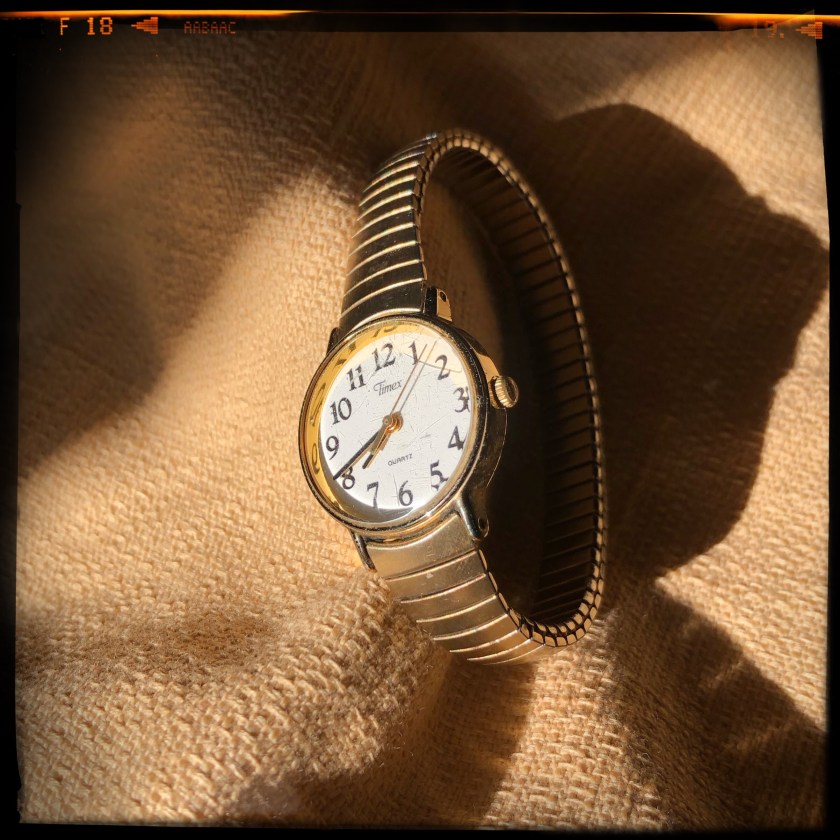
The story was actually a confabulation — a mixture of truth and her own version of the truth. As a nurse, she had always worn a watch with a sweep-second hand so she could take pulses the old-fashioned way. Momma still liked to wear the last watch she owned as a nurse. There came a day when neither story lingered in her mind. It was my turn to point to her watch and help her recapture that story, if only for a moment.
Oh, how my mom loved to work with children–her own and the children of others. In addition to being a very involved mom, she was also a leader of a local Brownie troop. Later, she would work for many years as the secretary for the Awana girls’ club. Her grandchildren adored her. No doubt the open-fridge policy had something to do with their love of spending time at their grandparents’ home, but their teenage years were nurtured and fed in more ways that food because mom and dad gave each of them a housekey and made sure they knew they were always welcome.
For my part, I loved to reminisce with mom about some of the special ways she blessed our family. I would show her photos of some of the fun times she had when working with kids in the Awana program.
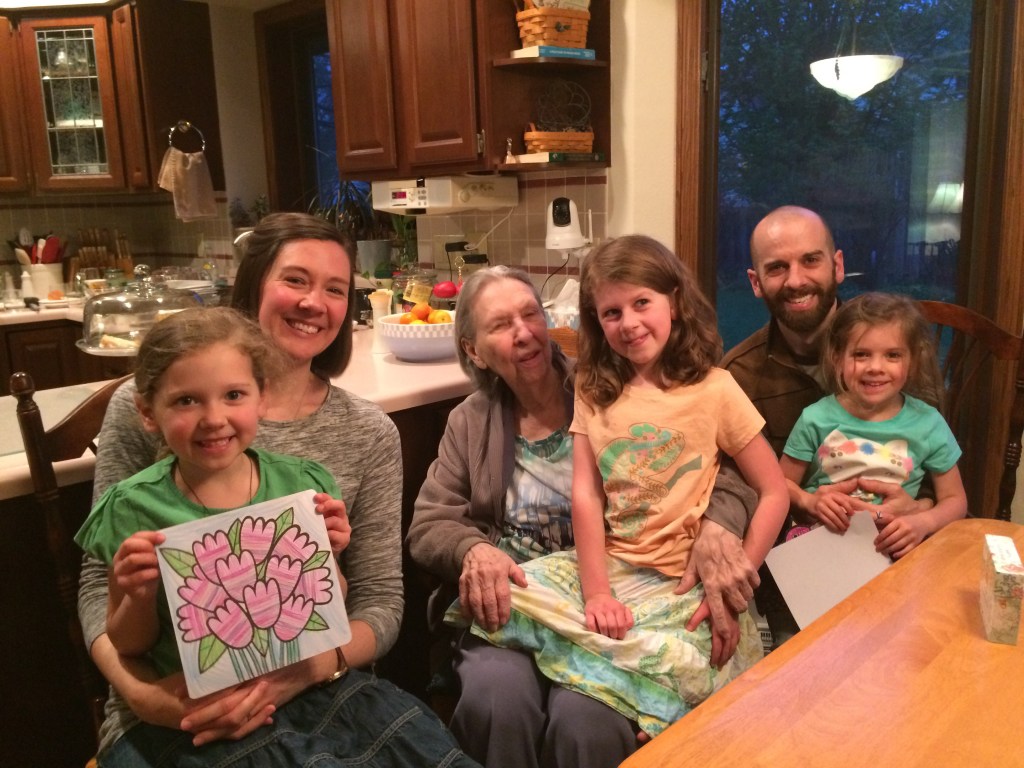
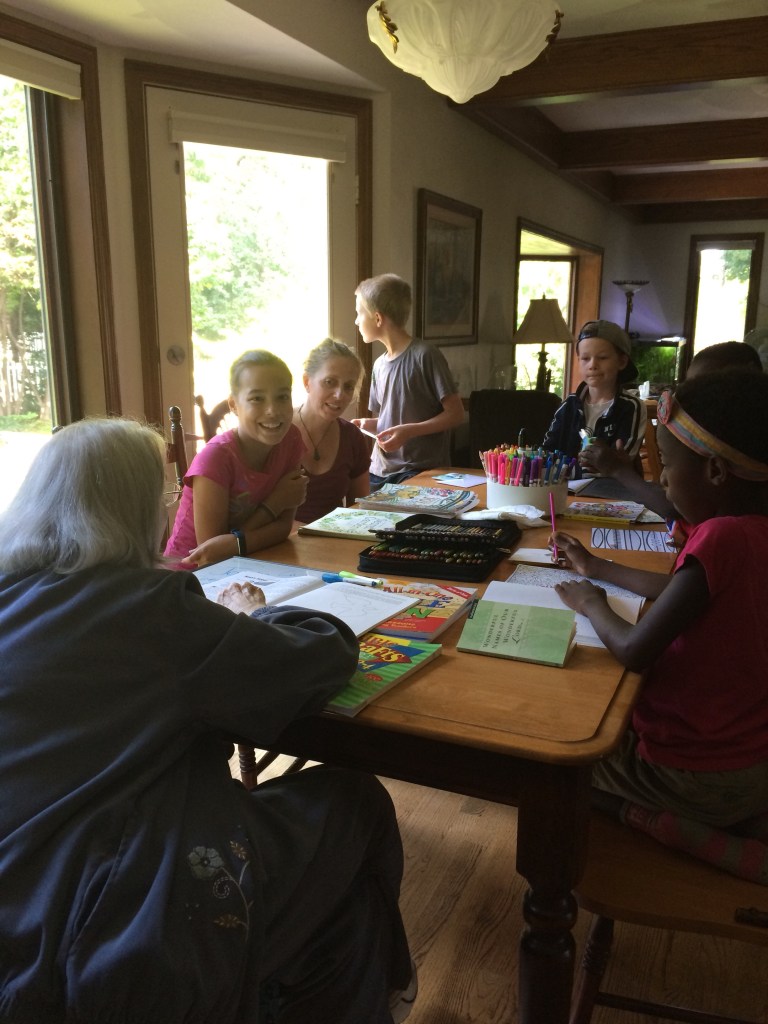
One way I helped mom feel like she was still contributing something valuable was by inviting families with young children to come and share a meal with us. I would tell mom that the kids were hoping she’d teach them something about coloring, or help them with a hard puzzle. She delighted in those times around the kitchen table. As they colored, she’d proffer her wisdom in how to hold the crayon or colored pencil in such a way as to shade the color onto the paper evenly. If she was working on a puzzle with her little friends, she’d share a tip and demonstrate how to put puzzle pieces in color groupings to make it easier to find the piece needed.

Quit quizzing me with Who, What, Where and When questions. I would add Why to the questions we needn’t ask.
In the earliest stages of Alzheimer’s, mom seemed to struggle with the Who questions the most, followed by Where. Names which had been familiar would drop off her radar. As I spent more time with my mom, I learned not to ask her who she had lunch with on Sunday, or who taught the discipleship class she attended. As the names of family started to slip, I learned to slip the name of the person we were with into the conversation so that mom could be reminded of the name.

For instance, as her neighbor and friend, Gisela, was approaching to have a chat with mom in the front yard, I’d greet Gisela by name. Later in the conversation, I’d say something like, “So, Gisela, you and mom have lived in this neighborhood together for over 50 years, haven’t you?” Then the conversation could continue with mom and Gisela reminiscing about old times.
Minding our p’s and q’s in dementia caregiving helps ensure a smoother passage on the labyrinthian road in life marked by memory loss. Thus far in medical research, there are no fixes for this formidable detour of the mind. Caregivers with a well-equipped “caregiving toolbox” can bring roadside assistance and a little extra joy along the way.
In talking with other caregivers, I realize all the more keenly how incredibly blessed I was to have an amazing support system. In a recent post, I (re)shared with my readers how my loving church family came alongside me to help me in caring for my sweet mom. Today I am (re)sharing another note that I wrote and published on Facebook in 2017–which was the year mom’s Alzheimer’s disease dramatically advanced.
Continue reading “Rewind: The Family that Cares”You’ve put years of your life on “pause” so that you can provide the care your loved one deserved during the worst years of their life. Then, all at once, it seems, what you’ve known would happen all along finally happens.
They’re gone.
Yet, when it comes time to hit the “play button” and get on with your life, you discover you’re not the same person you were. The all-encompassing caregiving experience has changed your life.
So, you may ask, what has changed?
In addition to knowing more about Alzheimer’s than I ever dreamed possible, I have a whole new skill set. I work with certified nursing assistants and am continually amazed at how much of what they have learned in their training I learned by necessity.
I’m much more assertive than I was prior to caring for my mom. I learned this by being an advocate for my mom and my brother with their physicians and healthcare insurance providers. I learned to speak up for what was right while making countless phone calls to people and organizations who were preying on mom and helping her spend her modest pension and Social Security income. My newly acquired boldness helped me to relentlessly insist upon a refund from the companies taking hundreds of dollars from her every month.
Another thing has changed too. My eyesight. My physical vision is changing due to a pair of cataracts, but the vision I’m talking about isn’t physical.
It’s an internal ability to see the caregivers around me more clearly than ever.
Not long ago, my hubby took me out for lunch. I saw the caregiving granddaughter sitting in the corner with her memory-challenged grandma. While others probably tuned it out, I heard her gently answering her grandma’s myriad questions — over and over again. I heard this precious granddaughter sharing and resharing the “news” of her pregnancy and the baby who would arrive in July – to the beautiful and heartrending delight of that baby’s great-grandma. I could see that granddaughter rewinding bits and pieces of her conversation: that she lived just down the block from her grandma, the names and ages of her children, what they were doing in school, and all of the details about which her grandmother was curious.
With caring for Momma behind me, and eyes that are now wide open to the world of dementia caregivers, it’s my heartfelt desire to press life’s “play button” again—this time purposefully engaging with and caring for the caregivers I encounter all around me.
I am a caregiving daughter forever changed by Alzheimer’s.
Mom is so focused on her coloring. I’ve been sitting at the table with her as she colored for the past few hours. I just stood up to move a bit and she looked up and said in a tone of surprise,
Cindie’s Caregiving Journal, February 11, 2018
“Oh hi! When did you get here?”
Sad, but sweet. Today I’ve been her mom. When I told her it was time to put her coloring away and get ready for bed, she stalled and pouted just like a child. “But I’m not tired! You always make me quit when I’m having fun!”
There are those who wonder why caregiving children speak to their memory-challenged parent like they are a child. Some also believe it to be a bit demeaning to provide child-like things for them to do as activities.
I get the concern. I’ve had that concern in the past too.
Not anymore.
Now that I have journeyed alongside my mother (who had Alzheimer’s), I totally get it.
As Alzheimer’s claimed more and more of her cognitive abilities, it seemed that mom traveled backward in time to a time when she was much younger. Toward the end, she became very childlike. She often thought I was her mom. There was no use in fighting the role reversal—it was part of the disease progression.
Like a child, mom enjoyed coloring. When I first introduced adult coloring books, her coloring was magnificent and her eye for color was impeccable. She stayed within the lines and had the art of “shading” down pat. Now, as I look through her coloring books, I can see the obvious regression in ability. In the beginning, mom would use all of her colors; toward the end, she settled in on yellow and green. In the beginning, mom’s color choices would closely approximate the true color of the object she was coloring. As the disease advanced, the coloring books I purchased for her were simpler, in keeping with her diminishing artistic abilities and instinct for color. Ultimately, in the last few months of her life, much like a child who colors everything in their favorite color, she would color everything yellow or green.
Correspondingly, mom’s behavior changed. She’d have times when she was unhappy about something and would throw a childlike tantrum. Tears, pitiful pouting face, crossed arms and all. Mom reverted to baby-like play on the floor, preferring to crawl about on the floor, rather than tootle around in her wheelchair. Like the child running out into a crowded room butt-naked, inhibitions over inappropriate public behavior goes by the wayside too.
On those days when mom thought I was her mom, I soon learned it was in mom’s best interest if I would just play that role. Putting on the soothing “mom voice” was part of it. Likewise, when encouraging her to do what needed to be done (like changing her clothing), it was necessary to communicate with her as I would with a young child or (sometimes) like a toddler, using what I’ll call “simple speak.”
So, dear reader who has never experienced the role of caregiver, please be gentle and understanding with the caregivers you know. Your caregiving friend is living in an upside-down world juggling sippy-cups, adult-size diapers and discreet diaper bags, mealtime feeding issues, and lack of good sleep. Believe me, your prayerful encouragement and friendship would mean the world to them.
What happens when you want to remember something, but absolutely know you won’t? You write it down. For the individual experiencing short term memory loss, lists sometimes become a source of frustration. A caregiving daughter shares her view on helping her momma remember, while guarding her fragile dignity.
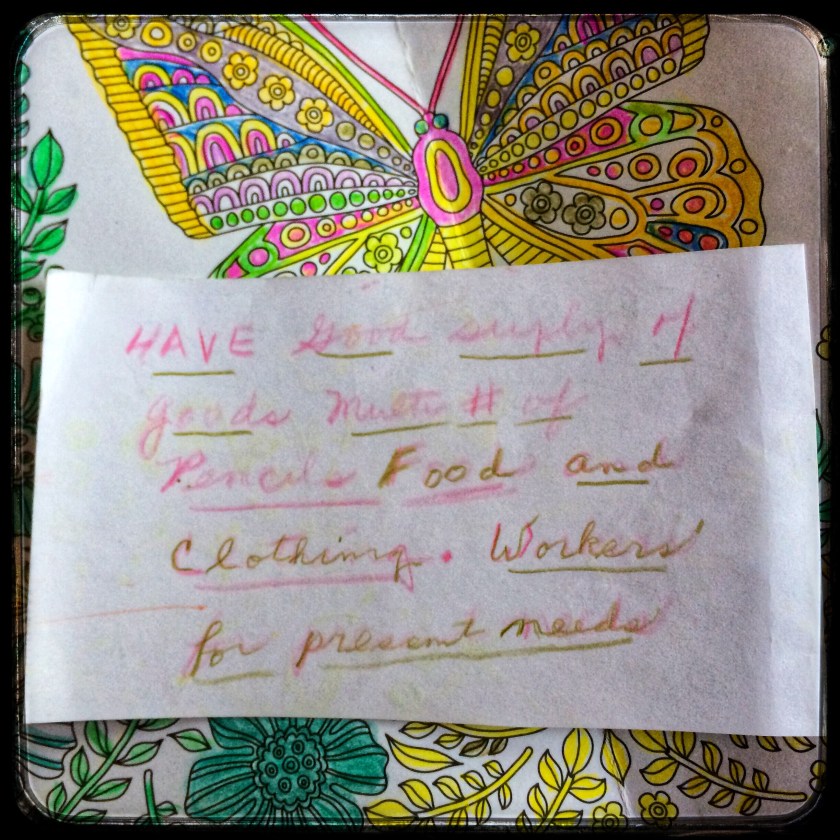
Journal entry from June 7, 2016
Quite often these days, Momma will ask me to buy her a notebook the next time I go to the store, declaring that she can never find any paper on which to write her lists. I know for a fact that she has umpteen notebooks and pads of paper squirreled away all over her apartment home.
Mom is at what her doctor calls the “moderate stage” of dementia where she is keenly aware that she is losing her ability to recall information and is trying her hardest to keep random pieces of information that won’t stay filed away in her brain in a place where she can easily retrieve them. Her lists are her safety net helping her capture not only her to-do list, but the stray thoughts, ideas, and necessities of life.
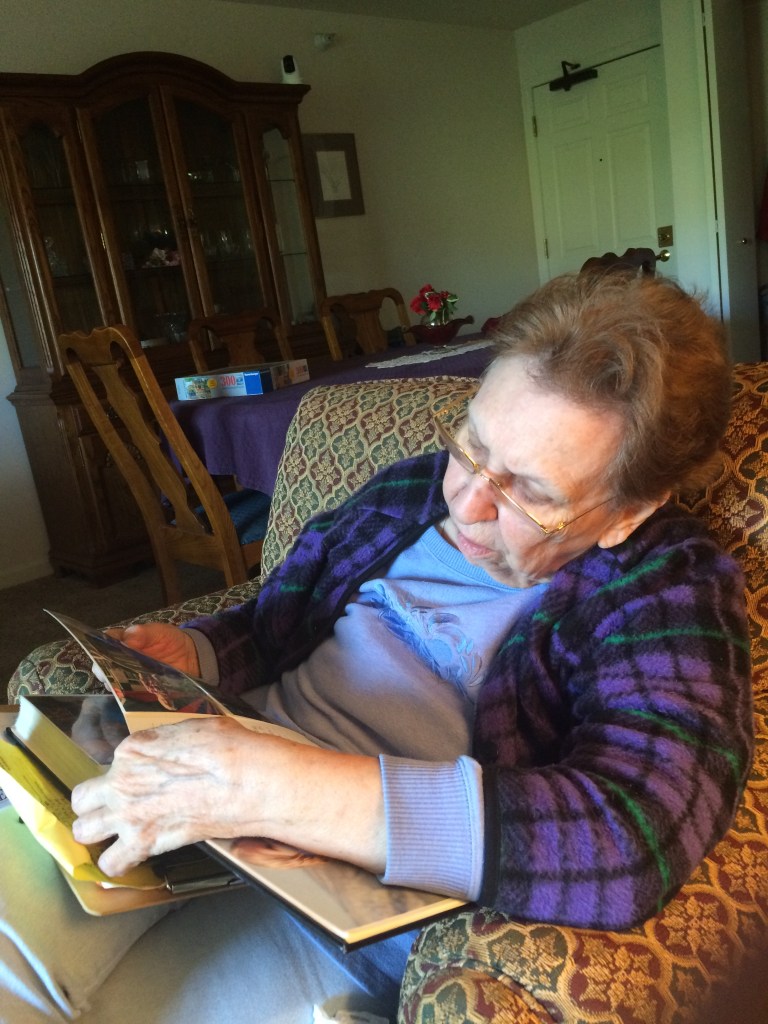
Once in awhile, mom asks me to take her shopping. Shopping excursions to Walmart or Walgreens invariably result in Mom tossing a new package of legal pads or a brightly colored spiral bound notebook into her shopping cart. She insists she is all out of them and there is no convincing her otherwise. Rather than bringing a sense of order to her world, the multiplicity of lists bring chaos to her sense of order as she tries in vain to gather her thoughts into one place.
I have since gathered most of those notepads/books into one cabinet in her apartment. One thing is certain–she has no need for more notepads. Rather, under her watchful eye, I acquiesce to mom’s request and jot down a note for myself on a shopping list, assuring her I will purchase a notebook for her on my next trip to the store.
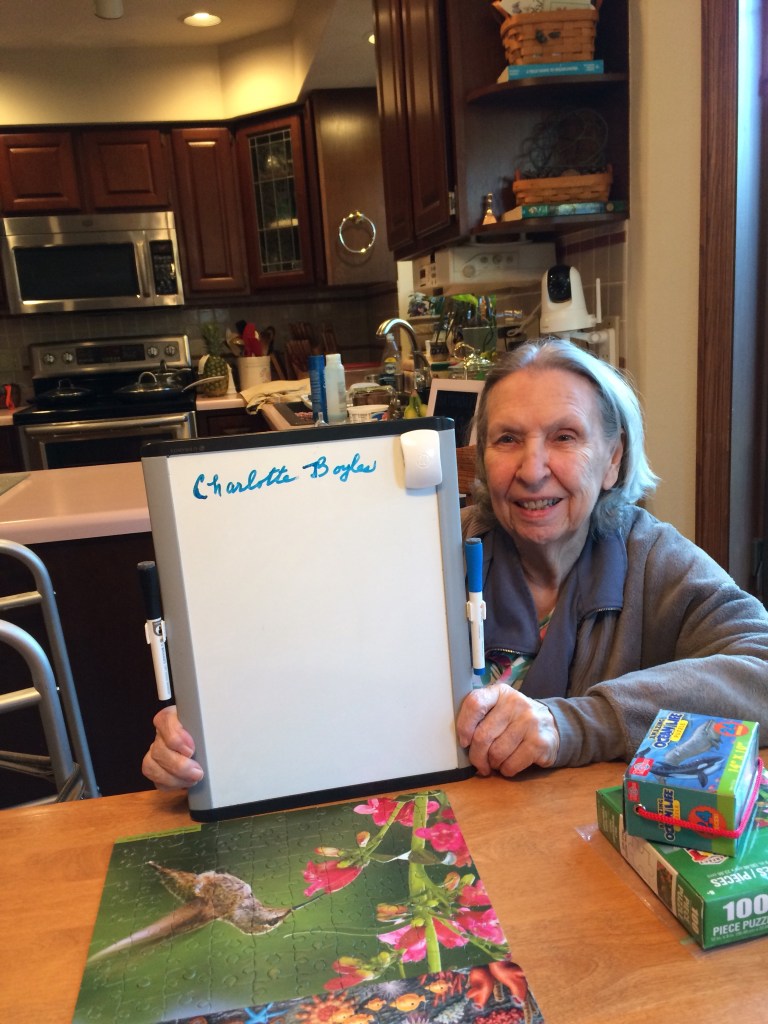
You may be wondering, why not tell her the truth? Why the charade? Why not just tell her that she has plenty of notebooks? Right or wrong, I believe I am honoring my mom when I later “find” one of her notebooks and we can cross the “notebook for Mom” off my list. It gives mom the fleeting pleasure of having one of her requests granted, and I receive the gratification of pleasing my mother and guarding her fragile dignity.
Keeping On Moving On
Man is made of dreams and bones. (The Garden Song)
Notes on Seeing, Reading & Writing, Living & Loving in The North
All things come. All things go.
Simple ideas to make every room feel stylish and welcoming
Behaviour Support Specialist • Emotion-focused Care Strategies
Low Carb Diet & Lifestyle
CONNECTING HEARTS THROUGH WORDS
thoughts on the spiritual journey
the joy of creativity
The Lord God has given me the tongue of those who are taught, that I may know how to sustain with a word him who is weary. - Isaiah 50:4
A retrospective of the photographs from my last garden plus a few meanderings based on my own experience and a love of all things Asiatic.
Connecting the Americas, Bridging Cultures Supergringa in Spain: A Travel Memoir


 Barefoot Lily Lady