A-Z Caregiving Tips (R-S)

Time to revisit my little series of A-Z Caregiving Tips. The photo below is the article which inspired me to make my own A-to-Z list. Let me pick up where I left off and invite you to join me this week for R and S.
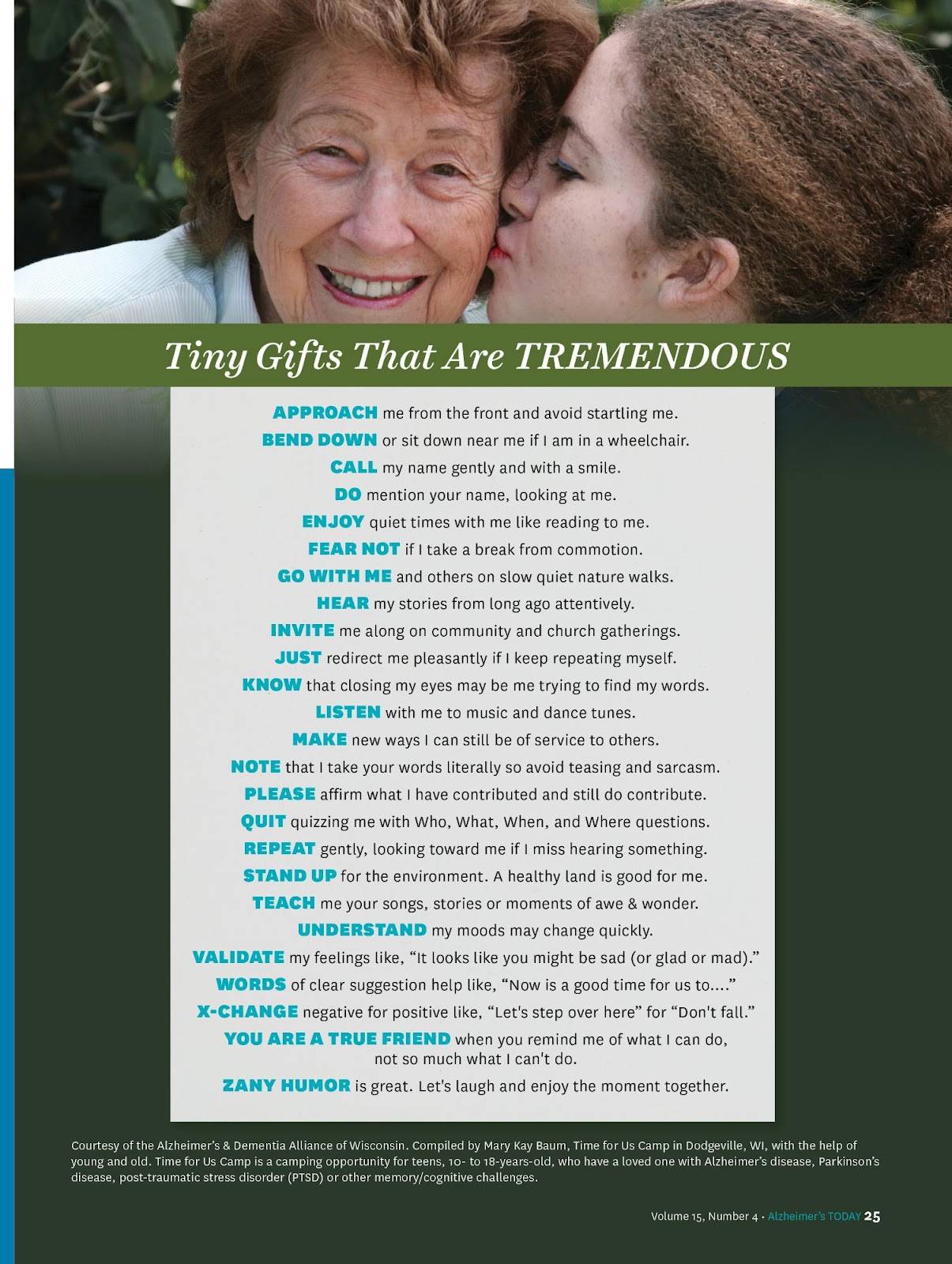
Repeat gently, looking toward me if I miss hearing something.

One thing we caregivers do a lot is repeat ourselves. When our loved ones have trouble understanding what we say, it’s important to repeat things. It’s also important to communicate in a way that includes facial expressions, which provide important information for our loved ones. Because my mom was also very hard of hearing, she relied even more heavily on my facial expressions.

The person who has dementia needs you to sit down on their level, look them in the eyes with all gentleness as you speak. I say “gentleness” because it is very easy to have a look of annoyance or irritation when you feel like you’re repeating something for the umpteenth time. Caregivers must be aware that the non-verbal messages we communicate with our body language and facial expressions speak louder than the actual words we speak.

Facial expressions can be difficult for people with hearing problems to understand when we’re moving. Think about how often we call out to someone in another room during the day. Or when we talk to someone in passing as we’re busy with other things. If you’d like more information on this topic, click here for another great resource.

(With all respect to the original author of this list, I didn’t quite see how standing up for the environment relates to caregiving, so let me proffer my own version of the letter S.)

Step back and take a break.

Being a caregiver can be very stressful. I often felt overwhelmed while taking care of my mom. During those moments, I had to take a step back and take a break from all the pressure. For me, that meant leaving my mom with my husband for an hour or two so I could go to the gym. Sometimes he called me back home, but most of the time, I was able to enjoy some time for myself and relax.
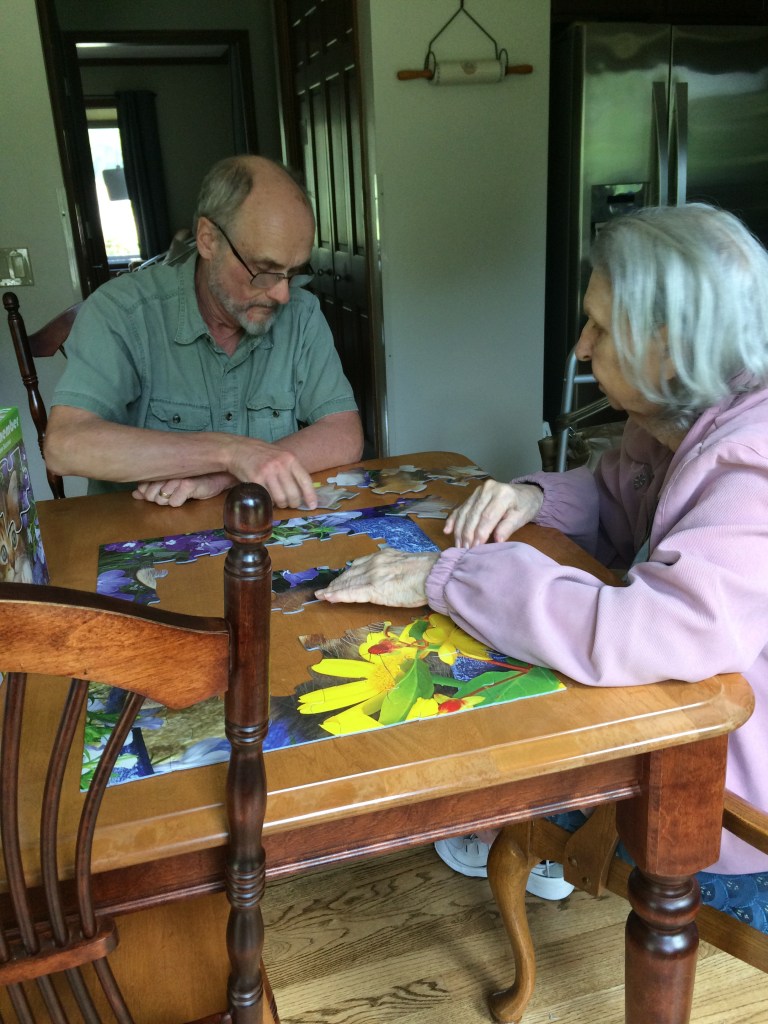
My husband working a puzzle with mom.

It bothers me when I hear caregivers lament that they have no one to help them. I know that it is too often the case; but more often than not, the reality of the situation is that they (we) are afraid to ask for help–or reticent to accept help when it is offered.

I believed I was the best person to take care of my mom, but I also realized that I wasn’t the only one who could do it. It was important for my well-being to take a little break sometimes. I would reach out to our church’s private Facebook page and ask for someone to spend time with my mom for a few hours so I could do something else. Most of the time, someone was willing to help.

There were times when a friend would say something like, “Hey, my daughter and I would like to stop by on Monday to color with your mom. What time would be good for you?”

I learned two important lessons: Ask for help, and never refuse an offer of help.

Considering Assisted Living?

If you are a caregiver for a loved one with dementia (or some other form of life-altering illness), there may come a day when you realize you need to consider other options for providing the best care. Perhaps the post that follows will be helpful as you wrestle with that important decision.

Continue reading “Considering Assisted Living?”

A Gardener’s Quiet Nod to Alzheimer’s Awareness

I walked alongside my mother in the part of her life where Alzheimer’s dementia was her daily companion. I’m grateful for that time spent with her and learned so much as we traveled those years together.

She’s been enjoying heaven for three years now —freed from the bondage of failing mind and body. In these three years, I’m gradually learning to enjoy the freedom to spend moments (more like hours) of joy playing in the dirt in my garden.

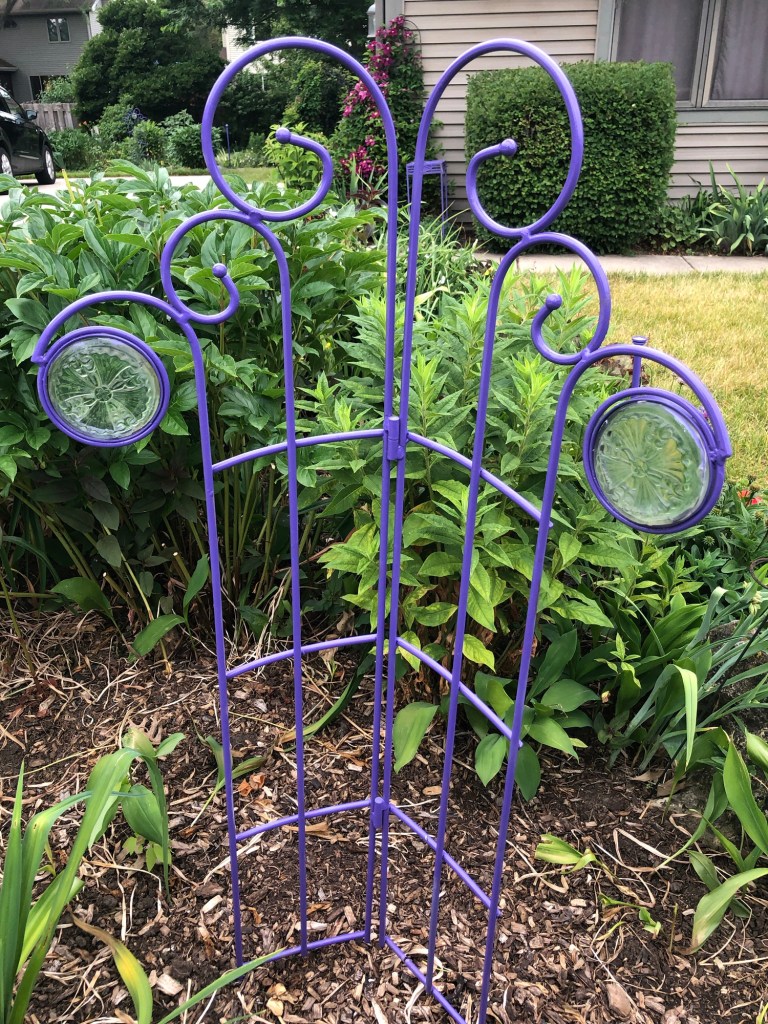
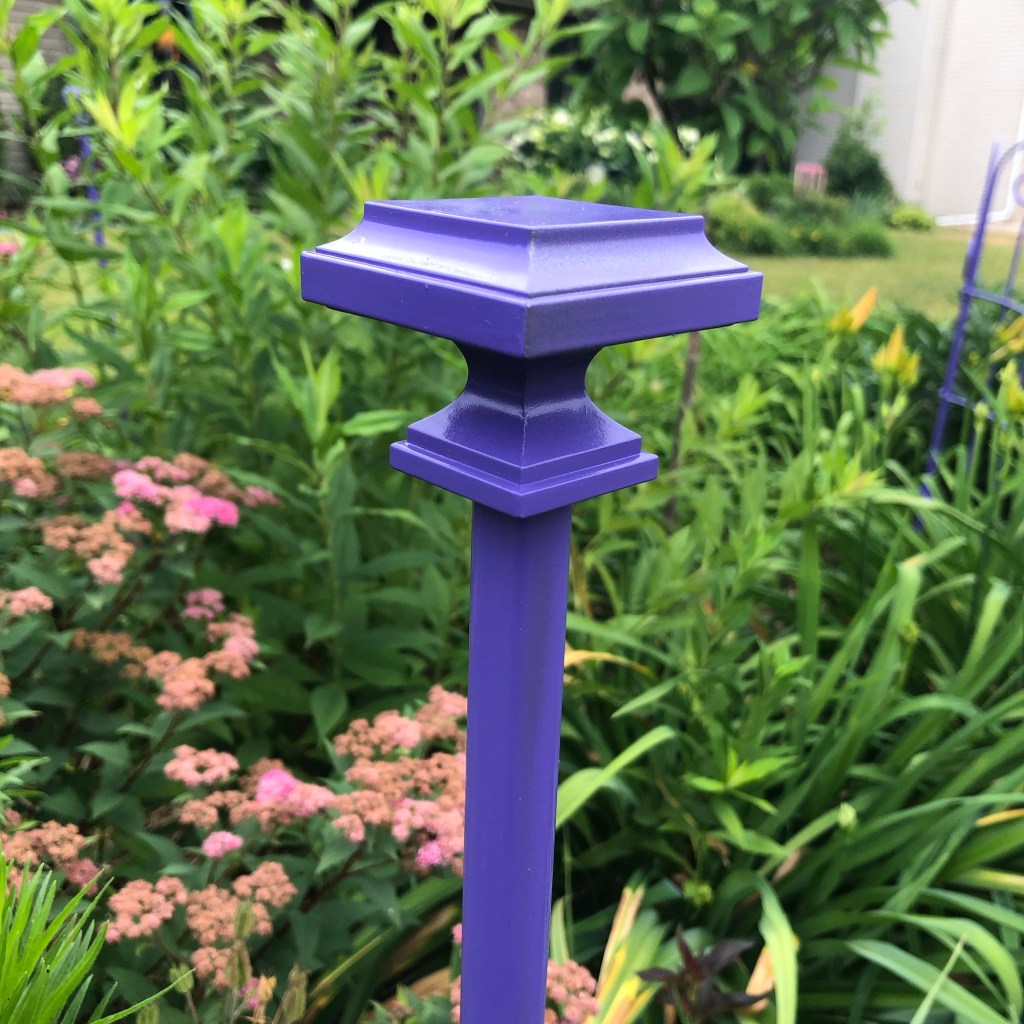
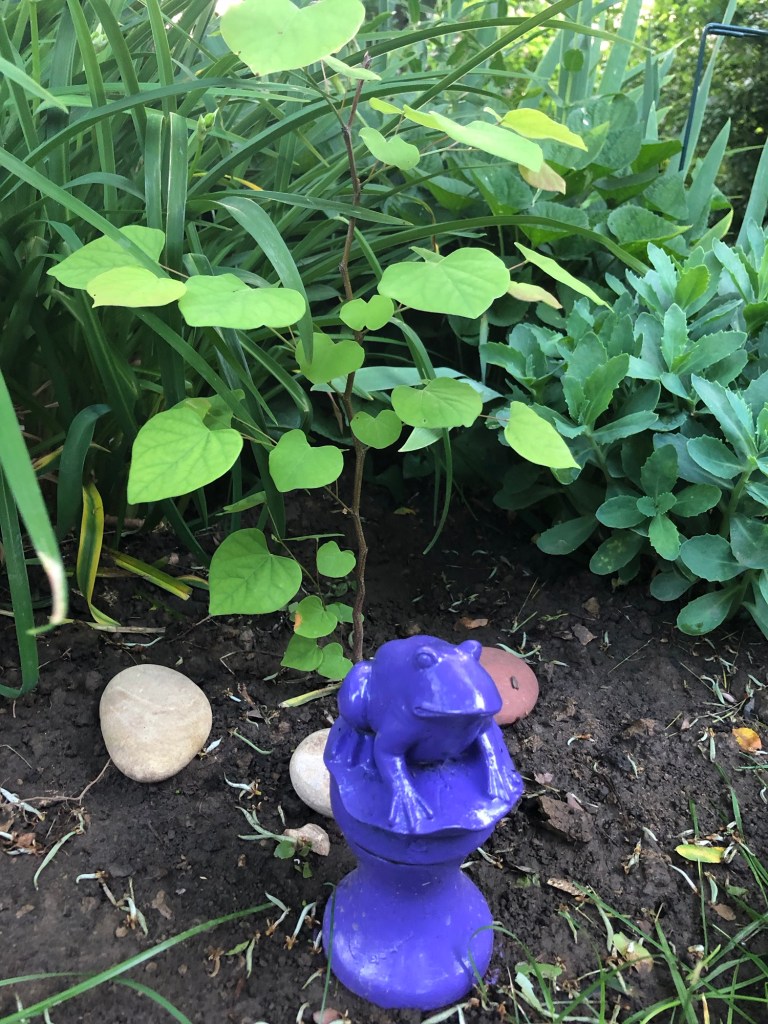
If you were to visit my garden (and I hope you will), you might notice little splashes of purple objects d’art sprinkled throughout the flowerbeds. Second-hand curtain and drapery rods, trellises, and various chairs have all taken on a coat or two of purple spray paint.

Why purple? It’s both in memory of my mother (who loved that color), and also my quiet nod to Alzheimer’s awareness.

A Week of Flowers – Day #5

Sundays are busy days for me, so I missed posting on day 3. Then, I forgot to hit “publish” on Day #4, but once again joining Cathy at Words and Herbs for Day #5 of her annual ‘A Week of Flowers’ meme. It’s trying to snow again today. Not much on the ground–just enough to outline the branches of trees, brighten up the rooftops, and spread a smidge of snowy white frosting on faded flowers. Pretty, but I’m glad for the opportunity to splash a little summery garden color onto my December blog posts.

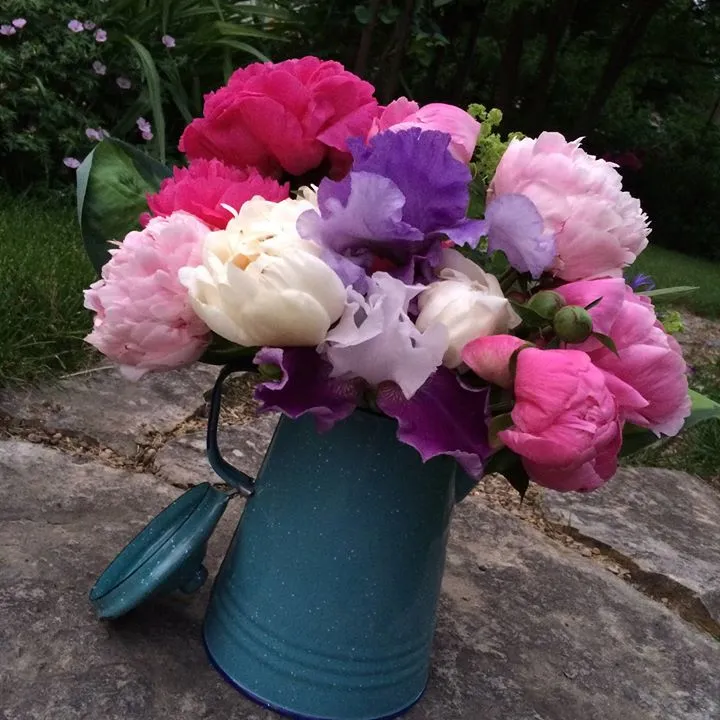
A favorite arrangement of peonies and iris
Continue reading “A Week of Flowers – Day #5”

A Week of Flowers – Day #2

I’m joining Cathy at Words and Herbs for her annual ‘A Week of Flowers’ meme. It’s Day #2 and I’m happy to take you on a little reminisce of some pretty spring and early summer days in my garden. Let me introduce you to a few of my favorite peonies.

Continue reading “A Week of Flowers – Day #2”

Crying Hearts

Rewind of a Facebook Note written sometime in 2015


I made Momma cry today.

Somewhere near the intersection of my trying to be helpful and Momma’s trying to remember, she snapped at me, shooed me away with the wave of her hand, blurting, “Get out of here! Leave me alone! Let me just try to think about one thing at a time!”

With more hurt and frustration in my voice than I intended, I retorted, “Alright Momma, I’ll leave you alone!” Retreating to the solitude of my former bedroom, I felt the door slam behind me, hot tears stinging my eyes, ready to gush at a moment’s notice. I really wanted to throw myself on my bed, bury my face in my pillow, scream and bawl, then drift off to sleep, leaving the nightmare of Mom’s advancing memory loss behind.

Mom in her favorite chair–surrounded by great-grandkid love (circa 2012)

Instead, I stood there in the middle of the room and cried out to God. I was only in prayer for a minute or two, maybe even only a few seconds of time. But in that small measure of time, I felt God’s presence. He was speaking to me. Not in an audible voice, but in that place in the very core of your being where all of life’s decisions are made and emotions are felt. That place where you love. The heart.

God was reminding me He was there and that we would get through this together.

Gingerly opening my bedroom door and peeking down the hall, I spied my sweet Momma at the other end of the hall. She was right where I left her minutes ago, sitting in her favorite chair in the living room, quietly dabbing away her tears of confusion with great big wads of tissue.

Humbled in heart and quieted by the Spirit, I went to Momma, knelt in front of her, then wrapped her in my arms and said, “I’m so sorry, Momma.” My sweet mom put her arms around my neck in a motherly hug and laid her tearful, trying-to-remember weary head on my shoulder.

“Momma, Jesus will help us through this.”

“I know. I know,” acknowledged Momma with gentle, reassuring pats on my back.

Curating Life

I’ve seen this meme floating around on social media a bit lately.

Photo credit: https://www.thesimplicityhabit.com/

I confess that I haven’t read any of this author’s books, so am not sure of the author’s context for this quote. I do know that his philosophy of life leans toward encouraging simple, minimalistic living. Its something to which I aspire, especially since I have reached the summit of decade six and am now careening at breakneck speed toward number seven. However, each time I read, “Be a curator of your life,” something strikes me as being untrue in my life. While I do make choices each and every day to simplify my life, I’m not so sure I am (or even want to be) my life’s curator.

God is a better Curator of my life.

As I look back over the past several years, I see things in it that I wouldn’t choose, but He allowed. I’ve seen family relationships crumble — not something I orchestrated or desired, but even that hardship passed the muster of His divine curatorship in my life for my ultimate good and His glory.

On this day in 2020, my life took an expected turn which left me with more unexpected feelings than I ever dreamed possible. It was the day my momma met Jesus face to face. It was fully expected–I knew in my heart she would be leaving. When my sweet momma breathed her last, my role as her daughter, friend and caregiver suddenly ended. While the weight of years of caring for her was now lifted from my shoulders, I also felt an unexpected void that my “purpose” as mom’s caregiver had previously filled. Even in the midst of incredible grief, my sadness was wrapped in the grateful realization that my loving God had edited and rearranged my life in a way I could never have planned so that I could walk my sweet momma Home.


The heart of man plans his way,
    but the Lord establishes his steps.

Proverbs 16:9 (ESV)

A-Z Caregiving Tips (P & Q)

Here’s the next in a series of Tuesday’s Caregiving Tips posts inspired by A-Z Caregiving Tips (an article in Alzheimer’s Today pictured below). A diagnosis of cognitive impairment or memory loss presents caregiving challenges, each as varied as the person experiencing it. Alzheimer’s was the diagnosis that spelled memory loss for my sweet mom. You can read my previous posts for my personal tips on A – O. Today I am sharing my thoughts about “P” and “Q.” Thanks for stopping by to read my blog. Readers, you are most welcome (and encouraged) to share your own tips and observations about dementia caregiving in the comments below.

If the generation before me said, “Mind your p’s and q’s”, it was usually said in a firm tone of voice. It meant be polite and mind your manners–it might also mean to watch your language. Today we have come to the letters ‘P’ and ‘Q’ in our alphabet-inspired suggestions for dealing with loved ones with dementia. Both letters speak to watching what we say–‘P’ encourages us to fashion our conversations in an encouraging way, and ‘Q’ reminds us to omit certain words in order to help our loved one avoid the embarrassment of not being able to remember a person or specific event. Both are equally valuable tools in the toolbox for good caregiver communication.

Please affirm what I contributed and still do contribute.

I feel like I’ve covered this in previous posts, but it probably can’t be overstated. For as long as my sweet Momma was able, it was important to let her tell and retell her stories of her years as a nurse. The day would come when she could no longer recount those stories. At that point, it became my turn to tell her the stories I remembered her telling me. One such conversation went something like this:

Momma, I remember when the whole city of Milwaukee was snowed in and you stayed at the hospital and worked three days in a row because no one could get to work on the deep, snow-drifted roads. Then someone gave you a ride home on a snowmobile. First, you had them take you to the grocery store so you could buy your family food to eat, then he took you the rest of the way home. I remember that, even though you were very tired, you fixed us supper, then slept for a very long time.

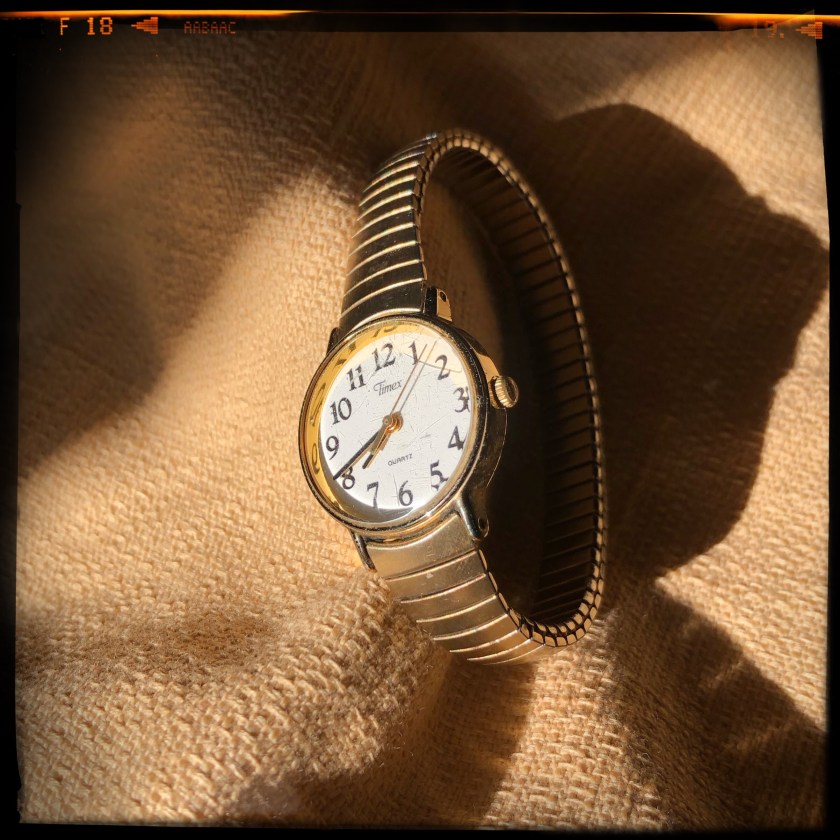
Momma would tell and retell the story of her watch.

The story was actually a confabulation — a mixture of truth and her own version of the truth. As a nurse, she had always worn a watch with a sweep-second hand so she could take pulses the old-fashioned way. Momma still liked to wear the last watch she owned as a nurse. There came a day when neither story lingered in her mind. It was my turn to point to her watch and help her recapture that story, if only for a moment.

Oh, how my mom loved to work with children–her own and the children of others. In addition to being a very involved mom, she was also a leader of a local Brownie troop. Later, she would work for many years as the secretary for the Awana girls’ club. Her grandchildren adored her. No doubt the open-fridge policy had something to do with their love of spending time at their grandparents’ home, but their teenage years were nurtured and fed in more ways that food because mom and dad gave each of them a housekey and made sure they knew they were always welcome.

For my part, I loved to reminisce with mom about some of the special ways she blessed our family. I would show her photos of some of the fun times she had when working with kids in the Awana program.

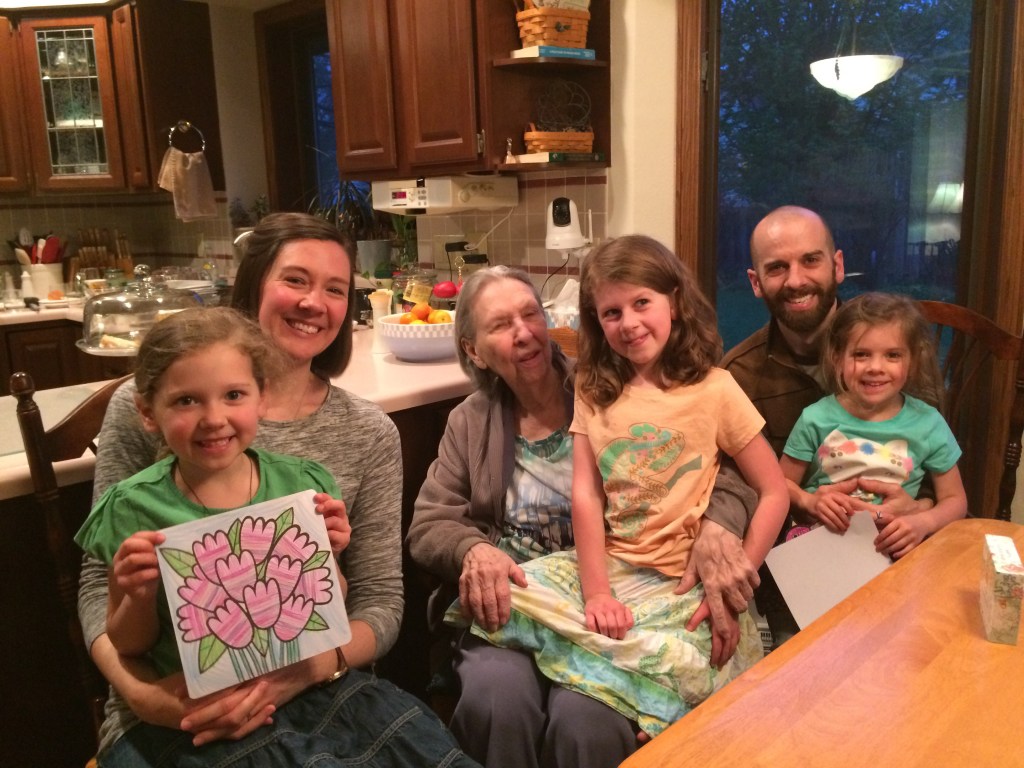
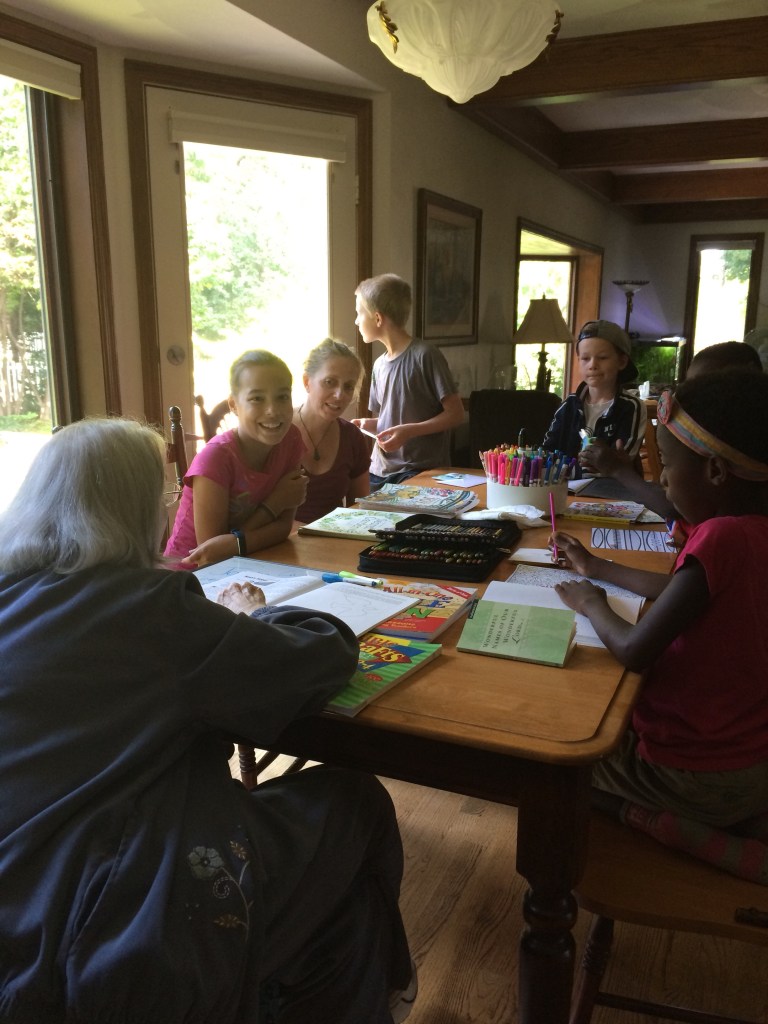
One way I helped mom feel like she was still contributing something valuable was by inviting families with young children to come and share a meal with us. I would tell mom that the kids were hoping she’d teach them something about coloring, or help them with a hard puzzle. She delighted in those times around the kitchen table. As they colored, she’d proffer her wisdom in how to hold the crayon or colored pencil in such a way as to shade the color onto the paper evenly. If she was working on a puzzle with her little friends, she’d share a tip and demonstrate how to put puzzle pieces in color groupings to make it easier to find the piece needed.

Quit quizzing me with Who, What, Where and When questions. I would add Why to the questions we needn’t ask.

In the earliest stages of Alzheimer’s, mom seemed to struggle with the Who questions the most, followed by Where. Names which had been familiar would drop off her radar. As I spent more time with my mom, I learned not to ask her who she had lunch with on Sunday, or who taught the discipleship class she attended. As the names of family started to slip, I learned to slip the name of the person we were with into the conversation so that mom could be reminded of the name.

For instance, as her neighbor and friend, Gisela, was approaching to have a chat with mom in the front yard, I’d greet Gisela by name. Later in the conversation, I’d say something like, “So, Gisela, you and mom have lived in this neighborhood together for over 50 years, haven’t you?” Then the conversation could continue with mom and Gisela reminiscing about old times.

Minding our p’s and q’s in dementia caregiving helps ensure a smoother passage on the labyrinthian road in life marked by memory loss. Thus far in medical research, there are no fixes for this formidable detour of the mind. Caregivers with a well-equipped “caregiving toolbox” can bring roadside assistance and a little extra joy along the way.

Rewind: The Family that Cares

In talking with other caregivers, I realize all the more keenly how incredibly blessed I was to have an amazing support system. In a recent post, I (re)shared with my readers how my loving church family came alongside me to help me in caring for my sweet mom. Today I am (re)sharing another note that I wrote and published on Facebook in 2017–which was the year mom’s Alzheimer’s disease dramatically advanced.

Continue reading “Rewind: The Family that Cares”

Pressing the “Play Button” Again

You’ve put years of your life on “pause” so that you can provide the care your loved one deserved during the worst years of their life. Then, all at once, it seems, what you’ve known would happen all along finally happens.

They’re gone.

Yet, when it comes time to hit the “play button” and get on with your life, you discover you’re not the same person you were. The all-encompassing caregiving experience has changed your life.

So, you may ask, what has changed?

In addition to knowing more about Alzheimer’s than I ever dreamed possible, I have a whole new skill set. I work with certified nursing assistants and am continually amazed at how much of what they have learned in their training I learned by necessity.

I’m much more assertive than I was prior to caring for my mom. I learned this by being an advocate for my mom and my brother with their physicians and healthcare insurance providers. I learned to speak up for what was right while making countless phone calls to people and organizations who were preying on mom and helping her spend her modest pension and Social Security income. My newly acquired boldness helped me to relentlessly insist upon a refund from the companies taking hundreds of dollars from her every month.

Another thing has changed too. My eyesight. My physical vision is changing due to a pair of cataracts, but the vision I’m talking about isn’t physical.

It’s an internal ability to see the caregivers around me more clearly than ever.

Not long ago, my hubby took me out for lunch. I saw the caregiving granddaughter sitting in the corner with her memory-challenged grandma. While others probably tuned it out, I heard her gently answering her grandma’s myriad questions — over and over again. I heard this precious granddaughter sharing and resharing the “news” of her pregnancy and the baby who would arrive in July – to the beautiful and heartrending delight of that baby’s great-grandma. I could see that granddaughter rewinding bits and pieces of her conversation: that she lived just down the block from her grandma, the names and ages of her children, what they were doing in school, and all of the details about which her grandmother was curious.

With caring for Momma behind me, and eyes that are now wide open to the world of dementia caregivers, it’s my heartfelt desire to press life’s “play button” again—this time purposefully engaging with and caring for the caregivers I encounter all around me.

I am a caregiving daughter forever changed by Alzheimer’s.

Páraig - Bike Run Swim

Keeping On Moving On

Páraig - Grow Write Repeat

Man is made of dreams and bones. (The Garden Song)

FabFourBlog

Notes on Seeing, Reading & Writing, Living & Loving in The North

Patti Bee

All things come. All things go.

Garden Lovers Guide

Bring the Outdoors In, and the Indoors Out

Caring for Dementia

Behaviour Support Specialist • Emotion-focused Care Strategies

Low Carb Revelation LLC

Low Carb Diet & Lifestyle

Debbie Prather

CONNECTING HEARTS THROUGH WORDS

Lindy Thompson

thoughts on the spiritual journey

Wild Daffodil

the joy of creativity

Stacy J. Edwards

The Lord God has given me the tongue of those who are taught, that I may know how to sustain with a word him who is weary. - Isaiah 50:4

A Plantsman's World

A retrospective of the photographs from my last garden plus a few meanderings based on my own experience and a love of all things Asiatic.

Fake Flamenco

Connecting the Americas, Bridging Cultures Supergringa in Spain: A Travel Memoir